Institutions predict gold will reach $6,000 next year, while silver may break through $90.
2026-10-20 12:10:20
Despite persistent inflation and rising interest rates forcing funds into high-yield assets, the bearish sentiment in the gold market has failed to overshadow its deep structural support. Matthew Piggott, Director of Gold and Silver at Metals Focus, stated clearly that the market is currently in a consolidation phase, and the core drivers that propelled gold prices to historic highs last year remain unshaken, making the future performance of precious metals still worth anticipating.
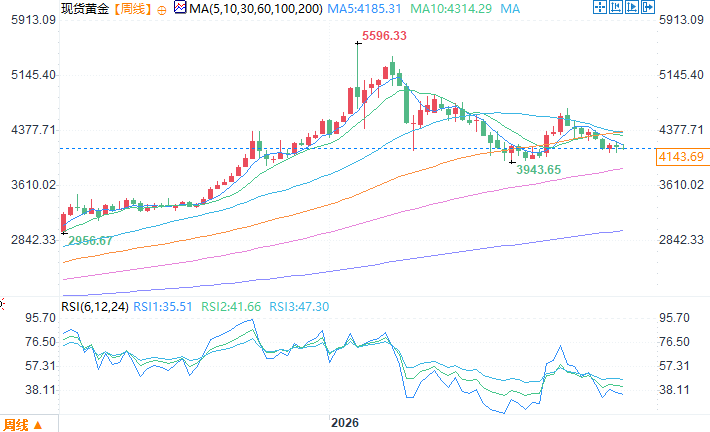 Spot gold weekly chart source: FX678. As of 12:08 Beijing time on October 20th, spot gold was trading at $4144.29 per ounce.
Intensified financial speculation and gold consolidation highlight deep support.
Matthew Piggett provides an in-depth analysis of the current macroeconomic situation for gold. He points out that although investors have become more cautious recently, the firm buying by institutional buyers and central banks has successfully kept gold prices firmly above $4,000 per ounce. Metals Focus has released an extremely optimistic forward forecast, predicting that the average gold price will reach $5,330 per ounce in 2027, a 16% surge from the $4,600 projected this year, and is expected to reach $5,600 per ounce in the fourth quarter of next year, even approaching the $6,000 mark. The average silver price is also expected to reach a high of $84.4 per ounce next year, and break through $90 in the fourth quarter. Piggett further explains that the correction in gold prices at the beginning of this year and the subsequent weak rebound essentially reflect the fierce competition for investment capital among different assets, and are by no means a substantial deterioration in the long-term fundamentals of gold. Currently, investors' attention is drawn to the stock market, energy, and other commodities, while high bond yields have significantly increased the opportunity cost of holding non-interest-bearing assets like gold. However, institutional funds demonstrated remarkable strategic resolve as gold prices approached the $4,000 mark. He added that both institutional buying and continued central bank purchases collectively built a solid floor at $4,000. More importantly, the deep-seated economic and geopolitical factors supporting the 2025 gold price surge have not dissipated. The ever-expanding government debt and fiscal uncertainty have, on the contrary, greatly strengthened the long-term investment logic for gold; however, these macroeconomic drivers are temporarily masked by short-term disturbances in inflation, energy prices, and monetary policy.Geopolitical maneuvering poses a constraint, but a shift in monetary policy could present a turning point.
At the macro-financial level, the ongoing conflict in the Middle East remains a major obstacle to the recovery of gold investment demand. Piggett points out that soaring energy prices are pushing up inflation and supporting the dollar, further solidifying expectations that central banks will maintain tight monetary policy. This complex macroeconomic situation makes the pricing logic of precious metals exceptionally difficult to grasp. He states that only substantial progress on the energy front and a complete resolution of the conflict can fundamentally alleviate inflationary pressures and restore market confidence. He warns of the risk of a renewed escalation of the conflict after the midterm elections, which could lead to the spread of energy inflation and maintain expectations of tightening. Nevertheless, Metals Focus firmly believes that the Federal Reserve will not initiate a prolonged period of aggressive interest rate hikes; excessive tightening will inevitably trigger a deep economic recession, ultimately pushing up demand for gold as a portfolio diversification tool. Piggett emphasizes that although the delays in the Middle East situation have forced a postponement of the market's recovery, gold prices have demonstrated remarkable resilience amidst the dramatic shift in monetary policy expectations from rate cuts to rate hikes, with the bottom of the consolidation remaining rock solid. Furthermore, with the year-end approaching, seasonal physical demand from two major Asian countries is expected to provide additional support for gold prices.Silver prices break through bottlenecks; investment attributes will become the core engine.
Compared to gold, which enjoys strong support from central bank gold purchases and fiscal concerns, silver faces a more complex fundamental environment. Metals Focus predicts that although the average silver price will reach $84.4 per ounce in 2027 and break through $90 in the fourth quarter, the physical market will shift from a deficit of 35.4 million ounces this year to a surplus of 37.3 million ounces next year. The fundamental reason for this situation is that high silver prices are forcing industrial sectors such as photovoltaics to accelerate the reduction of silver consumption. Piggett points out in detail that photovoltaic manufacturers are continuously reducing the amount of silver used in production, which is not only a passive measure to cope with high prices, but also an inevitable trend for the industry to pursue cost reduction and efficiency improvement. The industry has passed a critical inflection point; even if solar installations continue to grow, the decrease in silver consumption per unit will lead to a downward trend in the absolute amount of silver used in photovoltaics. This cost-effective technological iteration does not rely on disruptive breakthroughs in new materials. Although the growth in silver use in areas such as electric vehicles and data centers can offset the weakness in photovoltaic demand to some extent, Piggett asserts that the core driver for silver's future return to strength will shift entirely to the investment side. He emphasized that the surge in silver prices could not have occurred independently of the simultaneous rise in gold prices. The core driver behind the price increase was the large-scale influx of funds into silver ETFs, which led to the withdrawal of physical silver from the market . With the increasing availability of investment channels, silver has gradually shed its label as a mere substitute and evolved into an independent precious metal asset alongside gold, demonstrating more diversified investment value.Conclusion
In conclusion, the gold and silver markets are undergoing a profound reshaping of their underlying dynamics. Despite the interplay of structural macroeconomic pressures and short-term geopolitical disturbances, the deep-seated support for precious metals remains robust. Both the long-term safe-haven value of gold and the full awakening of silver's investment attributes indicate that, after sufficient consolidation, the precious metals market will undoubtedly enjoy broader and more sustained upward potential in future financial competition. Spot gold weekly chart source: FX678. As of 12:08 Beijing time on October 20th, spot gold was trading at $4144.29 per ounce.
- Risk Warning and Disclaimer
- The market involves risk, and trading may not be suitable for all investors. This article is for reference only and does not constitute personal investment advice, nor does it take into account certain users’ specific investment objectives, financial situation, or other needs. Any investment decisions made based on this information are at your own risk.