The USD/JPY pair is under pressure at the 100-day moving average, awaiting direction from Japan's September CPI figures on Friday.
2026-10-20 13:34:22
On Tuesday (October 20) during the Asian session, the US dollar weakened slightly against the Japanese yen, currently trading around 158.15, down about 0.2%, pressured by the 100-day and 200-day moving averages. Overall trading was cautious, with traders choosing to wait and see ahead of Friday's national CPI inflation data. Rising US Treasury yields provided some support for the USD/JPY pair. Japanese Prime Minister Sanae Takaichi denied that she was responsible for the yen's weakness and high interest rates, while Bank of Japan Governor Kazuo Ueda reiterated that core inflation was approaching the 2% target level. These statements from both sides provided marginal support for the yen's performance.
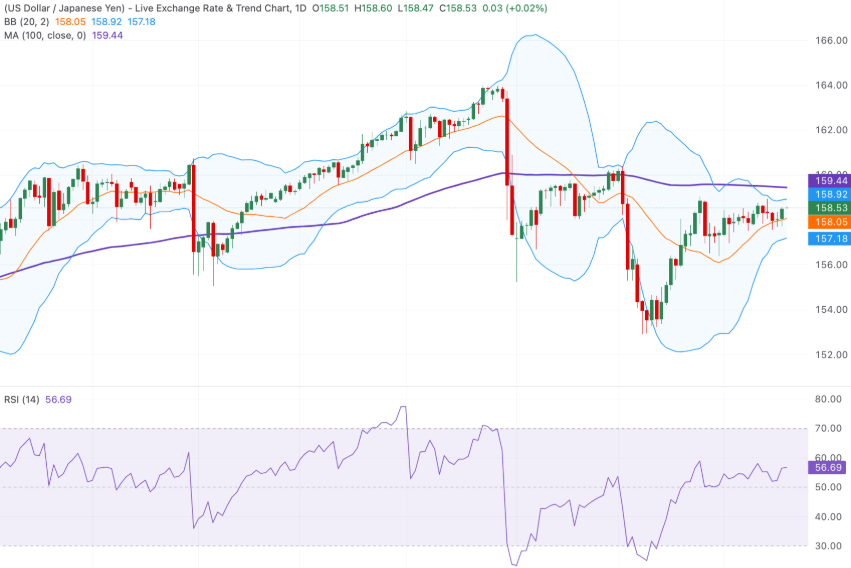 Chart: USD/JPY Technical Daily Chart
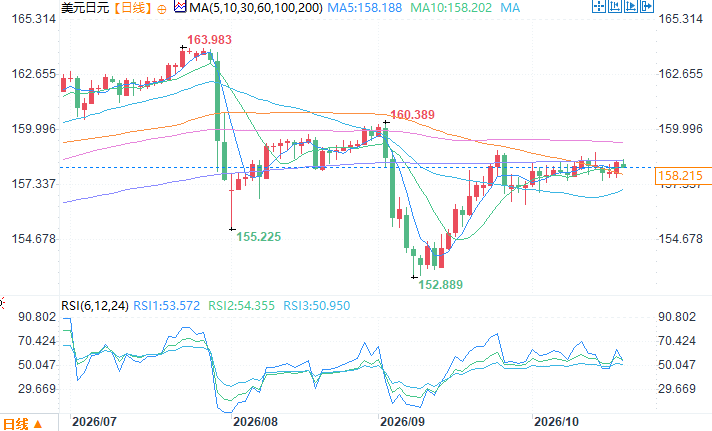 USD/JPY Daily Chart Source: EasyTrade. At 13:32 Beijing time on October 20, the USD/JPY exchange rate was 158.13/14.
Sanae Takaichi defended the weakness of the yen, emphasizing that a strong economy would boost confidence.
Japanese Prime Minister Sanae Takaichi denied any responsibility for the weak yen and high interest rates. She stated that her government would strengthen confidence in the currency by building a strong economy, adding that the issuance of Japanese government bonds would be appropriately controlled in the next fiscal year's budget. This statement was intended to respond to market criticism regarding the continued weakening of the yen and the lack of effective policy responses, while also conveying her idea of coordinating fiscal and monetary policies.Kazuo Ueda reiterated that inflation is nearing its target and warned of rising yields.
Bank of Japan Governor Kazuo Ueda stated that core inflation is very close to the central bank's 2% target. He also cautioned that long-term bond yields could rise if the market perceives that the Bank of Japan has not raised its benchmark policy rate at an appropriate pace. This statement continues his recent hawkish stance, closely linking the Bank of Japan's policy to achieving a sustainable 2% inflation level.US Inflation and Interest Rate Environment: High Expectations for the Fed to Hold Rates Steady
U.S. Treasury yields rose slightly as traders assessed the Federal Reserve's policy stance ahead of its meeting at the end of the month. The CME FedWatch Tool showed traders believed there was an 82.8% probability that the Fed would keep interest rates unchanged this month, while expectations for a December rate hike remained close to 93.6%. With the Fed likely to hold rates steady and the Bank of Japan gradually normalizing, the policy divergence between the dollar and the yen has become a major variable influencing exchange rates.Japan's CPI is expected to rise slightly, while the pace of central bank tightening will be restrained.
Brown Brothers Harriman analysts expect Japan's September inflation data, to be released on Friday, to show a moderate acceleration. They anticipate the overall CPI to rise to 2.1% year-on-year from 1.9% in August, the core CPI excluding fresh food to rise to 2.1% from 1.7%, and the core CPI excluding fresh food and energy to rise to 2.3% from 1.9%. However, they emphasize that given that both the overall CPI and the core CPI excluding food and energy remain below the Bank of Japan's 2026 forecast of 2.5%, the Bank of Japan is unlikely to accelerate its tightening pace. In the interest rate market, the probability of the Bank of Japan raising interest rates by 25 basis points to 1.5% on October 30th is less than 5%, while the probability of a rate hike on December 18th is 80%, reflecting market expectations for a gradual normalization path. Therefore, the bank believes that the USD/JPY exchange rate may fluctuate between 155.00 and 160.00 in the short term.Ueda is moderately hawkish, and monetary policy is gradually normalizing.
Ueda's speech, which tracked a 7-point index, slightly below its historical average of 7.4, showed a mildly hawkish bias compared to his previous cautious approach, emphasizing core inflation near 2% and a virtuous cycle of wages and prices. He highlighted demand-pull inflation driven by strong global demand, domestic capital expenditure, and a tight labor market, while warning that inappropriate policies could push up long-term government bond yields. This suggests that the Bank of Japan is more willing to tolerate rising interest rates as long as the 2% target is credibly achievable. At the same time, Ueda stressed that the fundamental pace of bond reduction would not change, refused to announce emergency government bond operations, and defined any intervention as dependent on the speed of long-term yield changes and market stability. This combination demonstrates the Bank of Japan's confidence in achieving its 2% target and its commitment to maintaining loose monetary conditions, outlining a path of gradual normalization, which is mildly favorable for the yen, but constrained by its cautious stance on bond market operations. Chart: USD/JPY Technical Daily ChartTechnical Analysis: USD/JPY remains under pressure from the 100-day moving average.
On the daily chart, USD/JPY maintains a short-term bearish bias, with the spot price remaining below the 100-day simple moving average and holding above the 20-day Bollinger Band middle line. The 14-period Relative Strength Index (RSI) is at 56.69, indicating mild positive momentum, only partially offsetting the pressure from the upward trendline resistance. On the upside, initial resistance is at 158.92 near the 20-day Bollinger Band upper line, followed by the 100-day moving average at 159.45, which forms stronger resistance. On the downside, initial support is at 158.05 near the Bollinger Band middle line, below which is 157.20 near the Bollinger Band lower line, where buyers may attempt to mitigate a deeper pullback.Conclusion
In summary, the USD/JPY pair is holding steady around 158.50 in the short term, with the market awaiting direction from Friday's Japanese CPI data. Sanae Takashi defended the yen's weakness by citing a strong economy, while Kazuo Ueda reiterated that inflation is nearing the 2% target and is moderately hawkish, providing marginal support for the yen. Meanwhile, high expectations of the Federal Reserve holding rates steady and rising US Treasury yields are providing support for the dollar. Technically, the USD/JPY pair remains under pressure from the 100-day moving average, with clear resistance and support levels. Friday's Japanese inflation data and the evolution of policy expectations from both central banks will be key to determining the short-term direction of this currency pair. USD/JPY Daily Chart Source: EasyTrade. At 13:32 Beijing time on October 20, the USD/JPY exchange rate was 158.13/14.
- Risk Warning and Disclaimer
- The market involves risk, and trading may not be suitable for all investors. This article is for reference only and does not constitute personal investment advice, nor does it take into account certain users’ specific investment objectives, financial situation, or other needs. Any investment decisions made based on this information are at your own risk.