With long-term Japanese government bond yields exceeding 3%, will any shift in the Bank of Japan's stance be amplified?
2026-10-20 13:08:20
On Tuesday (October 20) during the Asian session, the USD/JPY pair traded in a narrow range, currently hovering around 158.20. Daiwa Securities stated that the Bank of Japan (BOJ) is entering a new phase, with its policy objective no longer pushing inflation to 2%, but rather stabilizing it at that level. The core of this shift lies in the sustainability of wage growth. BOJ Governor Kazuo Ueda stated at a press conference on October 16 that underlying inflation is roughly close to 2%, and further increases from that level are intolerable. He pointed out that the central bank was previously willing to let underlying inflation climb towards its target, but now anchoring inflation firmly around 2% has become a core policy objective. Daiwa Securities stated that these remarks confirm its previously identified policy shift—from "reaching 2%" to "stabilizing at 2%." This shift means that the BOJ no longer needs to push inflation upwards, but rather to prevent inflation from deviating excessively from 2%. This adjustment in the policy framework shifts the central bank's focus from "whether the target has been achieved" to "how to maintain the target," and also sets a new logic for the timing and pace of future interest rate hikes. 
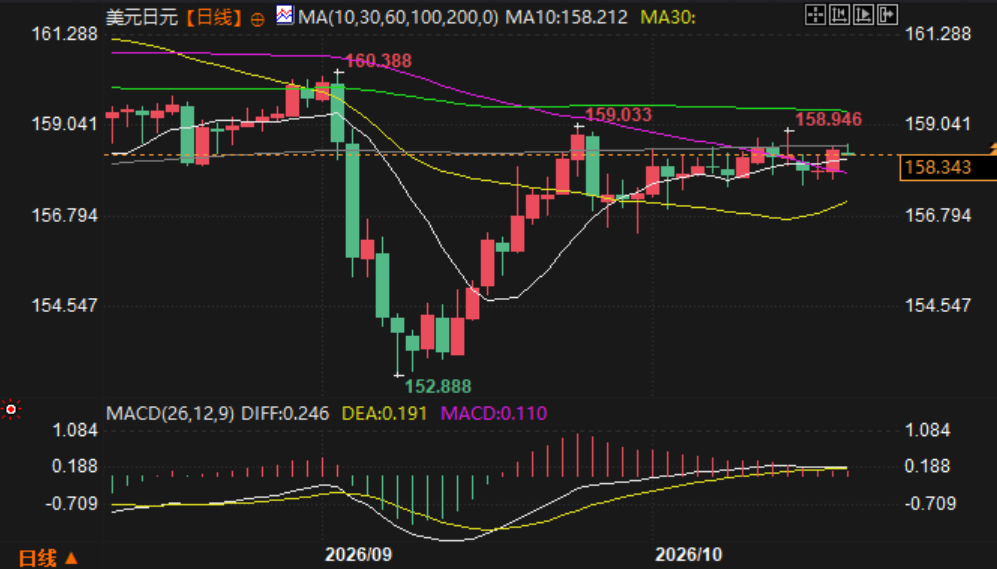 (USD/JPY daily chart, source: EasyForex) At 13:05 Beijing time, USD/JPY was trading at 158.20/21.
October meeting: Most likely to hold rates steady, but may revise inflation assessment upward.
Ueda stated that the Policy Committee will discuss in depth whether potential inflation has reached 2% at its meeting on October 29-30. Daiwa Securities, citing reports, indicated that the Bank of Japan may maintain the policy rate at 1.25% at that meeting, but may raise its assessment of potential inflation to around 2%. This will not be seen as an immediate achievement of the price target; the central bank is expected to continue raising interest rates as financial conditions remain loose, with a December rate hike reportedly not ruled out. The core of this expectation is that the October meeting will likely remain unchanged, but may send a hawkish signal by raising the inflation assessment. If the central bank formally acknowledges that potential inflation has reached around 2%, it will pave the way for a rate hike in December or later, while retaining policy flexibility.Wages are key: Spring negotiations in 2027 will be a window to see if inflation is established.
Daiwa Securities stated that there is no need to accelerate the pace of interest rate hikes, as consumer spending remains weak, despite robust corporate investment. Core machinery orders rose 5.2% in August, pointing to resilient capital expenditures, including in AI-related sectors. Meanwhile, inflationary pressures have not subsided significantly. Corporate goods prices rose 6.8% year-on-year in September, a slowdown from 7.6% in August but still at a high level, with import prices rebounding due to rising crude oil prices. The bank believes that next spring's wage negotiations will be crucial in determining whether inflation has been established. Japan's largest labor union federation is reportedly considering demanding a 5% or higher wage increase by 2027, aiming for the fourth consecutive year at that level, with a higher target of 6% or higher for small businesses, and an overall target of approximately 6%. This year's negotiations resulted in a wage increase of about 5%, but the increase for small businesses was lower, at about 4.7%. Daiwa Securities stated that what matters is not just the overall figures, but whether strong wage increases can become a sustainable norm and spread from large companies to small businesses. More details will emerge in the coming months, including the combined basic plan in October and the position of the business lobbying group Keidanren in November, which will give the Bank of Japan a clearer picture ahead of its December meeting.Market Implications: The yen is supported, and short-term Japanese government bond yields may rise.
Daiwa Securities' interpretation points to a Bank of Japan that is in no hurry to act but has not yet completed its rate hikes. This provides support for the yen against any signs that wage growth is becoming entrenched. A rate hike in December, coupled with an upward revision of the inflation assessment, will keep the rate unchanged at the October 29-30 meeting and could push up short-term Japanese government bond yields. Oil prices are a key swing factor. Daiwa Securities points out that import prices have begun to rise again due to rising crude oil prices, and if the conflict in Iran causes oil prices to jump further, it will increase the risk of inflation overshooting and strengthen the case for faster tightening. For the Japanese stock market, gradual rate hikes accompanied by robust capital spending are unlikely to derail the market, but a faster pace of rate hikes will test valuations. Long-term Japanese government bond yields have already risen above 3% and remain sensitive to any shift in the Bank of Japan's tone.The yen received marginal support, but interest rate differentials still dominate its movements.
Daiwa Securities' interpretation suggests a marginally positive effect on the USD/JPY exchange rate. Their core logic is that the Bank of Japan's shift from "pursuing 2%" to "maintaining 2%" signifies that the direction of policy normalization remains unchanged, only the pace is more cautious. The October meeting is likely to maintain the interest rate at 1.25%, but may raise its inflation assessment to approximately 2%, keeping a December rate hike within reach. If wage negotiations in the spring of 2027 show that wage increases become a persistent norm and spread to small businesses, the reasons for the Bank of Japan to accelerate tightening will strengthen, and the yen's interest rate disadvantage is expected to gradually narrow, providing a medium-term support base for the yen. However, in the short term, USD/JPY remains dominated by the USD/JPY interest rate differential. The US 10-year Treasury yield remains around 5.30%, and the expectation of a Fed rate hike in December is still priced in, with the significant interest rate differential remaining unchanged. Daiwa Securities also points out that the Bank of Japan is not in a hurry to accelerate rate hikes, as weak consumer spending constrains the pace of tightening. Therefore, the yen's support is more likely to gradually emerge in the medium to long term rather than immediately reversing the exchange rate trend. Oil prices are a key factor influencing price movements. If the conflict in Iran pushes up oil prices, rising import prices in Japan will increase the risk of inflation overshooting, potentially prompting the Bank of Japan to tighten monetary policy more quickly, which would provide additional support for the yen. Overall, the USD/JPY pair is likely to remain range-bound between 157 and 159 in the short term. The Bank of Japan's October meeting, progress in wage negotiations, and oil price trends are the key variables determining its medium-term direction.Summarize
Daiwa Securities believes the Bank of Japan (BOJ) is shifting from pursuing 2% inflation to maintaining it at 2%, with the sustainability of wage growth being key. Kazuo Ueda stated that potential inflation is close to 2%, and further increases are intolerable; the BOJ will anchor inflation around 2% as its core target. The October meeting is expected to maintain the interest rate at 1.25%, but may raise the inflation assessment to approximately 2%, with a December rate hike not ruled out. Daiwa Securities believes there is no need to accelerate rate hikes because consumer spending is weak but corporate investment is strong, and inflationary pressures have not subsided significantly. The wage negotiations in the spring of 2027 are crucial for testing whether inflation is established; the union may demand a wage increase of 5% or more, and it is important whether this wage increase can become a sustainable norm and spread to small businesses. For the market, this interpretation points to a BOJ that is not in a hurry to act but has not yet completed its rate hike. The yen is supported by signs of deeply rooted wage growth. Maintaining the interest rate and raising the inflation assessment at the October meeting will keep a December rate hike within reach and may push up short-term JGB yields. Oil prices are a key swing factor, and long-term JGB yields remain sensitive to any shift in tone. (USD/JPY daily chart, source: EasyForex) At 13:05 Beijing time, USD/JPY was trading at 158.20/21.
- Risk Warning and Disclaimer
- The market involves risk, and trading may not be suitable for all investors. This article is for reference only and does not constitute personal investment advice, nor does it take into account certain users’ specific investment objectives, financial situation, or other needs. Any investment decisions made based on this information are at your own risk.