The USD/JPY pair traded in a narrow range as Japanese CPI data and Federal Reserve policy expectations clashed.
2026-10-20 15:34:21
On Tuesday during Asian trading hours, the USD/JPY pair traded around 158.00, with a significantly narrower range than the previous trading day's close, as the market generally adopted a wait-and-see approach ahead of key data and policy events. The core contradiction in the current exchange rate lies in the fact that high US Treasury yields continue to provide interest rate differential support for the dollar, while expectations of a gradual normalization by the Bank of Japan and domestic political statements stabilizing the exchange rate limit the yen's downside potential. The forces on both sides are currently in a state of equilibrium.  From a fundamental perspective, US Treasury yields have risen slightly recently as traders reassess the Federal Reserve's stance at its policy meeting at the end of this month. According to the CME Group's FedWatch tool, the market is pricing in an 82.8% probability that the Fed will keep interest rates unchanged in October, but expectations for a December rate hike remain as high as 93.6%. This combination of "holding steady this month, with a possible tightening at the end of the year" means that the US-Japan interest rate differential is unlikely to narrow substantially in the short term, and the overall attractiveness of the US dollar has not been fundamentally shaken. Meanwhile, factors such as volatility in the French bond market and geopolitical risks in the Middle East have made global risk appetite cautious, and the safe-haven demand for the US dollar has, to some extent, offset the negative impact of the flattening yield curve. In Japan, Prime Minister Sanae Takashi explicitly denied responsibility for the yen's weakness and high interest rates on Monday, stating that she would boost market confidence in the Japanese currency by building a strong economy, while also promising to appropriately control the scale of government bond issuance in the next fiscal year's budget. This statement aimed to alleviate concerns that its fiscal expansionary tendencies would push up long-term interest rates and drag down the yen. However, the market generally believes that verbal intervention alone is unlikely to change the medium-term direction of the exchange rate. Investors are more concerned about whether fiscal discipline can be implemented in actual budget preparation. Bank of Japan Governor Kazuo Ueda pointed out on the same day that underlying inflation is rising very close to the central bank's 2% target and warned that if the market believes the central bank has failed to raise benchmark interest rates at an appropriate pace, long-term government bond yields could rise further. This speech received a score of 7/10, slightly below its historical average of 7.4/10, but the statements regarding "underlying inflation approaching 2%" and the positive wage-price cycle showed a milder hawkish bias compared to previous cautious language. Ueda also emphasized that the fundamental policy of reducing bond purchases will not change, and there will be no pre-announcement of emergency bond-buying measures. Any intervention will depend on the speed of changes in long-term interest rates and market stability. This communication approach, which demonstrates both policy resolve and operational flexibility, provides mild support for the yen, but its actual boosting effect is relatively limited due to its cautious attitude towards bond market operations. On the data front, Japan's September inflation data, scheduled for release on Friday, is expected to show a moderate acceleration: overall CPI is projected at 2.1% year-on-year (previous value 1.9%), core CPI excluding fresh food is projected at 2.1% year-on-year (previous value 1.7%), and core CPI excluding fresh food and energy is projected at 2.3% year-on-year (previous value 1.9%). However, the bank also emphasized that given that both overall CPI and core indicators excluding food and energy remain below the Bank of Japan's 2026 forecast of 2.5%, the central bank is "unlikely to accelerate the pace of tightening." Interest rate market pricing also confirms this assessment—the swap curve shows that the probability of a 25 basis point rate hike to 1.50% on October 30 is less than 5%, while the probability of a rate hike on December 18 is approximately 80%. Against this backdrop, the bank expects the USD/JPY exchange rate to trade within the 155.00 to 160.00 range in the short term. This assessment is largely consistent with the current technical structure and explains why the exchange rate has struggled to break out of its current directional trend in the absence of new catalysts. From a global market perspective, the yen's status as a low-interest funding currency remains unchanged, and the unwinding and rebuilding of carry trades remain important variables driving cross-border capital flows. If Friday's CPI data exceeds expectations and the Bank of Japan releases a clearer tightening signal, the yen is expected to strengthen in the short term, thus providing support for Asian currencies as a whole. Conversely, if inflation data is lackluster and expectations for a Fed rate hike in December further intensify, the widening USD/JPY interest rate differential could push the exchange rate to retest the upper limit of its range. Furthermore, Middle East shipping risks, European political uncertainty, and volatility in the technology sector will indirectly affect the short-term direction of the USD/JPY exchange rate through risk appetite channels. Investors should be wary of sudden fluctuations caused by the convergence of multiple factors. On the daily chart, USD/JPY is still trading below the 100-day simple moving average, and the short-term bias has not yet reversed. However, the price has stabilized above the 20-day Bollinger Band middle line, and the RSI (14) is at 56.69, indicating that the bullish momentum is moderate and has not entered the overbought zone. This is a typical oscillating bullish structure rather than a trend breakout structure. The first resistance is at the 20-day Bollinger Band upper line at about 158.92, and the stronger resistance is at the 100-day moving average at about 159.45. Only by effectively breaking through this level can the medium-term bearish structure be confirmed to have been broken. The support below is successively at the Bollinger Band middle line at about 158.05 and the Bollinger Band lower line at about 157.20. The latter is the key area for buyers to defend. On the 4-hour chart, the exchange rate is consolidating between 158.00 and 159.00. Short-term moving averages are converging, and the MACD histogram is near the zero line, indicating neutral momentum. If the price retraces to the 158.00-158.10 area and finds support, there is still a chance for a short-term retest of the 158.90-159.45 resistance zone. Conversely, if it breaks below 158.00 with increased volume, it may seek support near 157.20 or even 156.50. An upward breakout would require confirmation from Friday's Japanese CPI or relevant signals from the Federal Reserve.
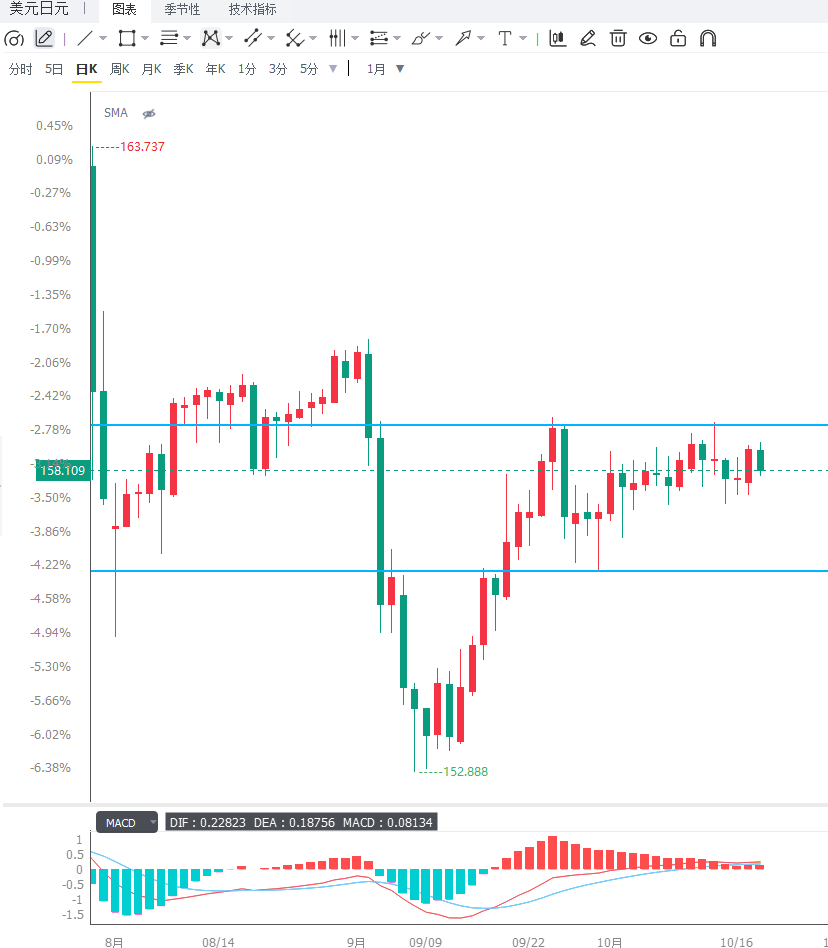 Editor's Summary: The USD/JPY pair is currently caught in a tug-of-war between "high US Treasury yields supporting the dollar" and "the Bank of Japan's gradual normalization supporting the yen." Neither side offers decisive policy catalysts, resulting in a narrow consolidation around 158.50. The key variable this week is Friday's Japanese CPI data—if the overall figure accelerates in tandem with the core reading, it could strengthen expectations of a December rate hike and provide a temporary boost to the yen; if the data is lackluster, the interest rate differential will continue to dominate the market, and the dollar is likely to retest resistance above 159. Next week's Fed meeting is the second crucial juncture. Although a hold on in October is widely expected, the Fed's post-meeting statements will directly impact expectations for the USD/JPY interest rate differential.
From a fundamental perspective, US Treasury yields have risen slightly recently as traders reassess the Federal Reserve's stance at its policy meeting at the end of this month. According to the CME Group's FedWatch tool, the market is pricing in an 82.8% probability that the Fed will keep interest rates unchanged in October, but expectations for a December rate hike remain as high as 93.6%. This combination of "holding steady this month, with a possible tightening at the end of the year" means that the US-Japan interest rate differential is unlikely to narrow substantially in the short term, and the overall attractiveness of the US dollar has not been fundamentally shaken. Meanwhile, factors such as volatility in the French bond market and geopolitical risks in the Middle East have made global risk appetite cautious, and the safe-haven demand for the US dollar has, to some extent, offset the negative impact of the flattening yield curve. In Japan, Prime Minister Sanae Takashi explicitly denied responsibility for the yen's weakness and high interest rates on Monday, stating that she would boost market confidence in the Japanese currency by building a strong economy, while also promising to appropriately control the scale of government bond issuance in the next fiscal year's budget. This statement aimed to alleviate concerns that its fiscal expansionary tendencies would push up long-term interest rates and drag down the yen. However, the market generally believes that verbal intervention alone is unlikely to change the medium-term direction of the exchange rate. Investors are more concerned about whether fiscal discipline can be implemented in actual budget preparation. Bank of Japan Governor Kazuo Ueda pointed out on the same day that underlying inflation is rising very close to the central bank's 2% target and warned that if the market believes the central bank has failed to raise benchmark interest rates at an appropriate pace, long-term government bond yields could rise further. This speech received a score of 7/10, slightly below its historical average of 7.4/10, but the statements regarding "underlying inflation approaching 2%" and the positive wage-price cycle showed a milder hawkish bias compared to previous cautious language. Ueda also emphasized that the fundamental policy of reducing bond purchases will not change, and there will be no pre-announcement of emergency bond-buying measures. Any intervention will depend on the speed of changes in long-term interest rates and market stability. This communication approach, which demonstrates both policy resolve and operational flexibility, provides mild support for the yen, but its actual boosting effect is relatively limited due to its cautious attitude towards bond market operations. On the data front, Japan's September inflation data, scheduled for release on Friday, is expected to show a moderate acceleration: overall CPI is projected at 2.1% year-on-year (previous value 1.9%), core CPI excluding fresh food is projected at 2.1% year-on-year (previous value 1.7%), and core CPI excluding fresh food and energy is projected at 2.3% year-on-year (previous value 1.9%). However, the bank also emphasized that given that both overall CPI and core indicators excluding food and energy remain below the Bank of Japan's 2026 forecast of 2.5%, the central bank is "unlikely to accelerate the pace of tightening." Interest rate market pricing also confirms this assessment—the swap curve shows that the probability of a 25 basis point rate hike to 1.50% on October 30 is less than 5%, while the probability of a rate hike on December 18 is approximately 80%. Against this backdrop, the bank expects the USD/JPY exchange rate to trade within the 155.00 to 160.00 range in the short term. This assessment is largely consistent with the current technical structure and explains why the exchange rate has struggled to break out of its current directional trend in the absence of new catalysts. From a global market perspective, the yen's status as a low-interest funding currency remains unchanged, and the unwinding and rebuilding of carry trades remain important variables driving cross-border capital flows. If Friday's CPI data exceeds expectations and the Bank of Japan releases a clearer tightening signal, the yen is expected to strengthen in the short term, thus providing support for Asian currencies as a whole. Conversely, if inflation data is lackluster and expectations for a Fed rate hike in December further intensify, the widening USD/JPY interest rate differential could push the exchange rate to retest the upper limit of its range. Furthermore, Middle East shipping risks, European political uncertainty, and volatility in the technology sector will indirectly affect the short-term direction of the USD/JPY exchange rate through risk appetite channels. Investors should be wary of sudden fluctuations caused by the convergence of multiple factors. On the daily chart, USD/JPY is still trading below the 100-day simple moving average, and the short-term bias has not yet reversed. However, the price has stabilized above the 20-day Bollinger Band middle line, and the RSI (14) is at 56.69, indicating that the bullish momentum is moderate and has not entered the overbought zone. This is a typical oscillating bullish structure rather than a trend breakout structure. The first resistance is at the 20-day Bollinger Band upper line at about 158.92, and the stronger resistance is at the 100-day moving average at about 159.45. Only by effectively breaking through this level can the medium-term bearish structure be confirmed to have been broken. The support below is successively at the Bollinger Band middle line at about 158.05 and the Bollinger Band lower line at about 157.20. The latter is the key area for buyers to defend. On the 4-hour chart, the exchange rate is consolidating between 158.00 and 159.00. Short-term moving averages are converging, and the MACD histogram is near the zero line, indicating neutral momentum. If the price retraces to the 158.00-158.10 area and finds support, there is still a chance for a short-term retest of the 158.90-159.45 resistance zone. Conversely, if it breaks below 158.00 with increased volume, it may seek support near 157.20 or even 156.50. An upward breakout would require confirmation from Friday's Japanese CPI or relevant signals from the Federal Reserve. Editor's Summary: The USD/JPY pair is currently caught in a tug-of-war between "high US Treasury yields supporting the dollar" and "the Bank of Japan's gradual normalization supporting the yen." Neither side offers decisive policy catalysts, resulting in a narrow consolidation around 158.50. The key variable this week is Friday's Japanese CPI data—if the overall figure accelerates in tandem with the core reading, it could strengthen expectations of a December rate hike and provide a temporary boost to the yen; if the data is lackluster, the interest rate differential will continue to dominate the market, and the dollar is likely to retest resistance above 159. Next week's Fed meeting is the second crucial juncture. Although a hold on in October is widely expected, the Fed's post-meeting statements will directly impact expectations for the USD/JPY interest rate differential.
- Risk Warning and Disclaimer
- The market involves risk, and trading may not be suitable for all investors. This article is for reference only and does not constitute personal investment advice, nor does it take into account certain users’ specific investment objectives, financial situation, or other needs. Any investment decisions made based on this information are at your own risk.