Despite supply recovery, oil prices continue to rise? How are diesel cracking and shipping premiums impacting global asset classes?
2026-10-20 16:16:20
On Tuesday (October 20th) during the Asian and European sessions, last night's article pointed out that although international oil prices had fallen, an unexpected rebound could put pressure on major asset classes. Today, oil prices indeed rebounded more than expected, and those performing strongly should be given priority attention. This raises a question: with crude oil supply somewhat restored, why are oil prices still so high? Meanwhile, global investment instruments continue to plummet due to inflation and slowing economic growth. In fact, even with a recovery in oil supply, rigid costs such as shipping and insurance premiums will still significantly push up oil prices. Combined with diesel shortages, this is constraining global inflation resilience and economic growth potential. In other words, crude oil supply is unlikely to quickly compensate for the diesel shortage caused by distillate deficits. The focus of the oil market and macroeconomic game has shifted from crude oil to diesel crack spreads. Therefore, the ultimate issue for energy air transport remains the geopolitical issues of the Middle East (US-Iran, Houthi-Saudi), and the resolution process of the Russia-Ukraine conflict in Europe. 
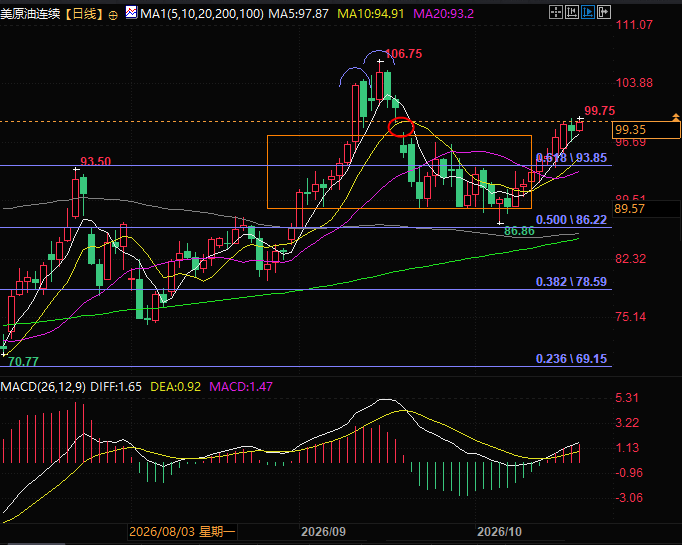 (WTI crude oil futures daily chart, source: EasyTrade) At 16:13 Beijing time, WTI crude oil futures are currently trading at $99.34 per barrel.
The expected positive impact on diesel fuel has failed to materialize, and the reserve buffer has reached its limit.
One of the core themes of previous market trading was the expectation of easing restrictions, particularly the US waiving sanctions and encouraging the influx of Russian diesel into the spot market. However, this positive effect has not materialized as expected. US Energy Secretary Wright explicitly stated that no Russian diesel has been released into the market yet, and whether Russia will release diesel remains to be seen. Although the US is simultaneously consulting with the UK on a plan to release diesel reserves, such releases are only a short-term emergency measure with limited capacity, insufficient to fundamentally address the global distillate fuel shortage. Meanwhile, the traditional safety net of US crude oil reserves has been significantly weakened. Latest data shows that US strategic petroleum reserve crude oil inventories have fallen to 282.7 million barrels, a new low since October 1982, significantly narrowing the room for maneuver in offsetting oil price shocks through large-scale reserve releases.The Russia-Ukraine stalemate is hindering refinery repairs, and the diesel shortage is unlikely to be resolved in the short term.
The root cause of the current diesel shortage lies in the continued damage to Russia's secondary refining facilities, with lengthy repair cycles for damaged hydrogenation equipment used in diesel production. Coupled with differing stances from the US and Europe regarding aid to Ukraine and the handling of the conflict, the Russia-Ukraine conflict has reached a stalemate, further constraining the recovery of Russian refined oil exports. Domestic securities research reports predict that global refining capacity is unlikely to improve significantly in the short term, the diesel supply-demand gap is unlikely to ease quickly, diesel prices are likely to remain high, and this will continue to exert moderate upward pressure on US inflation.Multiple shipping routes in the Middle East present shared risks, and geopolitical premiums continue to disrupt the market.
The US-Iran negotiations have yet to find a ceasefire, and Iranian officials have stated that the country needs control of the Strait of Hormuz to maintain national security, thus the risk premium associated with the strait persists. In addition to the Strait of Hormuz, the Houthi military operations have further amplified uncertainty in the Middle East. In recent weeks, the Houthis have launched multiple attacks on Saudi airports, oil facilities, Aramco-related bases, and military targets, claiming to have carried out six rounds of strikes. While Saudi Arabia has not yet announced major damage, security concerns have already spread: Saudi Arabia canceled next week's global investment conference and extended online learning arrangements in Riyadh and surrounding schools, dampening regional investment confidence. Furthermore, the Houthis are vying for positions in the Red Sea and the Bab el-Mandeb Strait, a key alternative shipping route to the Strait of Hormuz. Obstruction of this waterway would further reduce alternative routes for transporting Gulf crude oil.As increased crude oil production in the Americas continues to materialize, the center of gravity for energy pricing is gradually shifting westward, which is a long-term positive for the US dollar.
Positive changes have already emerged on the supply side. US Energy Secretary Wright revealed that oil flow through the Strait of Hormuz has recovered to approximately 80% of pre-war levels. Rystad Energy data also shows that, guided by the US-style "Don Rothschild" energy strategy, oil production in the Americas continues to break records, with production increasing in the US, Canada, Brazil, Venezuela, and Suriname. Total crude oil production in the Americas is projected to grow by 10% within two years. It is noteworthy that the current tight balance in global refined oil products has objectively increased the US's influence in the global energy market, and the center of gravity for global oil pricing is gradually shifting from the traditional Gulf oil-producing regions to the South American continent. Most of the new crude oil and refined oil exports from the Americas are settled in US dollars, continuously consolidating the petrodollar cycle—a fundamental logic supporting the US dollar index in the medium to long term.Pay attention to the turning point in oil prices; marginal improvement may arrive quickly.
The market is prone to a misconception that crude oil and diesel are completely separated, and that even if crude oil prices fall, diesel prices will remain high. However, oil and diesel prices remain highly correlated, and a de-escalation of the US-Iran conflict will quickly impact diesel pricing. Even without Russian diesel entering the market, as long as the situation in the Middle East eases, crude oil shipping insurance and rerouting premiums decrease, crude oil prices will decline. With diesel crack spreads remaining high, the lower cost of crude oil delivered to refineries will directly increase the real processing profits of non-Russian refineries in the Americas and elsewhere. These substantial processing profits will incentivize refineries to fully utilize their existing capacity: postponing planned maintenance, adjusting process parameters to increase diesel yield, and restarting some previously unprofitable idle hydrogenation units to maximize diesel supply. The combination of lower crude oil costs and increased supply elasticity at the refining end will jointly drive diesel prices down along with crude oil, easing inflationary pressures. Of course, this path has a clear upper limit; it is essentially a short-term overdraft of existing facilities, and the incremental volume it can release is limited. The speed and impact of alleviating the supply gap are far less than if US-Russia negotiations were finalized and Russian diesel directly entered the spot market.Summary and Technical Analysis:
The market needs to clarify two different recovery themes, as their impact on the oil market and diesel crack spreads is completely different. The first is a substantial breakthrough in US-Russia negotiations, with Russia releasing diesel in bulk. This path can directly fill the distillate fuel supply gap and is the fastest and most powerful way to suppress diesel crack spreads. Key data to monitor includes Russian diesel loading data and the cross-border flow of Kpler distillate fuels. The second is a easing of tensions in the Middle East, with fewer attacks in the Strait of Hormuz and the Bab el-Mandeb Strait, leading to a decline in crude oil shipping insurance and route detour premiums, thus driving down crude oil prices. Lower crude oil costs will increase processing profits for refineries in the Americas and other overseas regions, incentivizing them to maximize diesel production, leading to a simultaneous weakening of diesel prices and indirectly alleviating the tight supply of refined oil products. This path is relatively slow to take effect, and the increase in supply is constrained by the existing refining flexibility limit. In addition, the coordinated release of refined oil product inventories by the US and UK is only a short-term emergency measure with limited buffering effect, unlikely to change the medium- to long-term supply and demand pattern. In the medium to long term, it is necessary to continuously monitor the realization of increased crude oil production in the Americas, the progress of repairs to the damaged Russian hydrogenation unit, and be wary of OPEC re-activating production cuts to offset price declines. Technical Analysis: International oil prices have recovered the gap from the previous decline and have also broken through the trading range. Further upside potential remains for oil prices, and the strong upward trend will continue as long as the 5-day moving average holds. (WTI crude oil futures daily chart, source: EasyTrade) At 16:13 Beijing time, WTI crude oil futures are currently trading at $99.34 per barrel.
- Risk Warning and Disclaimer
- The market involves risk, and trading may not be suitable for all investors. This article is for reference only and does not constitute personal investment advice, nor does it take into account certain users’ specific investment objectives, financial situation, or other needs. Any investment decisions made based on this information are at your own risk.