Inflation locks in the Fed, capital rush drives up interest rates, gold prices fail to rise despite bullish news, indicating underlying selling pressure.
2026-10-20 17:02:25
Spot gold weakened on Tuesday, falling as much as 0.6% to $4115.50, a three-day low. While routine geopolitical conflicts should trigger safe-haven buying, the current Middle East risks, after pushing up oil prices, have led to a reversal in market sentiment: the spillover effects of energy inflation have caused the market to reprice the Fed's interest rate path, and the AI industry's attraction of global funds has put continued pressure on non-interest-bearing gold due to rising real interest rates. 
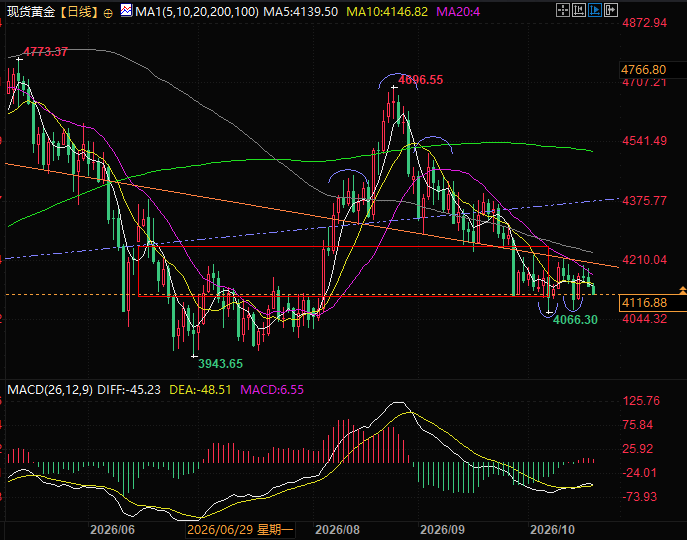 (Spot gold daily chart, source: EasyTrade) At 16:58 Beijing time, spot gold is currently trading at $4119 per ounce.
Energy inflation continues to escalate, locking up the Federal Reserve's room for further easing.
Brent crude oil briefly touched a five-month high as traders priced in the shipping risk premium resulting from the Houthi attacks on Saudi energy facilities. As discussed in previous oil market reviews, rigid premiums such as shipping insurance and detour costs, coupled with diesel shortages, are collectively locking in global inflation resilience. The transmission chain of rising energy costs is clear: rising crude oil and diesel prices push up prices for goods and services across the entire industry chain, increasing inflation stickiness and directly compressing the Federal Reserve's room for further easing. Domestic institutions believe that this round of Middle East conflict has not resulted in the traditional safe-haven gold market; the main trading theme has shifted from safe-haven to inflation and interest rate expectations. Rising oil prices and diesel shortages, increasing inflation stickiness, directly postpone the Fed's rate cut window. As a non-interest-bearing asset, the increased opportunity cost of rising real interest rates for gold is the core reason why geopolitical gains have led to a decline in gold prices. Even though Fed officials have stated that there is little urgency for further tightening in the short term, CME Group FedWatch data still shows that the market prices a 92% probability of a December rate hike. While gold is a traditional hedge against inflation, in a high-interest-rate environment, holding gold offers no interest return, increasing opportunity costs and completely offsetting the positive effects of inflation due to expectations of interest rate hikes. Meanwhile, Bank of Japan Governor Kazuo Ueda signaled that domestic inflation is nearing its target and further interest rate hikes are still possible, further suppressing gold prices in the tightening global environment.AI-driven financing and liquidity diversion from US Treasury bonds cause gold buying to falter.
Besides interest rate expectations, competition for capital is another key factor suppressing gold prices. OpenAI is accelerating its $30 billion fundraising, aiming to secure capital before Anthropic's IPO. The views of Goldman Sachs and CICC Wealth Futures are worth noting: in an environment of limited existing funds and high interest rates, high-growth AI equities and high-yield US Treasury bonds are directly competing with precious metals for capital. Large-scale fundraising by leading projects like OpenAI will absorb incremental funds already allocated to other asset classes, squeezing the supply of funds to gold ETFs and precious metal long positions. US Treasury yields are a benchmark for the opportunity cost of gold; when both US Treasury bonds and AI equities offer substantial returns, gold's disadvantage of not offering interest is amplified, leading to a continued lack of incremental buying.Exchange rate variables: The strength of the euro indirectly determines the degree of downward pressure the US dollar exerts on gold prices.
The current strengthening of the US dollar is driven by two clear factors: first, energy trade is settled in US dollars, and rising oil prices increase demand for dollars; second, risks related to France are disrupting the market, weakening the euro, passively pushing up the dollar index, and suppressing gold prices denominated in dollars. JPMorgan's foreign exchange team analyzes that the strength of the dollar is largely dominated by the US-EU interest rate differential. Internal European risks depress the euro and push up the dollar; conversely, once European risks ease, the euro stabilizes, and the US-EU interest rate differential narrows, it becomes an important supporting condition for a phased rebound in gold prices. Domestic investment banks further remind investors that exchange rates are a second-order variable in gold prices; interest rate expectations are the dominant factor. Support from a stronger euro is more suitable for short-term trading and is unlikely to reverse the overall trend of gold prices on its own.Cautionary note: Despite a flurry of positive news, gold prices have failed to rise.
As a candidate favoring monetary easing and a stock market rally, Trump posted extensively on social media in the lead-up to the midterm elections, touting a series of policy benefits including subsidies, tax cuts, and reduced tax burdens, continuously injecting easing expectations into the market. Logically, easing expectations should be bullish for gold, but gold prices failed to rebound significantly, forming a typical pattern of "positive news but no price increase." Institutional analysis points out that "buy the rumor, sell the fact" often occurs before and after policy benefits are implemented. Many positive factors are already priced in during the initial hype phase, and after the news is released, bullish investors take profits and exit, easily leading to a situation where positive news fails to drive prices up or even weakens. Bank of America and UBS Wealth Management also noted that policy pronouncements are unlikely to independently drive gold prices; the market ultimately follows the real interest rate trend. Even if the market expects a looser policy stance, as long as inflation and high interest rate expectations remain unchanged, simple easing pronouncements are unlikely to drive gold prices sustainably upward, increasing the risk of bullish investors exiting on the news.Key signals to watch for future turning points in gold prices
Multiple futures institutions have reached a consensus: the first point to observe for a gold price inflection point is the energy sector. Middle East shipping risks, shipping insurance premiums, declining diesel crack spreads, cooling inflation expectations, and declining real interest rates are the core triggering conditions for a gold price rebound. Simultaneously, inflection points in capital flows and exchange rates should also be observed. Inflection points in capital flows include a peak and subsequent decline in US Treasury yields, a slowdown in large-scale AI financing, and a return of existing funds to the precious metals sector. Finally, exchange rate inflection points occur when French risks subside, the euro stabilizes and rebounds, leading to a weakening of the US dollar index and providing secondary support for gold prices. Furthermore, the Fed's interest rate decisions are traditionally the most relevant. If this meeting releases a clear dovish signal and lowers expectations for subsequent rate hikes, it will directly reverse the weakness in gold prices; if it continues to emphasize inflation risks, the correction will continue. Technically, after finding support at a double bottom, the rebound momentum in gold prices has weakened, and the 5-day and 10-day moving averages have begun to turn downwards, making it highly probable that gold prices will continue to test the bottom towards 3950. (Spot gold daily chart, source: EasyTrade) At 16:58 Beijing time, spot gold is currently trading at $4119 per ounce.
- Risk Warning and Disclaimer
- The market involves risk, and trading may not be suitable for all investors. This article is for reference only and does not constitute personal investment advice, nor does it take into account certain users’ specific investment objectives, financial situation, or other needs. Any investment decisions made based on this information are at your own risk.