Middle East shipping disruptions and a rebound in oil prices boosted the Canadian dollar, causing the USD/CAD pair to decline for the fourth consecutive day; caution is advised against a downward breakout.
2026-10-20 15:28:21
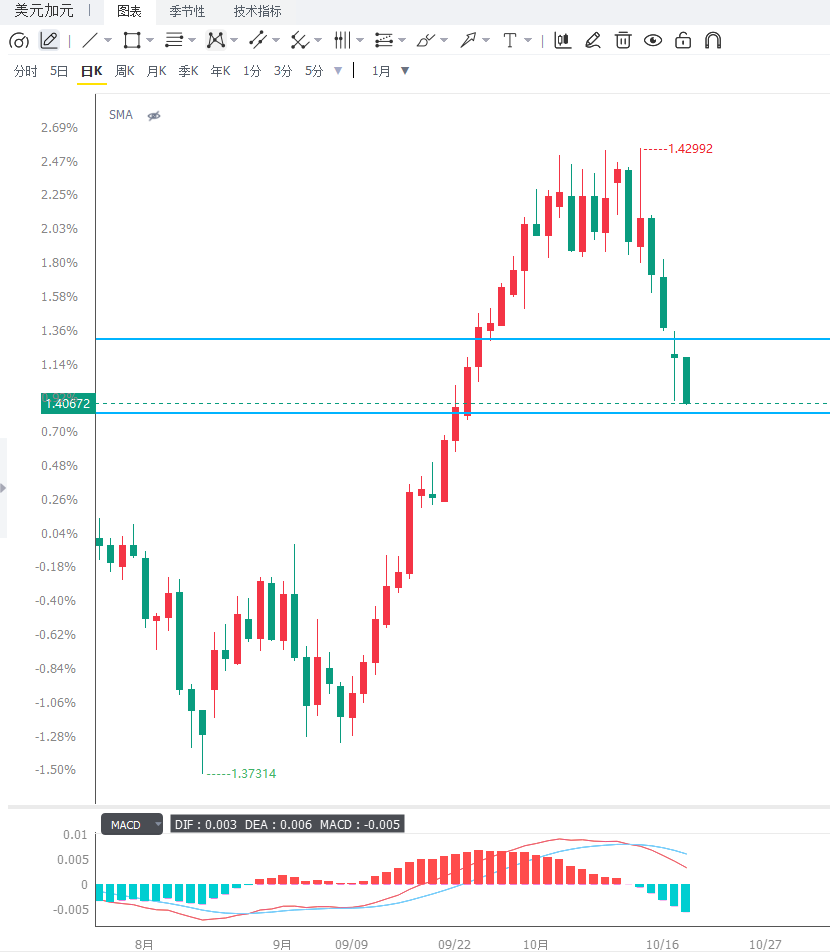
On Tuesday during Asian trading hours, the US dollar continued its decline against the Canadian dollar, closing lower for the fourth consecutive trading day. The exchange rate traded around 1.4090, further down from the close of the previous trading day. This round of decline was mainly driven by two factors: first, escalating geopolitical conflicts in the Middle East pushed up international oil prices, directly supporting the commodity-oriented Canadian dollar; second, the repricing of expectations regarding the Federal Reserve's policies weakened the dollar's interest rate advantage. The combination of these two factors made the exchange rate more likely to fall than rise in the short term.  In the crude oil market, the concentrated release of geopolitical risks was the main driving force. Iran continued to emphasize its control over the Strait of Hormuz, and maritime agencies reported multiple attacks on merchant ships; Saudi Arabia and the Houthi rebels in Yemen launched mutual attacks, while Russia and Ukraine resumed targeted attacks on energy infrastructure. According to data from market analysis firm Kpler, the seven-day average flow of crude oil in the Middle East fell to approximately 8.5 million barrels per day last week, compared to over 20 million barrels per day the previous week, with at least 10 confirmed incidents involving merchant ships occurring during this period. This sudden drop in logistics disruptions was quickly reflected in prices, with Brent crude returning above $109 and WTI crude fluctuating between $98 and $99. As a typical resource-based currency, the Canadian dollar is highly sensitive to energy prices, and the rebound in oil prices provided immediate buying support for the Canadian dollar. This is the core reason why the USD/CAD exchange rate has been able to maintain an independent downward trend despite the overall strength of the US dollar in this round of market conditions. In terms of monetary policy, the differences in the situations of the two central banks are narrowing the trend space for exchange rates. Regarding the Bank of Canada, Royal Bank economists noted that the bank remains in an "uncomfortable balance": the domestic economy is weak, but rising oil prices are bringing new inflationary pressures. Currently, overall inflation is only slightly above the target level, with core CPI excluding food and energy, CPI-trim, and CPI-median all hovering around 2%. This contradictory combination keeps policymakers cautious, and the Royal Bank's basic assessment is that interest rates will remain unchanged until 2026. This means the Canadian dollar is unlikely to gain additional momentum from interest rate hike expectations; its strength depends more on oil prices and risk appetite than on interest rate differentials, which also determines that the Canadian dollar's strength may lack sustainability. As for the US dollar, Federal Reserve Chairman Warsh expressed optimism about the resilience of the US economy last week but did not provide specific guidance on the timing and likelihood of future interest rate adjustments. Based on this, the market has pushed the expectation of keeping interest rates unchanged in October to around 82.8% (with slight differences between institutions), and there is also disagreement on whether policy will be tightened at the end of the year. This combination of "uncertain direction and delayed timing" caused the US dollar index to continue its weak trend at the beginning of the week. Market analysis shows that the US dollar index weakened last week, and overall trading sentiment was defensive on Monday, reflecting investors' cautious attitude as they reassess the Federal Reserve's policy path. However, it's important to note that the dollar's weakness is more of a temporary pullback than a trend reversal. If year-end tightening expectations intensify again, the dollar's interest rate advantage could resurface, putting downward pressure on the USD/CAD exchange rate. From a global market perspective, the current exchange rate fluctuations are essentially a result of the transmission chain of "oil prices—inflation—policy." While rising oil prices are beneficial to the Canadian dollar in the short term, a sustained increase could exacerbate inflationary pressures on the Bank of Canada and even compress its future easing space. This self-offsetting mechanism is a typical characteristic of commodity currencies. Meanwhile, the Strait of Hormuz handles about one-fifth of global seaborne crude oil transport; any prolonged disruption could trigger a reassessment of global energy costs, which in turn could affect the policy pace of major central banks through inflation expectations, ultimately impacting exchange rates. Therefore, investors should not simply equate rising oil prices with a bullish outlook for the Canadian dollar, but rather focus on whether this price increase can translate into a sustainable trade surplus and capital inflows. On the daily chart, the USD/CAD pair has broken below the lower edge of its recent consolidation range, trading below the 20-day exponential moving average and the 100-day simple moving average. Short-term moving averages are in a bearish alignment, indicating that the medium-term bearish structure has not yet been repaired. The RSI (14) has fallen to around 44, below the 50 neutral line but not yet in oversold territory, suggesting that downward momentum is still being released and there is room for further declines. The primary resistance level is at 1.4150-1.4160, followed by the psychological level of 1.4200 and the previous high of 1.4260. Support levels to watch are 1.4050, 1.4160, 1.4200, and 1.4260. The key levels to watch are the psychological level of 1.4000 and 1.3950. On the 4-hour chart, after falling back from around 1.4180, the price has been slowly moving downwards along the short-term moving average. The MACD histogram is expanding below the zero line, and the fast and slow lines are diverging downwards, indicating that the bears are still in control. If the price rebounds to the 1.4120-1.4140 range and encounters resistance, it can be considered a short-term sell signal. If it breaks below 1.4050 with increased volume, it may accelerate the test of 1.4000. Conversely, only by rising back above 1.4160 can we confirm that the current four-day losing streak has come to an end and the market has entered a consolidation phase.
 Editor's Summary: The core logic for the USD/CAD pair in the short term lies in the resonance between the rebound in oil prices and the weakening of the US dollar, but the sustainability of this resonance is questionable. The current support for the Canadian dollar mainly comes from geopolitical premiums rather than fundamental improvements. The Bank of Canada's cautious stance amidst economic weakness and inflationary concerns determines that it is unlikely to provide additional interest rate support. The dollar's pullback stems from the ambiguity of policy expectations, rather than the end of the tightening cycle. Therefore, the exchange rate is more likely to fluctuate repeatedly within the 1.4000-1.4200 range, with a stronger catalyst needed for a unilateral breakout. Three variables need to be closely watched going forward: first, the situation regarding passage through the Strait of Hormuz and the evolution of the Middle East situation, which directly determines the duration of the oil price premium; second, Canadian inflation data and the central bank's statements; if core indicators deviate from the 2% range, market expectations may be revised; and third, the final confirmation of the Federal Reserve's policy path at the end of the year, which remains the key to the medium-term direction of the US dollar.
In the crude oil market, the concentrated release of geopolitical risks was the main driving force. Iran continued to emphasize its control over the Strait of Hormuz, and maritime agencies reported multiple attacks on merchant ships; Saudi Arabia and the Houthi rebels in Yemen launched mutual attacks, while Russia and Ukraine resumed targeted attacks on energy infrastructure. According to data from market analysis firm Kpler, the seven-day average flow of crude oil in the Middle East fell to approximately 8.5 million barrels per day last week, compared to over 20 million barrels per day the previous week, with at least 10 confirmed incidents involving merchant ships occurring during this period. This sudden drop in logistics disruptions was quickly reflected in prices, with Brent crude returning above $109 and WTI crude fluctuating between $98 and $99. As a typical resource-based currency, the Canadian dollar is highly sensitive to energy prices, and the rebound in oil prices provided immediate buying support for the Canadian dollar. This is the core reason why the USD/CAD exchange rate has been able to maintain an independent downward trend despite the overall strength of the US dollar in this round of market conditions. In terms of monetary policy, the differences in the situations of the two central banks are narrowing the trend space for exchange rates. Regarding the Bank of Canada, Royal Bank economists noted that the bank remains in an "uncomfortable balance": the domestic economy is weak, but rising oil prices are bringing new inflationary pressures. Currently, overall inflation is only slightly above the target level, with core CPI excluding food and energy, CPI-trim, and CPI-median all hovering around 2%. This contradictory combination keeps policymakers cautious, and the Royal Bank's basic assessment is that interest rates will remain unchanged until 2026. This means the Canadian dollar is unlikely to gain additional momentum from interest rate hike expectations; its strength depends more on oil prices and risk appetite than on interest rate differentials, which also determines that the Canadian dollar's strength may lack sustainability. As for the US dollar, Federal Reserve Chairman Warsh expressed optimism about the resilience of the US economy last week but did not provide specific guidance on the timing and likelihood of future interest rate adjustments. Based on this, the market has pushed the expectation of keeping interest rates unchanged in October to around 82.8% (with slight differences between institutions), and there is also disagreement on whether policy will be tightened at the end of the year. This combination of "uncertain direction and delayed timing" caused the US dollar index to continue its weak trend at the beginning of the week. Market analysis shows that the US dollar index weakened last week, and overall trading sentiment was defensive on Monday, reflecting investors' cautious attitude as they reassess the Federal Reserve's policy path. However, it's important to note that the dollar's weakness is more of a temporary pullback than a trend reversal. If year-end tightening expectations intensify again, the dollar's interest rate advantage could resurface, putting downward pressure on the USD/CAD exchange rate. From a global market perspective, the current exchange rate fluctuations are essentially a result of the transmission chain of "oil prices—inflation—policy." While rising oil prices are beneficial to the Canadian dollar in the short term, a sustained increase could exacerbate inflationary pressures on the Bank of Canada and even compress its future easing space. This self-offsetting mechanism is a typical characteristic of commodity currencies. Meanwhile, the Strait of Hormuz handles about one-fifth of global seaborne crude oil transport; any prolonged disruption could trigger a reassessment of global energy costs, which in turn could affect the policy pace of major central banks through inflation expectations, ultimately impacting exchange rates. Therefore, investors should not simply equate rising oil prices with a bullish outlook for the Canadian dollar, but rather focus on whether this price increase can translate into a sustainable trade surplus and capital inflows. On the daily chart, the USD/CAD pair has broken below the lower edge of its recent consolidation range, trading below the 20-day exponential moving average and the 100-day simple moving average. Short-term moving averages are in a bearish alignment, indicating that the medium-term bearish structure has not yet been repaired. The RSI (14) has fallen to around 44, below the 50 neutral line but not yet in oversold territory, suggesting that downward momentum is still being released and there is room for further declines. The primary resistance level is at 1.4150-1.4160, followed by the psychological level of 1.4200 and the previous high of 1.4260. Support levels to watch are 1.4050, 1.4160, 1.4200, and 1.4260. The key levels to watch are the psychological level of 1.4000 and 1.3950. On the 4-hour chart, after falling back from around 1.4180, the price has been slowly moving downwards along the short-term moving average. The MACD histogram is expanding below the zero line, and the fast and slow lines are diverging downwards, indicating that the bears are still in control. If the price rebounds to the 1.4120-1.4140 range and encounters resistance, it can be considered a short-term sell signal. If it breaks below 1.4050 with increased volume, it may accelerate the test of 1.4000. Conversely, only by rising back above 1.4160 can we confirm that the current four-day losing streak has come to an end and the market has entered a consolidation phase. Editor's Summary: The core logic for the USD/CAD pair in the short term lies in the resonance between the rebound in oil prices and the weakening of the US dollar, but the sustainability of this resonance is questionable. The current support for the Canadian dollar mainly comes from geopolitical premiums rather than fundamental improvements. The Bank of Canada's cautious stance amidst economic weakness and inflationary concerns determines that it is unlikely to provide additional interest rate support. The dollar's pullback stems from the ambiguity of policy expectations, rather than the end of the tightening cycle. Therefore, the exchange rate is more likely to fluctuate repeatedly within the 1.4000-1.4200 range, with a stronger catalyst needed for a unilateral breakout. Three variables need to be closely watched going forward: first, the situation regarding passage through the Strait of Hormuz and the evolution of the Middle East situation, which directly determines the duration of the oil price premium; second, Canadian inflation data and the central bank's statements; if core indicators deviate from the 2% range, market expectations may be revised; and third, the final confirmation of the Federal Reserve's policy path at the end of the year, which remains the key to the medium-term direction of the US dollar.
- Risk Warning and Disclaimer
- The market involves risk, and trading may not be suitable for all investors. This article is for reference only and does not constitute personal investment advice, nor does it take into account certain users’ specific investment objectives, financial situation, or other needs. Any investment decisions made based on this information are at your own risk.