With the Reserve Bank of Australia (RBA) hinting ahead of time that inflation is higher than expected, is a November rate hike still a certainty?
2026-10-21 07:34:20
The Australian dollar extended its gains against the US dollar in Asian trading on Wednesday (October 21), currently trading around 0.7010, its highest level since the end of September. Reserve Bank of Australia (RBA) Deputy Governor Hauser said on Wednesday that the third-quarter cutoff mean inflation looks set to be higher than the central bank's expectations, and that capacity pressures in the economy are more pronounced than anticipated. He added that the central bank must respond to supply shocks to keep inflation expectations anchored, although he acknowledged that September employment data was slightly weaker than expected. Predicting a higher-than-expected cutoff mean a week before the official CPI data release is unusually direct guidance, which will tilt the risk balance to the upside for the data release on October 28. 
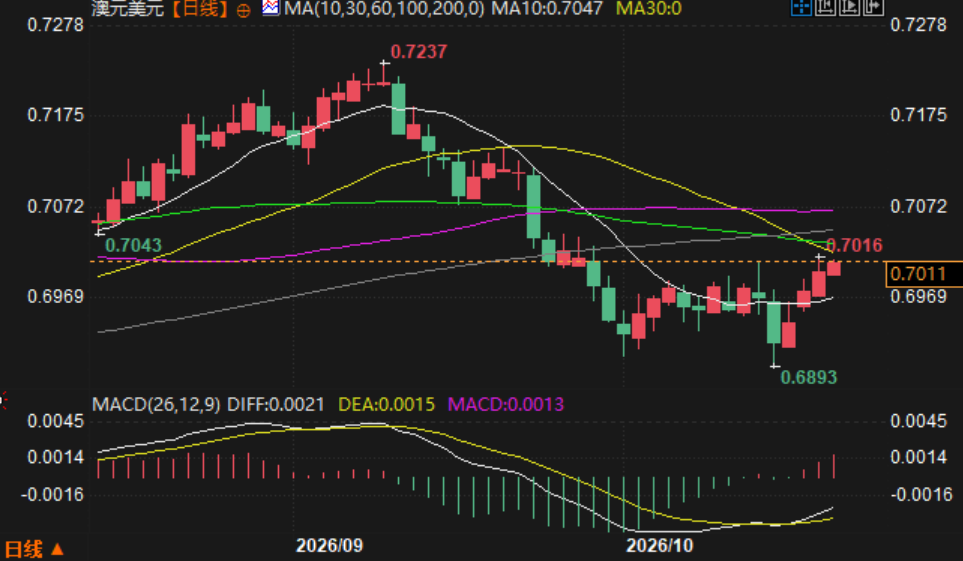 (Australian dollar to US dollar daily chart, source: EasyForex) At 7:11 Beijing time, the Australian dollar to US dollar exchange rate was 0.7009/10.
Key signals: Cut-off mean inflation is expected to be higher than anticipated, and capacity pressures are tightening.
Speaking at the Citi Australia and New Zealand Investment Conference in Sydney, Hauser said the quarterly cut-off mean looked set to be higher than the Reserve Bank of Australia's (RBA) expectations. The cut-off mean, which removes the largest price fluctuations each quarter to more clearly reflect underlying inflation, is a key indicator the RBA watches closely. His comments came a week before the Australian Bureau of Statistics released its September quarterly inflation data on October 28. Hauser also stated that capacity pressures in the economy were more pronounced than the RBA had anticipated, suggesting that demand was still leading supply faster than policymakers had assumed. The key point of this signal is that Hauser's prediction of higher-than-expected inflation a week before the official data release is unusually direct. This statement tilts the risk balance to the upside when the October 28 data release is released; if the actual data confirms his prediction, the pricing in a November 3 rate hike will be strengthened.Supply shock: The Reserve Bank of Australia must respond to anchor inflation expectations
Regarding supply shocks, Hauser stated that the Reserve Bank of Australia (RBA) must respond to them to keep inflation expectations anchored. Central banks typically ignore supply-driven price increases, arguing that such shocks will subside over time. However, Hauser's comments suggest that after a prolonged period of high inflation, the RBA sees less room to ignore these shocks. The RBA has previously cited the Middle East conflict and its impact on oil prices as supply-side pressures. This statement indicates that with inflation expectations at risk, the RBA is unlikely to ignore energy-driven price increases, making crude oil a more direct factor influencing Australian interest rate pricing. If the Middle East situation pushes up oil prices, the RBA's tightening bias may increase, providing support for the Australian dollar.Policy logic: We cannot focus solely on current inflation, but current inflation is not insignificant.
Hauser added that monetary policy cannot target current inflation because of its lag effect, but he emphasized that this does not mean current inflation is irrelevant, as sustained price increases can transmit to expectations. The essence of this logic is that central banks need to weigh current inflation against future expectations. Even if current inflation stems from a supply shock, central banks should respond as soon as sustained price increases begin to impact expectations.Job Market: September data was slightly weak, but the unemployment rate remains low, and the labor market is easing.
The labor market provided some hedging. Hauser noted that the September jobs report was significantly weaker than expected, and while the unemployment rate remained quite low, conditions were easing. The weakness in the labor market provided arguments for a dovish stance, but Hauser's framework suggests that this alone is insufficient to keep the committee on hold, especially given the rising risks to inflation.Policy Path: The November 3rd meeting will focus on the key data point: the truncated mean.
The Reserve Bank of Australia (RBA) raised the cash rate to 4.60% on September 29. The committee will meet on November 2-3, with the decision announced at 2:30 pm Sydney time on November 3 (11:30 am Beijing time), along with updated staff forecasts. If next week's cutoff mean is higher than expected, it could firmly keep further rate hikes on the table. From a policy perspective, the inflation data on October 28 is a key variable for the November 3 decision. If the data confirms Hauser's predictions, the likelihood of a rate hike will increase significantly.Summarize
Reserve Bank of Australia (RBA) Deputy Governor Hauser stated that the third-quarter cutoff mean inflation appears likely to be higher than the central bank's expectations, and that capacity pressures in the economy are also more pronounced than anticipated. His prediction, made a week before the official data release, tilts the risk balance to the upside for the October 28th data release. Hauser emphasized that the RBA must respond to supply shocks to keep inflation expectations anchored, suggesting that after a prolonged period of high inflation, the central bank is unlikely to ignore energy-driven price increases, making crude oil a more direct input variable for Australian interest rate pricing. Slightly weaker-than-expected September employment data provided a hedge for the dovish stance, but Hauser's framework suggests this was insufficient for the committee to remain on hold. The RBA raised the cash rate to 4.60% in September, and the November 3rd decision will depend on the October 28th inflation data. If the cutoff mean is higher than expected, further rate hikes will remain firmly on the table, which typically supports the Australian dollar and pushes up short-term Australian government bond yields. (Australian dollar to US dollar daily chart, source: EasyForex) At 7:11 Beijing time, the Australian dollar to US dollar exchange rate was 0.7009/10.
- Risk Warning and Disclaimer
- The market involves risk, and trading may not be suitable for all investors. This article is for reference only and does not constitute personal investment advice, nor does it take into account certain users’ specific investment objectives, financial situation, or other needs. Any investment decisions made based on this information are at your own risk.