Gold Trading Alert: With the Fed's interest rate hike looming large, the $4,000 mark may face another test?
2026-10-21 07:44:20
Gold prices edged lower on Tuesday (October 20), with spot gold closing down 0.37% at $4,125.08 per ounce, after dipping as low as $4,111.58 during the session. December gold futures closed down 0.4% at $4,142.60. Although a weaker dollar briefly pushed gold prices to around $4,155, all gains were erased by the close, indicating that investor caution ahead of the Federal Reserve's policy meeting next week is dominating the market. Current gold prices are about 26% lower than the record high of $5,594.82 reached in January, and about 22% lower than at the beginning of the Iranian conflict. The market is at a crucial intersection of sentiment and technical factors. On Wednesday (October 21) in Asian trading, spot gold continued to be under pressure, currently trading around $4,115 per ounce. 
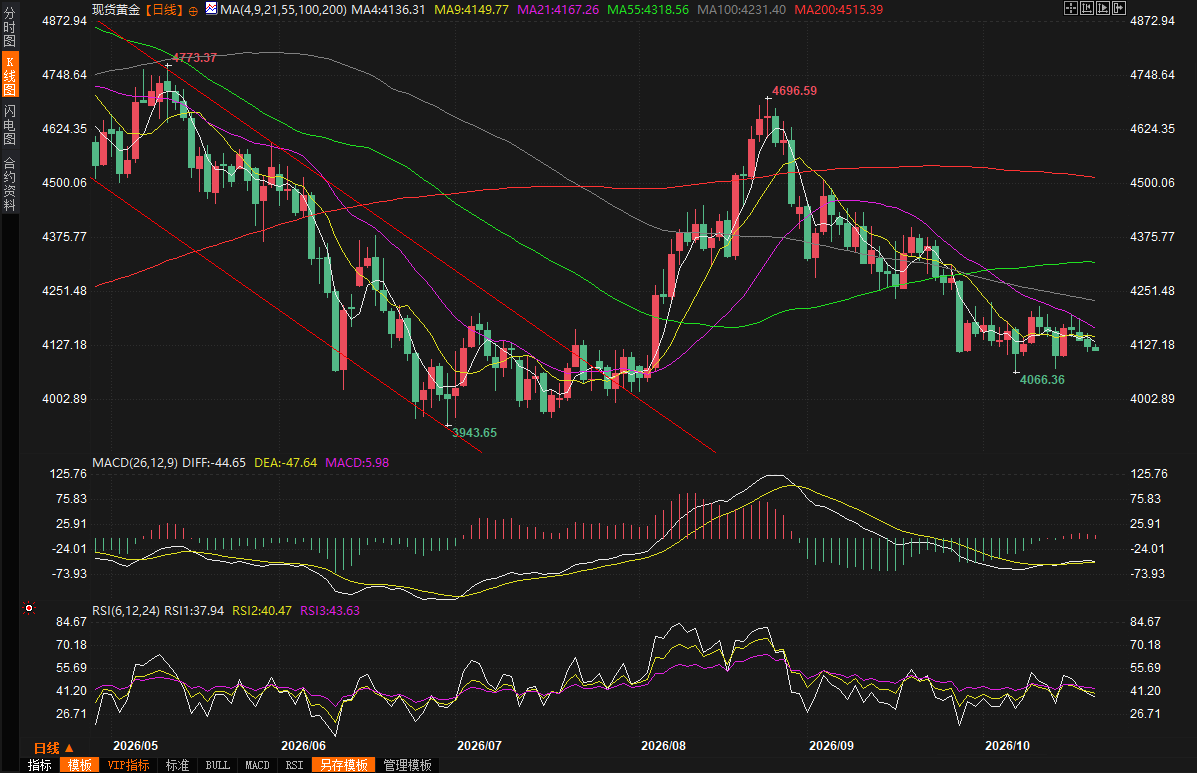 (Spot gold daily chart, source: FX678) At 07:40 Beijing time, spot gold is currently trading at $4115.56 per ounce.
Federal Reserve policy expectations have become the core force suppressing gold prices.
StoneX Senior Market Strategist Bob Haberkorn explicitly pointed out that sticky inflation and the Fed's interest rate path are the main factors currently suppressing gold. US Treasuries currently appear more attractive as a safe-haven asset than gold, resulting in a clear diversion of funds between the two. The Fed implemented its first rate hike of the year in September, raising rates by 25 basis points, and recent statements from officials have generally signaled a "no rush to further tighten," directly lowering market expectations for a rate hike at the October 27-28 meeting. The CME Group's FedWatch tool shows that the probability of a rate hike next week has fallen to around 17.2%, far below the high of a month ago. However, traders are still pricing in a 92% rate hike in December. This "relaxed near-term, still tight long-term" expectation structure makes it difficult for gold to receive sustained policy support in the short term. Investors will now be closely watching the upcoming Personal Consumption Expenditures (PCE) price index. This data is considered the Fed's most valued inflation indicator, and its results will directly influence market judgments on the subsequent interest rate path. If the PCE data continues to show persistent inflationary pressures, then even if the October meeting holds rates steady, the certainty of a December rate hike will be further strengthened, thus continuing to put downward pressure on gold prices. Conversely, if the data shows a significant easing, gold may see a period of respite.The interplay between US Treasury yields and the US dollar
In contrast to gold's performance, the US Treasury market saw a slight decline in the 10-year Treasury yield to 5.121% and the 30-year yield to 5.431% on Tuesday, both significantly recovering from their intraday lows by the close. This was due to a rebound in US stocks, driven by the artificial intelligence sector, which boosted risk appetite and reduced safe-haven buying. Last week, AI infrastructure stocks experienced a sharp correction due to concerns about rising borrowing costs, which briefly increased demand for US Treasuries. However, as stocks like CoreWeave recovered their losses, short-term yields even rebounded intraday. Robert Tipp, Chief Investment Strategist at PGIM, pointed out that the market is facing conflicting forces: strong economic growth, persistently high inflation, and a generally tight policy stance from global central banks have collectively pushed up the central yield; however, at the same time, the market has already priced in a large amount of tightening expectations, and the actual pace of central bank rate hikes may lag behind pricing. Therefore, once risk sentiment improves, yields are likely to fall rapidly. This dynamic has a dual impact on gold—theoretically, lower yields are beneficial to gold as a non-interest-bearing asset, but a recovery in risk appetite will weaken its safe-haven demand. The spread between 2-year and 10-year US Treasury yields remains positive, and the yield curve itself does not signal a strong recession, thus temporarily lacking a catalyst for gold's role as a "recession hedge." The US dollar index fell 0.28% to around 101.70 on Tuesday, hitting a near three-week low during the session. Lower oil prices and declining longer-term US Treasury yields were the main drags. While rising energy prices typically support the dollar, market concerns about the sustainability of AI-driven trading are reaching a tipping point. Nomura strategist Dominic Bunning cautioned that if interest rates rise too high, causing a reversal in AI-related capital flows, factors that were initially favorable to the dollar could quickly turn unfavorable. The dollar's pullback theoretically provided room for gold prices, but gold failed to hold onto its gains at the end of Tuesday's session, indicating that the downward pressure from interest rate expectations and actual capital flows still prevails.Geopolitical and external central bank factors intertwined
Geopolitically, tensions surrounding Iran continue to influence oil price volatility. Traders are monitoring diplomatic interactions between Iran and Pakistan, while also watching for ongoing Houthi attacks on Saudi infrastructure and reports of attacks on ships in the Gulf region. Oil prices, after hitting a five-month high, have retreated, reducing concerns about a resurgence of short-term inflation but also diminishing gold's premium as a geopolitical safe-haven asset. Meanwhile, new diplomatic developments have emerged in Ukraine: US envoy Witkov will travel to Russia to deliver a security guarantee plan after meeting with Zelensky, while Trump has publicly pressured Kyiv to end the war as soon as possible. While these developments may have limited short-term impact on gold prices, a substantial breakthrough or sudden deterioration in negotiations could quickly shift safe-haven sentiment. Regarding the Bank of Japan, Governor Kazuo Ueda stated that core inflation is "very close" to the 2% target, suggesting further room for interest rate hikes. The divergence in policies among major global central banks continues, causing gold's attractiveness as a non-US dollar currency-denominated asset to fluctuate at different times.Technical barriers and key variables for the market outlook
From a technical perspective, the area around 4066 and the $4000 level are considered important psychological and practical support levels that the market needs to closely monitor. Haberkorn emphasizes that whether gold prices can hold the $4000 level will largely depend on the Federal Reserve's statements. If next week's meeting statement and press conference convey a more dovish signal than expected, gold prices are expected to regain upward momentum; conversely, if officials emphasize inflation risks and the necessity of further tightening, gold prices may accelerate their test of lower ranges. Currently, gold prices are still significantly away from historical highs, and market sentiment has shifted from extreme optimism at the beginning of the year to cautious observation. This shift itself means that volatility may increase. In summary, gold is currently caught in a tug-of-war between multiple forces. The Fed's interest rate path and inflation data are the dominant variables, while the real yield of US Treasury bonds and the dollar's movement constitute immediate constraints, and geopolitics and global central bank policies provide background noise. In the short term, gold prices are unlikely to show a unilateral trend and will more likely exhibit range-bound trading. Investors need to closely monitor next week's PCE data and the Fed's meeting statement, while also paying attention to whether the $4000 level can be held. If this level is breached and accompanied by a renewed rise in US Treasury yields, gold may enter a deeper correction phase; however, if it can stabilize with the support of data and policy signals, it is expected to regain upward momentum. The market is awaiting a clear catalyst, which is likely to emerge within the next two weeks. (Spot gold daily chart, source: FX678) At 07:40 Beijing time, spot gold is currently trading at $4115.56 per ounce.
- Risk Warning and Disclaimer
- The market involves risk, and trading may not be suitable for all investors. This article is for reference only and does not constitute personal investment advice, nor does it take into account certain users’ specific investment objectives, financial situation, or other needs. Any investment decisions made based on this information are at your own risk.