Crude oil trading alert: Geopolitical tensions continue to put pressure on the supply side, and US crude oil prices remain in a wide range of fluctuations.
2026-10-21 09:48:20
On Wednesday during Asian trading hours, WTI crude oil rebounded after two consecutive days of decline, trading around $98.80, while Brent crude oil climbed to $111.2, its highest level since May 20. The core driver of this rally was the renewed escalation of geopolitical risk premiums. However, the market's conflicting interpretations of the progress in US-Iran diplomacy have resulted in a noticeably hesitant upward trend—making a deep pullback difficult, and also hindering a smooth, one-sided breakout.  From the supply side, risks have accumulated significantly. In the past two weeks, at least 18 attacks involving merchant ships have occurred in the Strait of Hormuz, a vital waterway carrying approximately one-fifth of the world's seaborne crude oil transport, remaining under constant tension. Simultaneously, conflicts between Saudi Arabia, the Iranian-backed Houthi rebels in Yemen, and Russia and Ukraine have escalated, with each side launching attacks and targeted strikes against energy infrastructure. This confluence of conflicts has repeatedly priced in the vulnerability of the global energy supply chain. Against this backdrop, crude oil prices have risen by more than 10% this month, and investor interest in the energy sector has increased significantly. However, the supply side is also sending hedging signals: oil flows in the Middle East have largely recovered to about 80% of pre-conflict levels, and energy infrastructure has shown resilience exceeding market expectations. This fact suggests that the current oil price increase is driven more by "disruption expectations" than by "actual shortages," and once logistical data continues to improve, the premium could be quickly reversed. Diplomatic news has further amplified market volatility. Pakistani Army Chief of Staff Asim Munir met with senior Iranian diplomatic and military officials in Tehran to discuss bilateral relations and the progress of negotiations with Washington. Subsequently, a diplomat involved in the discussions clarified that efforts to end the conflict were still underway, but explicitly denied rumors that a "final agreement was imminent." This intermediate state of "negotiations in progress, agreement not yet finalized" is precisely the scenario most difficult for the market to price: it is neither sufficient to disprove the risk of supply disruptions nor to provide a clear path to easing tensions, leading to a tug-of-war in oil prices after news is released, often resulting in an initial surge followed by a pullback. Historically, risk premiums only systematically subside when the text of an agreement is substantially finalized or cross-strait traffic is fully restored; before that, any rumors can trigger impulsive fluctuations. Demand and the macroeconomic level also present a two-way tug-of-war. The Federal Reserve's decision to keep interest rates unchanged next week is widely expected, but the market's pricing in a December rate hike is still as high as approximately 93.5%; the European Central Bank expects to raise interest rates by at least 25 basis points this year to combat persistent inflation; and Bank of Japan Governor Kazuo Ueda also stated that potential inflation is "very close" to the 2% target. The collective hawkish stance of major central banks suggests a continuation of the high-interest-rate environment, which will suppress global economic growth and oil demand expectations, thus substantially constraining the medium-term upside potential of oil prices. Furthermore, despite the recent weakening of the US dollar, the market may be reluctant to excessively short it ahead of the month-end policy meeting; the shift in interest rate expectations has already eroded some of the dollar's yield advantage, and the weakening yield support may make the dollar more vulnerable to further weakness. If the dollar continues to decline due to weakening yield support, it will provide additional pricing support for dollar-denominated oil, which is a contributing factor to the current strength of oil prices despite macroeconomic headwinds. From a global market perspective, the current high oil prices are spilling over to other assets through cost channels. Rising energy prices will directly push up inflation readings in various countries, strengthening the rationale for central banks to maintain high interest rates, and thus negatively impacting the valuations of precious metals and growth sectors through the real interest rate channel; at the same time, rising freight and insurance costs caused by shipping disruptions will exacerbate global trade concerns. Therefore, crude oil is no longer just a single commodity, but a key starting point in this round of macro pricing chain. Its increased volatility will inevitably drive a synchronized rise across asset classes. On the daily chart, WTI crude oil is trading above its 20-day exponential moving average, with short-term moving averages in a bullish alignment, indicating that the rebound structure since last month's low remains intact. The RSI is around 62, above the 50 neutral line and not yet in overbought territory, showing a moderate release of upward momentum, a typical "bullish trend but nearing resistance" pattern. The first resistance level is at the $100 mark, a psychological level and a previous area of dense trading. Secondary resistance levels to watch are $102.50 and $105. Only a decisive break above $100 on the daily chart can confirm the opening of medium-term upside potential. Support levels below are $96.70, $95.00, and the previous support level of $93.00. $96.70 is a key support level in the near term; a break below this level could lead to a pullback to $95 or even lower. On the 4-hour chart, oil prices have been consolidating slowly along the short-term moving average after falling from around $99.50. The MACD histogram is close to the zero line, with the fast and slow lines repeatedly intertwined, indicating neutral momentum. Currently, the price is fluctuating narrowly between $97.80 and $99.50. If it finds support at $97.80-$98.20, there is still a chance for a short-term retest of the $99.50-$100 resistance zone. However, if it breaks below $97.50 with significant volume, it may seek support at $96.70 or even $95.80.
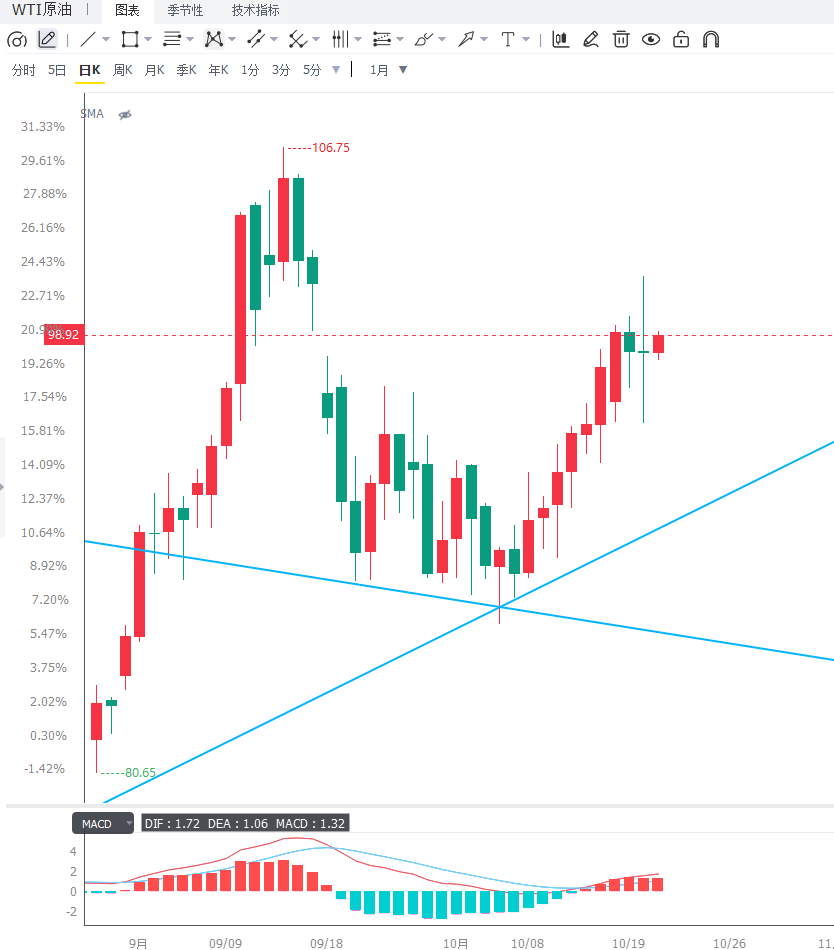 Editor's Summary: The core contradiction in the short term for crude oil lies in the support provided by geopolitical risk premiums, while the resilience of supply recovery and the high-interest-rate environment compress upside potential. The combined effect of these two factors suggests that oil prices are more likely to fluctuate repeatedly within the $96.70-$100 range. Three variables need to be closely monitored going forward: first, the passage through the Strait of Hormuz and the frequency of attacks, which directly determine the duration of the risk premium; second, the actual progress of US-Iran negotiations, as any substantial signs of easing tensions could trigger a rapid retracement of the premium; and third, whether Middle Eastern oil flows can continue to approach pre-war levels, which is crucial evidence of whether the market is driven by "expectations" or "substantial shortages." In the medium term, before a significant breakout from the current range, oil prices will maintain a high-level consolidation pattern. Confirmation of the trend direction still awaits the final clarification of the geopolitical situation and the central bank's year-end policy path.
From the supply side, risks have accumulated significantly. In the past two weeks, at least 18 attacks involving merchant ships have occurred in the Strait of Hormuz, a vital waterway carrying approximately one-fifth of the world's seaborne crude oil transport, remaining under constant tension. Simultaneously, conflicts between Saudi Arabia, the Iranian-backed Houthi rebels in Yemen, and Russia and Ukraine have escalated, with each side launching attacks and targeted strikes against energy infrastructure. This confluence of conflicts has repeatedly priced in the vulnerability of the global energy supply chain. Against this backdrop, crude oil prices have risen by more than 10% this month, and investor interest in the energy sector has increased significantly. However, the supply side is also sending hedging signals: oil flows in the Middle East have largely recovered to about 80% of pre-conflict levels, and energy infrastructure has shown resilience exceeding market expectations. This fact suggests that the current oil price increase is driven more by "disruption expectations" than by "actual shortages," and once logistical data continues to improve, the premium could be quickly reversed. Diplomatic news has further amplified market volatility. Pakistani Army Chief of Staff Asim Munir met with senior Iranian diplomatic and military officials in Tehran to discuss bilateral relations and the progress of negotiations with Washington. Subsequently, a diplomat involved in the discussions clarified that efforts to end the conflict were still underway, but explicitly denied rumors that a "final agreement was imminent." This intermediate state of "negotiations in progress, agreement not yet finalized" is precisely the scenario most difficult for the market to price: it is neither sufficient to disprove the risk of supply disruptions nor to provide a clear path to easing tensions, leading to a tug-of-war in oil prices after news is released, often resulting in an initial surge followed by a pullback. Historically, risk premiums only systematically subside when the text of an agreement is substantially finalized or cross-strait traffic is fully restored; before that, any rumors can trigger impulsive fluctuations. Demand and the macroeconomic level also present a two-way tug-of-war. The Federal Reserve's decision to keep interest rates unchanged next week is widely expected, but the market's pricing in a December rate hike is still as high as approximately 93.5%; the European Central Bank expects to raise interest rates by at least 25 basis points this year to combat persistent inflation; and Bank of Japan Governor Kazuo Ueda also stated that potential inflation is "very close" to the 2% target. The collective hawkish stance of major central banks suggests a continuation of the high-interest-rate environment, which will suppress global economic growth and oil demand expectations, thus substantially constraining the medium-term upside potential of oil prices. Furthermore, despite the recent weakening of the US dollar, the market may be reluctant to excessively short it ahead of the month-end policy meeting; the shift in interest rate expectations has already eroded some of the dollar's yield advantage, and the weakening yield support may make the dollar more vulnerable to further weakness. If the dollar continues to decline due to weakening yield support, it will provide additional pricing support for dollar-denominated oil, which is a contributing factor to the current strength of oil prices despite macroeconomic headwinds. From a global market perspective, the current high oil prices are spilling over to other assets through cost channels. Rising energy prices will directly push up inflation readings in various countries, strengthening the rationale for central banks to maintain high interest rates, and thus negatively impacting the valuations of precious metals and growth sectors through the real interest rate channel; at the same time, rising freight and insurance costs caused by shipping disruptions will exacerbate global trade concerns. Therefore, crude oil is no longer just a single commodity, but a key starting point in this round of macro pricing chain. Its increased volatility will inevitably drive a synchronized rise across asset classes. On the daily chart, WTI crude oil is trading above its 20-day exponential moving average, with short-term moving averages in a bullish alignment, indicating that the rebound structure since last month's low remains intact. The RSI is around 62, above the 50 neutral line and not yet in overbought territory, showing a moderate release of upward momentum, a typical "bullish trend but nearing resistance" pattern. The first resistance level is at the $100 mark, a psychological level and a previous area of dense trading. Secondary resistance levels to watch are $102.50 and $105. Only a decisive break above $100 on the daily chart can confirm the opening of medium-term upside potential. Support levels below are $96.70, $95.00, and the previous support level of $93.00. $96.70 is a key support level in the near term; a break below this level could lead to a pullback to $95 or even lower. On the 4-hour chart, oil prices have been consolidating slowly along the short-term moving average after falling from around $99.50. The MACD histogram is close to the zero line, with the fast and slow lines repeatedly intertwined, indicating neutral momentum. Currently, the price is fluctuating narrowly between $97.80 and $99.50. If it finds support at $97.80-$98.20, there is still a chance for a short-term retest of the $99.50-$100 resistance zone. However, if it breaks below $97.50 with significant volume, it may seek support at $96.70 or even $95.80. Editor's Summary: The core contradiction in the short term for crude oil lies in the support provided by geopolitical risk premiums, while the resilience of supply recovery and the high-interest-rate environment compress upside potential. The combined effect of these two factors suggests that oil prices are more likely to fluctuate repeatedly within the $96.70-$100 range. Three variables need to be closely monitored going forward: first, the passage through the Strait of Hormuz and the frequency of attacks, which directly determine the duration of the risk premium; second, the actual progress of US-Iran negotiations, as any substantial signs of easing tensions could trigger a rapid retracement of the premium; and third, whether Middle Eastern oil flows can continue to approach pre-war levels, which is crucial evidence of whether the market is driven by "expectations" or "substantial shortages." In the medium term, before a significant breakout from the current range, oil prices will maintain a high-level consolidation pattern. Confirmation of the trend direction still awaits the final clarification of the geopolitical situation and the central bank's year-end policy path.
- Risk Warning and Disclaimer
- The market involves risk, and trading may not be suitable for all investors. This article is for reference only and does not constitute personal investment advice, nor does it take into account certain users’ specific investment objectives, financial situation, or other needs. Any investment decisions made based on this information are at your own risk.