The euro is under short-term pressure due to growth concerns and the interest rate differential between the US and Europe. What will its future trend be?
2026-10-21 07:36:23
On Wednesday (October 21) during Asian trading hours, the euro fluctuated slightly lower against the US dollar, currently trading around 1.1225. The weakening growth outlook for the Eurozone and the narrowing room for interest rate hikes by the European Central Bank are jointly constraining the euro's short-term movement. Latest data shows that Germany's ZEW economic sentiment index fell to 18.5 in October, below the expected 24.2 and the previous reading of 25.8. The weaker-than-expected ZEW data reflects a weakening growth outlook for the Eurozone and also reduces the basis for further interest rate hikes by the European Central Bank. 
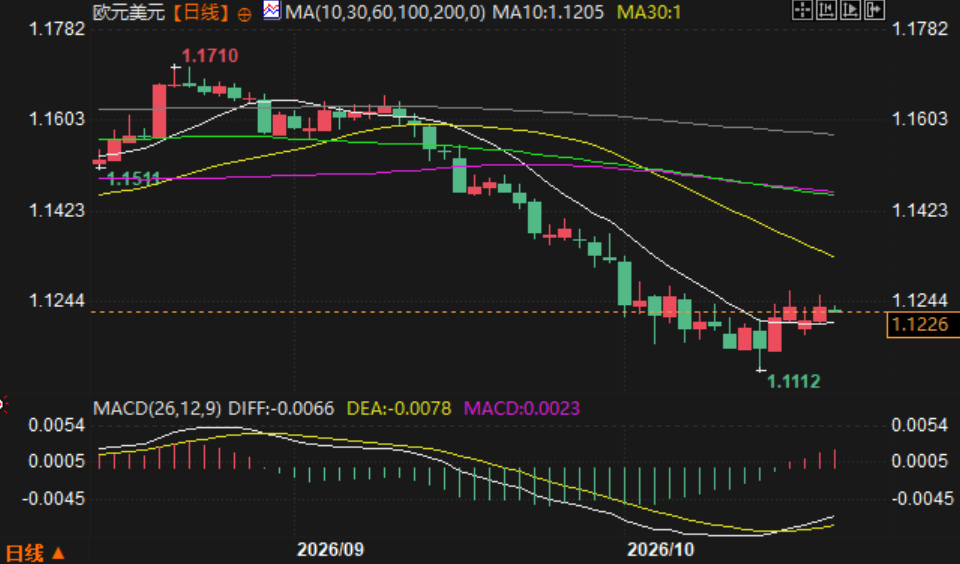 (Euro/USD daily chart, source: FX678) At 7:21 Beijing time, the euro was trading at 1.1225/26 against the US dollar.
Weaker-than-expected ZEW data weakens growth prospects and diminishes arguments for interest rate hikes.
Germany's ZEW economic sentiment index fell to 18.5 in October, below market expectations of 24.2 and September's 25.8. This weaker-than-expected figure reflects a weakening growth outlook for the Eurozone, which undermines the argument for further interest rate hikes by the European Central Bank. The ZEW data is a key indicator of economic sentiment in the Eurozone, and its sharp decline suggests deepening market concerns about Eurozone economic growth. For the euro, the implications are complex: weaker growth typically puts pressure on the currency, but if weak growth leads to easing inflationary pressures, it could reduce the need for the ECB to raise interest rates, further eroding the euro's interest rate advantage.The European Central Bank is expected to keep interest rates unchanged at 2.50% on October 29.
The market expects the European Central Bank (ECB) to keep its deposit rate unchanged at 2.50% on October 29. Danske Bank anticipates another rate hike in December to a peak of 2.75%, but this would still leave the deposit rate nearly one percentage point below the September inflation rate of 3.7%. The key point of this expectation is that the ECB's rate hike cycle is nearing its end, and the peak deposit rate may be significantly lower than the current inflation rate, meaning that real interest rates will remain negative. For the euro, the ECB's interest rate advantage is limited and unlikely to provide sustained support, especially given the backdrop of the Federal Reserve continuing to raise rates and the significant interest rate differential between the US and Europe.Market Implications: The euro is constrained in the short term by growth concerns and interest rate differentials.
Weaker-than-expected ZEW data, the ECB's interest rate hikes nearing their end, and the significant interest rate differential between the US and Europe are all constraining the euro's short-term upward movement. The euro is facing resistance around 1.1250 against the dollar, having attempted to break through several times without success. Stronger-than-expected Eurozone PMI data could provide support for the euro; conversely, weaker data could lead to a retest of support below 1.1200. Thursday's US initial jobless claims data and Friday's US PMI will be key variables determining the dollar's short-term direction.Institutional Views
UBS's Chief Investment Office believes the market has become "overly pessimistic" about Europe, with the euro's drop from around 1.17 to near 1.11 exceeding what European economic fundamentals can explain. Currently, the euro is trading around 1.12 against the dollar, and UBS recommends buying the euro below 1.12, targeting 1.16 by year-end, with a stop-loss below 1.10. The institution points out that strong US data, rising global bond yields, and French fiscal concerns have collectively weighed on the euro, but the probability of a sustained drop below 1.10 is decreasing as the market has almost completely ruled out a Fed rate hike in October. UBS expects the euro to rise to 1.18 by March 2027 and further strengthen to 1.20 after the French presidential election (April-May 2027). ING expects the euro to be under pressure in the 1.10-1.15 range against the dollar over the next 3-6 months. The institution believes that the Fed's hawkish stance and the resilience of the US economy support the dollar, while French fiscal and political uncertainty is a separate drag on the euro. ING draws parallels between the current situation and Italy's debt pressures in 2018, rather than a systemic crisis, and expects moderate fiscal consolidation to prevent a more severe sell-off. Despite a short-term bearish bias, ING maintains a bullish stance for 2027, with a 12-month target of 1.16. The bank emphasizes that if French debt pressures worsen further and force the ECB to adjust its policy, the downside risks to the euro will increase significantly; conversely, changes in US policy (such as after the midterm elections) could be an upside catalyst.Summarize
Germany's ZEW economic sentiment index fell to 18.5 in October, below the expected 24.2, reflecting a weakening growth outlook for the Eurozone and diminishing the argument for further interest rate hikes by the European Central Bank (ECB). The market expects the ECB to keep its deposit rate unchanged at 2.50% on October 29, while Danske Bank projects a rate hike to a peak of 2.75% in December, still below the September inflation rate of 3.7%. The ECB's limited interest rate advantage is unlikely to provide sustained support for the euro. (Euro/USD daily chart, source: FX678) At 7:21 Beijing time, the euro was trading at 1.1225/26 against the US dollar.
- Risk Warning and Disclaimer
- The market involves risk, and trading may not be suitable for all investors. This article is for reference only and does not constitute personal investment advice, nor does it take into account certain users’ specific investment objectives, financial situation, or other needs. Any investment decisions made based on this information are at your own risk.