The pound consolidated at high levels ahead of UK inflation data, with the dollar/pound pair holding near 1.3375 awaiting a CPI catalyst.
2026-10-21 14:44:22
On Wednesday morning in Asia, the pound traded around 1.3375 against the dollar, a slight pullback from the previous day's close, but still remaining within the recent highs. The core contradiction in the current exchange rate lies in the fact that the resilience of the labor market has almost fully priced in the Bank of England's interest rate hike expectations, while a true directional breakout requires confirmation from today's CPI data. Before the data is released, the exchange rate exhibits typical consolidation characteristics of "unable to rise significantly or fall sharply."  From a fundamental perspective, data released by the UK Office for National Statistics on Tuesday showed that the ILO unemployment rate fell to 4.7% in the three months to August, down from 4.9% in July, marking the lowest level in over a year. Despite a second consecutive month of decline in job vacancies, wage growth remained robust. Market analysis indicates a slight rebound in average private sector wage growth, which will bolster the confidence of hawkish members of the Bank of England's Monetary Policy Committee—who advocate for a rate hike now to avoid dealing with a second wave of effects later. Regarding the view held by some observers that the labor market is easing, market analysis points out that this judgment is mainly based on the 5.1% year-on-year decline in job vacancies, while both real and nominal wages remained stable. Furthermore, feedback from the UK Office for National Statistics' job vacancies survey suggests that "small businesses may stop hiring due to rising labor costs," highlighting the persistence of wage pressures. Combined with the backdrop of oil prices rising to their highest level since May, the market expects the Bank of England to have almost no reason to pause and anticipates a rate hike to 4% in November. According to LSEG data, the market has now almost fully priced in a 25 basis point rate hike at the November 5th meeting. A more forward-looking catalyst comes from today's inflation data. Economists expect the UK's overall CPI to rise 3.4% year-on-year in September, while core CPI will rise 2.7%. If the actual reading is close to or higher than expected, it will provide further confirmation of the interest rate hike path and provide a second boost to the pound; conversely, if the data is significantly lower than expected, it may weaken the interest rate advantage and trigger profit-taking. It is worth noting that price action suggests that the accumulation of CFTC short positions has been excessive, and the pound may gain demand due to short covering. Furthermore, if the bullish year-end seasonal factors following the autumn budget are re-established, the pound will receive additional support. Historically, investors typically reduce their holdings of the pound against G10 currencies before the budget, but this year's stronger macroeconomic backdrop and the Bank of England's outlook are giving the pound a slight advantage against the dollar and the euro. This also means that the biggest one-sided risk this week also comes from next week's autumn budget—if fiscal discipline falls short of expectations, pressure on long-term interest rates could quickly offset the support from the interest rate hike. Policy communication has also released hawkish signals. Green's recent remarks received a 7.4/10 rating, in line with the historical average, but her emphasis on stagnant wage deflation and the increased risk of a second round of inflation showed a clear hawkish bias. Forward-looking data points to wage growth near 3.5%, and wage levels still above the 2% inflation level, reinforcing the central bank's rationale for proactively addressing inflation stickiness. She also pointed out that the economy has shown unexpected resilience, and labor market slack may have peaked, indicating limited downside risks to growth and insufficient to constrain policy space. For the pound, this combination of resilient economic activity, a tight labor market, and concerns about a second round of inflation excludes the possibility of rapid easing and supports a more determined interest rate path than previously priced in by the market. The logic on the US side, however, creates a reverse pull. Last week's data showed that US CPI accelerated in September, but Fed Chairman Warsh explicitly stated that he would not "predict" interest rate decisions, giving no clear signal on whether the October meeting would raise rates or remain unchanged. This combination of "uncertain direction and delayed timing" allows the dollar's interest rate advantage to continue, while avoiding a risk-averse reversal triggered by excessive hawkishness. For GBP/USD, this means upside potential will be limited by the resilience of the dollar: support for the pound comes from verifiable data, while resistance for the dollar stems from undecided policy statements. This convergence suggests the exchange rate is more likely to fluctuate within a range rather than experience a smooth, one-sided breakout. On the daily chart, GBP/USD has just broken above the upper Bollinger Band, suggesting a possible short-term extension of the latest rebound; however, the price remains constrained by the 100-day simple moving average. Until this resistance is broken, the overall bias remains bearish. The RSI is around 56, with improved momentum indicating that buyers are accumulating strength. However, the resistance from the 100-day moving average suggests that upside potential is limited unless a clearer breakout occurs. The first resistance level is around 1.3390, near the 100-day moving average. A daily close above this level is needed to alleviate the current bearish pressure and open up space for a more sustained recovery. The next levels to watch are 1.3450 and the psychological level of 1.3500. Support levels are seen at the upper Bollinger Band around 1.3365, the middle Bollinger Band around 1.3255, and the lower Bollinger Band around 1.3150. These levels may attract renewed buying interest during a deeper pullback. On the 4-hour chart, the price is consolidating in a narrow range between 1.3360 and 1.3400. Short-term moving averages are converging, and the MACD histogram is close to the zero line, indicating neutral momentum. If the price retraces to 1.3365-1.3370 and finds support, there is still a chance for a short-term upward move towards 1.3390-1.3400. If the price breaks below 1.3350 with significant volume, it may seek support at 1.3300 or even 1.3255. An upward breakout requires the release of today's UK CPI data and next week's budget announcement. Until then, a range-bound trading strategy is advisable, avoiding chasing highs and lows.
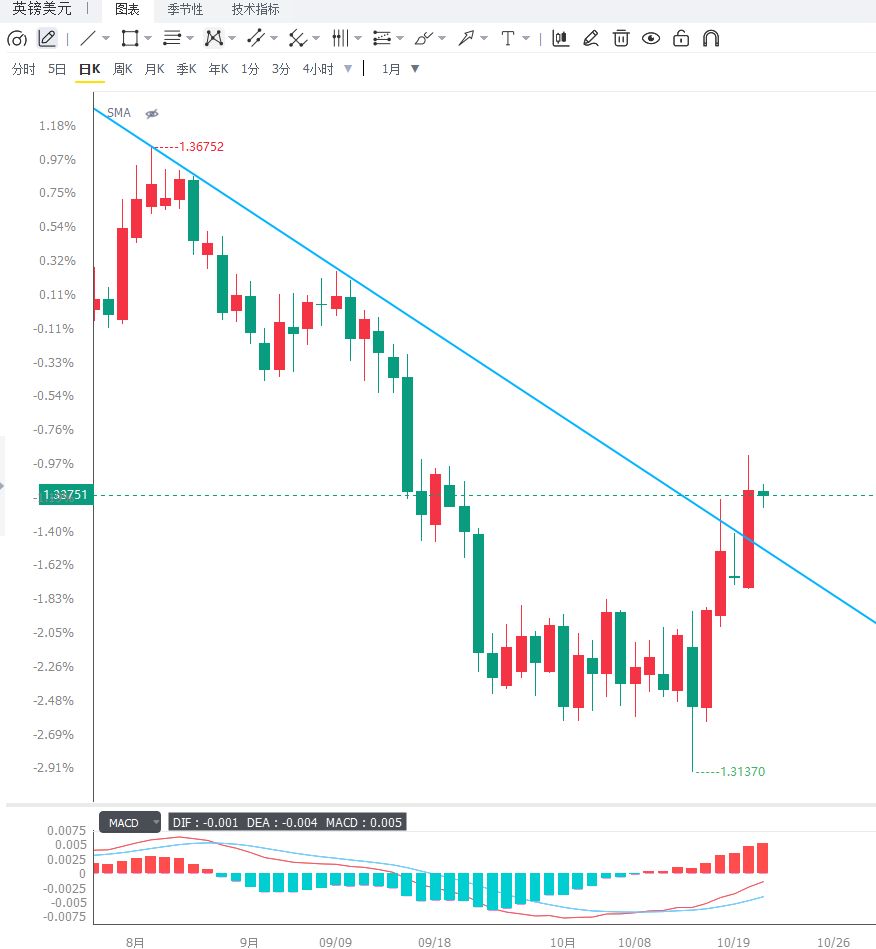 Editor's Summary: The core logic for the GBP/USD exchange rate in the short term lies in the support provided by the resilience of the UK labor market and expectations of interest rate hikes. This, coupled with resistance from the 100-day moving average and the resilience of the US dollar, creates a two-way dynamic, making the exchange rate more likely to consolidate within a narrow range of 1.3365-1.3390, awaiting a breakout based on data. Today's UK September CPI is the most critical risk event in the near term: if the overall figure accelerates in tandem with the core reading, Green's assessment of stalled wage deflation will be validated, and the pound could challenge 1.3390-1.3450; if the data is lower than expected, it may retrace to 1.3300-1.3255. In the medium term, excessive accumulation of short positions in the CFTC and year-end seasonal factors provide room for a reversal in the pound, but the fiscal discipline demonstrated in next week's autumn budget will determine whether this logic can materialize.
From a fundamental perspective, data released by the UK Office for National Statistics on Tuesday showed that the ILO unemployment rate fell to 4.7% in the three months to August, down from 4.9% in July, marking the lowest level in over a year. Despite a second consecutive month of decline in job vacancies, wage growth remained robust. Market analysis indicates a slight rebound in average private sector wage growth, which will bolster the confidence of hawkish members of the Bank of England's Monetary Policy Committee—who advocate for a rate hike now to avoid dealing with a second wave of effects later. Regarding the view held by some observers that the labor market is easing, market analysis points out that this judgment is mainly based on the 5.1% year-on-year decline in job vacancies, while both real and nominal wages remained stable. Furthermore, feedback from the UK Office for National Statistics' job vacancies survey suggests that "small businesses may stop hiring due to rising labor costs," highlighting the persistence of wage pressures. Combined with the backdrop of oil prices rising to their highest level since May, the market expects the Bank of England to have almost no reason to pause and anticipates a rate hike to 4% in November. According to LSEG data, the market has now almost fully priced in a 25 basis point rate hike at the November 5th meeting. A more forward-looking catalyst comes from today's inflation data. Economists expect the UK's overall CPI to rise 3.4% year-on-year in September, while core CPI will rise 2.7%. If the actual reading is close to or higher than expected, it will provide further confirmation of the interest rate hike path and provide a second boost to the pound; conversely, if the data is significantly lower than expected, it may weaken the interest rate advantage and trigger profit-taking. It is worth noting that price action suggests that the accumulation of CFTC short positions has been excessive, and the pound may gain demand due to short covering. Furthermore, if the bullish year-end seasonal factors following the autumn budget are re-established, the pound will receive additional support. Historically, investors typically reduce their holdings of the pound against G10 currencies before the budget, but this year's stronger macroeconomic backdrop and the Bank of England's outlook are giving the pound a slight advantage against the dollar and the euro. This also means that the biggest one-sided risk this week also comes from next week's autumn budget—if fiscal discipline falls short of expectations, pressure on long-term interest rates could quickly offset the support from the interest rate hike. Policy communication has also released hawkish signals. Green's recent remarks received a 7.4/10 rating, in line with the historical average, but her emphasis on stagnant wage deflation and the increased risk of a second round of inflation showed a clear hawkish bias. Forward-looking data points to wage growth near 3.5%, and wage levels still above the 2% inflation level, reinforcing the central bank's rationale for proactively addressing inflation stickiness. She also pointed out that the economy has shown unexpected resilience, and labor market slack may have peaked, indicating limited downside risks to growth and insufficient to constrain policy space. For the pound, this combination of resilient economic activity, a tight labor market, and concerns about a second round of inflation excludes the possibility of rapid easing and supports a more determined interest rate path than previously priced in by the market. The logic on the US side, however, creates a reverse pull. Last week's data showed that US CPI accelerated in September, but Fed Chairman Warsh explicitly stated that he would not "predict" interest rate decisions, giving no clear signal on whether the October meeting would raise rates or remain unchanged. This combination of "uncertain direction and delayed timing" allows the dollar's interest rate advantage to continue, while avoiding a risk-averse reversal triggered by excessive hawkishness. For GBP/USD, this means upside potential will be limited by the resilience of the dollar: support for the pound comes from verifiable data, while resistance for the dollar stems from undecided policy statements. This convergence suggests the exchange rate is more likely to fluctuate within a range rather than experience a smooth, one-sided breakout. On the daily chart, GBP/USD has just broken above the upper Bollinger Band, suggesting a possible short-term extension of the latest rebound; however, the price remains constrained by the 100-day simple moving average. Until this resistance is broken, the overall bias remains bearish. The RSI is around 56, with improved momentum indicating that buyers are accumulating strength. However, the resistance from the 100-day moving average suggests that upside potential is limited unless a clearer breakout occurs. The first resistance level is around 1.3390, near the 100-day moving average. A daily close above this level is needed to alleviate the current bearish pressure and open up space for a more sustained recovery. The next levels to watch are 1.3450 and the psychological level of 1.3500. Support levels are seen at the upper Bollinger Band around 1.3365, the middle Bollinger Band around 1.3255, and the lower Bollinger Band around 1.3150. These levels may attract renewed buying interest during a deeper pullback. On the 4-hour chart, the price is consolidating in a narrow range between 1.3360 and 1.3400. Short-term moving averages are converging, and the MACD histogram is close to the zero line, indicating neutral momentum. If the price retraces to 1.3365-1.3370 and finds support, there is still a chance for a short-term upward move towards 1.3390-1.3400. If the price breaks below 1.3350 with significant volume, it may seek support at 1.3300 or even 1.3255. An upward breakout requires the release of today's UK CPI data and next week's budget announcement. Until then, a range-bound trading strategy is advisable, avoiding chasing highs and lows. Editor's Summary: The core logic for the GBP/USD exchange rate in the short term lies in the support provided by the resilience of the UK labor market and expectations of interest rate hikes. This, coupled with resistance from the 100-day moving average and the resilience of the US dollar, creates a two-way dynamic, making the exchange rate more likely to consolidate within a narrow range of 1.3365-1.3390, awaiting a breakout based on data. Today's UK September CPI is the most critical risk event in the near term: if the overall figure accelerates in tandem with the core reading, Green's assessment of stalled wage deflation will be validated, and the pound could challenge 1.3390-1.3450; if the data is lower than expected, it may retrace to 1.3300-1.3255. In the medium term, excessive accumulation of short positions in the CFTC and year-end seasonal factors provide room for a reversal in the pound, but the fiscal discipline demonstrated in next week's autumn budget will determine whether this logic can materialize.
- Risk Warning and Disclaimer
- The market involves risk, and trading may not be suitable for all investors. This article is for reference only and does not constitute personal investment advice, nor does it take into account certain users’ specific investment objectives, financial situation, or other needs. Any investment decisions made based on this information are at your own risk.