High oil prices and safe-haven demand have supported the dollar index, which has rebounded to around 101.80 and is consolidating.
2026-10-21 14:42:20
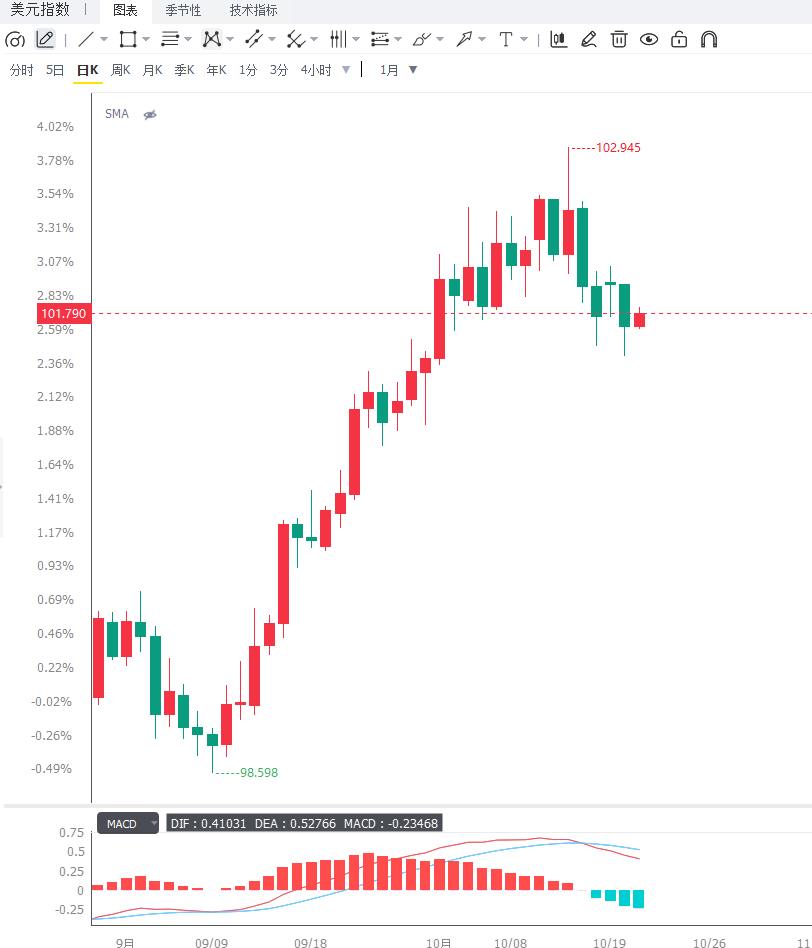
On Wednesday during Asian trading hours, the US dollar index continued its moderate upward trend, trading around 101.80, further rising from the close of the previous trading day. The core contradiction currently facing the index lies in the fact that geopolitical premiums and safe-haven demand in the energy sector provide a floor, while the Federal Reserve's policy mix of "uncertain path and delayed timing" limits upside potential. This, coupled with the possibility that volatility in technology stocks may weaken the dollar's appeal driven by the AI growth narrative, results in a three-way consolidation pattern where the index "can rise, but not rise far."  Geopolitical risks on the supply side are the main external driver of the current dollar strengthening. Oil traders are carefully assessing the mixed signals from US-Iran diplomatic contacts: although negotiations are still underway, after Pakistani Army Chief of Staff Munir met with senior Iranian diplomatic and military officials in Tehran, diplomats involved in the discussions clarified that efforts to end the conflict are ongoing, and reports of a "final agreement imminent" are premature. This intermediate state of "negotiations in progress, agreement not yet finalized" is precisely the scenario most difficult for the market to price – it is neither sufficient to disprove the risk of supply disruptions nor to provide a clear path to easing tensions. In the past two weeks, at least 18 merchant ships have been attacked in the Strait of Hormuz, pushing Brent crude to a multi-month high of $111.2. High oil prices have pushed up global inflation readings through the cost channel, reinforcing the rationale for major central banks to maintain high interest rates, thereby raising the central level of real interest rates. For the dollar, this means that the interest rate advantage continues; but it also means that if energy costs ultimately suppress global demand, the dollar's safe-haven status will face a more complex test. At the monetary policy level, market pricing is undergoing a subtle shift. According to the CME Group's FedWatch tool, traders are currently pricing in an 83.9% probability that the Federal Reserve will keep interest rates unchanged next week, while pricing in a rate hike at the December meeting at approximately 90%. Chairman Warsh explicitly stated that he would not "predict" interest rate decisions and did not provide a clear signal regarding the October meeting. This combination puts the dollar in an awkward middle ground: the year-end tightening expectation has not been disproven, providing a bottom support for the index; however, the lack of new hawkish catalysts in the short term makes the rise lack smoothness. Historically, the dollar only begins a trending market when the tightening path in December is substantially confirmed or disproven by data; before that, any rumors may trigger impulsive fluctuations. It is worth noting the potential for a reverse pull from within the asset class. A deep correction in the technology sector could become an additional headwind for the dollar, as the AI construction boom dominates the US growth and inflation narrative. Any sustained pressure on the technology sector could shake one of the key themes supporting the dollar, thereby reinforcing the overall weaker dollar profile. The logic behind this judgment is that the resilience of the US dollar in this round is partly based on the expectation of growth driven by "American exceptionalism" and AI capital expenditure. Once the leading technology companies experience a systemic correction, the contraction of risk appetite will simultaneously weaken the dollar's yield advantage and the motivation for capital inflows. Combined with the Fed's sentiment index remaining at a high level of 127.51 (far above the neutral benchmark), and Warsh's speech score of only 5.6/10 (slightly below the historical average of 6.1/10), it can be seen that while the policy narrative remains hawkish, the communication is becoming more moderate—this combination of "hawkish stance and soft tone" is precisely what makes the dollar most likely to fluctuate repeatedly within a range. From the perspective of global market linkages, the current fluctuations in the dollar index are essentially a superposition of three factors: first, safe-haven buying driven by Middle East shipping disruptions and rising energy prices; second, the passive weakening of the euro due to political turmoil in France (the Franco-German interest rate differential remains high at around 150 basis points) and European political uncertainty, which directly pushes up the dollar index in terms of weight; and third, the high level of the US-Japan interest rate differential against the backdrop of the yen's trade deficit and a surge in crude oil imports, further contributing to the index's rise. In other words, the dollar's strength stems more from the structural weakness of non-US currencies than from a strong improvement in its own fundamentals. This kind of rise driven by opposing forces often lacks sustainability; once the situation in France calms down or the Bank of Japan signals further tightening, the index's support could quickly weaken. On the daily chart, the dollar index is trading above its 20-day exponential moving average, with short-term moving averages in a bullish alignment, indicating that the rebound structure since last month's lows remains intact. The RSI is around 55, above the 50 neutral line and not yet in overbought territory, showing a moderate release of upward momentum rather than excessive extension—a typical "bullish trend but nearing resistance" pattern. The first resistance level is around 102.40, the previous support level, followed by the psychological level of 103.00 and 103.50. Only a decisive break above 102.40 on the daily chart can confirm the opening of medium-term upside potential. Support levels to watch are 101.20, 100.80, and the psychological level of 100.00. 101.20 is a key support level in the near term; a break below this level could lead to a pullback to 100.80 or even lower. On the 4-hour chart, the index has been consolidating slowly along the short-term moving average after falling from around 102.00. The MACD histogram is close to the zero line, with the fast and slow lines repeatedly intertwined, indicating neutral momentum. Currently, the price is oscillating narrowly between 101.60 and 102.00. If it finds support at 101.50-101.60, there is still a chance for a short-term retest of the 102.00-102.40 resistance zone. However, a break below 101.40 with significant volume could lead to a test of 101.00 or even 100.80 for support. An upward breakout requires confirmation from US inflation data and developments in geopolitical tensions. Until then, a range-bound trading strategy is advisable, avoiding chasing highs and lows.
 Editor's Summary: The core logic for the US dollar index in the short term lies in the bottom support provided by geopolitical risk premiums and safe-haven demand. However, the uncertainty surrounding the Fed's policy path and the headwinds on technology stocks are compressing the upside potential. The combined effect of these two factors suggests the index is more likely to fluctuate within the 101.20-102.40 range. Three key variables need to be monitored going forward: first, the situation regarding passage through the Strait of Hormuz and the direction of oil prices, which directly determine the duration of inflation expectations and safe-haven sentiment; second, the final confirmation of the Fed's year-end policy path—whether the probability of a December rate hike remains above 90% will be crucial to the medium-term direction of the dollar; and third, the performance of the technology sector—if the AI narrative suffers a substantial blow, the key supporting theme for the dollar will be weakened. In the medium term, before a significant breakout from the current range, the index will maintain a slightly bullish, oscillating pattern. Confirmation of the trend direction still requires the release of inflation data and clarification of non-US currency risks.
Geopolitical risks on the supply side are the main external driver of the current dollar strengthening. Oil traders are carefully assessing the mixed signals from US-Iran diplomatic contacts: although negotiations are still underway, after Pakistani Army Chief of Staff Munir met with senior Iranian diplomatic and military officials in Tehran, diplomats involved in the discussions clarified that efforts to end the conflict are ongoing, and reports of a "final agreement imminent" are premature. This intermediate state of "negotiations in progress, agreement not yet finalized" is precisely the scenario most difficult for the market to price – it is neither sufficient to disprove the risk of supply disruptions nor to provide a clear path to easing tensions. In the past two weeks, at least 18 merchant ships have been attacked in the Strait of Hormuz, pushing Brent crude to a multi-month high of $111.2. High oil prices have pushed up global inflation readings through the cost channel, reinforcing the rationale for major central banks to maintain high interest rates, thereby raising the central level of real interest rates. For the dollar, this means that the interest rate advantage continues; but it also means that if energy costs ultimately suppress global demand, the dollar's safe-haven status will face a more complex test. At the monetary policy level, market pricing is undergoing a subtle shift. According to the CME Group's FedWatch tool, traders are currently pricing in an 83.9% probability that the Federal Reserve will keep interest rates unchanged next week, while pricing in a rate hike at the December meeting at approximately 90%. Chairman Warsh explicitly stated that he would not "predict" interest rate decisions and did not provide a clear signal regarding the October meeting. This combination puts the dollar in an awkward middle ground: the year-end tightening expectation has not been disproven, providing a bottom support for the index; however, the lack of new hawkish catalysts in the short term makes the rise lack smoothness. Historically, the dollar only begins a trending market when the tightening path in December is substantially confirmed or disproven by data; before that, any rumors may trigger impulsive fluctuations. It is worth noting the potential for a reverse pull from within the asset class. A deep correction in the technology sector could become an additional headwind for the dollar, as the AI construction boom dominates the US growth and inflation narrative. Any sustained pressure on the technology sector could shake one of the key themes supporting the dollar, thereby reinforcing the overall weaker dollar profile. The logic behind this judgment is that the resilience of the US dollar in this round is partly based on the expectation of growth driven by "American exceptionalism" and AI capital expenditure. Once the leading technology companies experience a systemic correction, the contraction of risk appetite will simultaneously weaken the dollar's yield advantage and the motivation for capital inflows. Combined with the Fed's sentiment index remaining at a high level of 127.51 (far above the neutral benchmark), and Warsh's speech score of only 5.6/10 (slightly below the historical average of 6.1/10), it can be seen that while the policy narrative remains hawkish, the communication is becoming more moderate—this combination of "hawkish stance and soft tone" is precisely what makes the dollar most likely to fluctuate repeatedly within a range. From the perspective of global market linkages, the current fluctuations in the dollar index are essentially a superposition of three factors: first, safe-haven buying driven by Middle East shipping disruptions and rising energy prices; second, the passive weakening of the euro due to political turmoil in France (the Franco-German interest rate differential remains high at around 150 basis points) and European political uncertainty, which directly pushes up the dollar index in terms of weight; and third, the high level of the US-Japan interest rate differential against the backdrop of the yen's trade deficit and a surge in crude oil imports, further contributing to the index's rise. In other words, the dollar's strength stems more from the structural weakness of non-US currencies than from a strong improvement in its own fundamentals. This kind of rise driven by opposing forces often lacks sustainability; once the situation in France calms down or the Bank of Japan signals further tightening, the index's support could quickly weaken. On the daily chart, the dollar index is trading above its 20-day exponential moving average, with short-term moving averages in a bullish alignment, indicating that the rebound structure since last month's lows remains intact. The RSI is around 55, above the 50 neutral line and not yet in overbought territory, showing a moderate release of upward momentum rather than excessive extension—a typical "bullish trend but nearing resistance" pattern. The first resistance level is around 102.40, the previous support level, followed by the psychological level of 103.00 and 103.50. Only a decisive break above 102.40 on the daily chart can confirm the opening of medium-term upside potential. Support levels to watch are 101.20, 100.80, and the psychological level of 100.00. 101.20 is a key support level in the near term; a break below this level could lead to a pullback to 100.80 or even lower. On the 4-hour chart, the index has been consolidating slowly along the short-term moving average after falling from around 102.00. The MACD histogram is close to the zero line, with the fast and slow lines repeatedly intertwined, indicating neutral momentum. Currently, the price is oscillating narrowly between 101.60 and 102.00. If it finds support at 101.50-101.60, there is still a chance for a short-term retest of the 102.00-102.40 resistance zone. However, a break below 101.40 with significant volume could lead to a test of 101.00 or even 100.80 for support. An upward breakout requires confirmation from US inflation data and developments in geopolitical tensions. Until then, a range-bound trading strategy is advisable, avoiding chasing highs and lows. Editor's Summary: The core logic for the US dollar index in the short term lies in the bottom support provided by geopolitical risk premiums and safe-haven demand. However, the uncertainty surrounding the Fed's policy path and the headwinds on technology stocks are compressing the upside potential. The combined effect of these two factors suggests the index is more likely to fluctuate within the 101.20-102.40 range. Three key variables need to be monitored going forward: first, the situation regarding passage through the Strait of Hormuz and the direction of oil prices, which directly determine the duration of inflation expectations and safe-haven sentiment; second, the final confirmation of the Fed's year-end policy path—whether the probability of a December rate hike remains above 90% will be crucial to the medium-term direction of the dollar; and third, the performance of the technology sector—if the AI narrative suffers a substantial blow, the key supporting theme for the dollar will be weakened. In the medium term, before a significant breakout from the current range, the index will maintain a slightly bullish, oscillating pattern. Confirmation of the trend direction still requires the release of inflation data and clarification of non-US currency risks.
- Risk Warning and Disclaimer
- The market involves risk, and trading may not be suitable for all investors. This article is for reference only and does not constitute personal investment advice, nor does it take into account certain users’ specific investment objectives, financial situation, or other needs. Any investment decisions made based on this information are at your own risk.