Japan's trade deficit continued for five consecutive months, and a surge in crude oil imports put pressure on the yen, causing the USD/JPY pair to continue trading within a range.
2026-10-21 14:48:24
On Wednesday during Asian trading hours, the USD/JPY pair traded around 158.10, continuing its upward trend that began last week. The main driver of this exchange rate movement was the structural weakness of the yen: a widening trade deficit and rising energy import costs weakened the yen's current account support, while the USD/JPY interest rate differential remained high due to the Fed's hawkish narrative. These factors combined to make the exchange rate more likely to rise than fall.  Looking at trade data, Japan's Ministry of Finance released its September merchandise trade balance, showing a deficit of 536.6 billion yen. While this figure is significantly smaller than August's 1.1119 trillion yen, it greatly exceeded market expectations of 181 billion yen, marking the fifth consecutive month of trade deficit. Breaking it down, imports increased by 18.9% year-on-year, a slower pace than August's 28.0% and lower than the expected 19.6%, the slowest growth since May. Exports grew by 16.7%, also below the expected 20.1%, recording the slowest expansion in five months. Notably, despite the overall slowdown in import growth, crude oil imports surged by 51.1% year-on-year. This directly reflects Japan's increased procurement efforts to ensure energy security amid escalating geopolitical tensions in the Middle East—at least 18 merchant ships have been attacked in the Strait of Hormuz in the past two weeks, pushing Brent crude oil to a multi-month high of $111.2. The rigid rise in energy costs has not only eroded terms of trade but also compressed the Bank of Japan's policy space through imported inflation. This is the core reason why the yen has struggled to find substantial buying support during the current overall pullback in the US dollar. On the policy front, Japanese Finance Minister Katsunobu Kato stated on Wednesday that the government is maintaining close coordination with the Bank of Japan, and there are no major disagreements on inflation outlook and monetary policy. She also pointed out that while tax cuts will boost demand and push up prices, the government will ensure the implementation of an active and responsible fiscal policy, expanding supply capacity while avoiding accelerating inflation. The key implication of this statement is that the fiscal and monetary authorities have not shown any significant policy rift due to rising inflation, and the likelihood of supporting the yen through "verbal intervention" or fiscal tightening commitments in the short term is low. Combined with Bank of Japan Governor Kazuo Ueda's previous statement that potential inflation is "very close" to the 2% target, market expectations for further monetary tightening remain, but these expectations are more focused on a gradual approach, lacking a catalyst sufficient to quickly narrow the US-Japan interest rate differential. The logic on the US side is relatively clearer. Last week's September CPI rose 3.7% year-on-year, indicating persistent inflation stickiness. Federal Reserve Chairman Warsh explicitly stated he would not "predict" interest rate decisions, offering no clear signal on whether the October meeting would see a rate hike or remain on hold. According to the CME FedWatch tool, traders are currently pricing in a 16.1% probability of a 25 basis point rate hike at the October 27-28 meeting, while pricing in a December rate hike is over 90%, with most policymakers expecting at least one more rate hike this year. This combination of "clear direction, delayed timing" allows the dollar's interest rate advantage to continue while avoiding a reversal of risk aversion triggered by overly hawkish rhetoric. For USD/JPY, this is a relatively favorable macroeconomic environment: interest rate differentials provide bottom support, while stable risk appetite suppresses safe-haven buying of the yen. Warsh's recent speeches scored 5.6/10 on FXS Speechtracker, slightly below the historical average of 6.1/10, indicating a more moderate communication style than usual, but the overall tone remains constructive. He described himself as "too traumatized by the global financial crisis," highlighting his continued vigilance regarding financial stability despite emphasizing structural growth, surging investment, and the boosting effect of artificial intelligence on data and policy confidence. The FXS Fed Sentiment Index remained high at 127.51, well above the neutral benchmark, indicating that the overall policy narrative remains firmly hawkish. This means that despite the lack of incremental signals in his speech, policy support for the dollar has not weakened. As long as the index remains above 127 and the year-end tightening path is not disproven, the pullback in USD/JPY is more likely a technical correction than a trend reversal. From a global market perspective, the current USD/JPY movement is essentially a result of the transmission of the "energy cost—inflation—interest rate differential" chain. High oil prices, on the one hand, suppress the Bank of Japan's easing space through imported inflation, and on the other hand, reinforce the Fed's hawkish stance by pushing up US inflation readings. This two-way effect naturally favors the upward movement of USD/JPY. However, investors should be aware that if the situation in the Middle East deteriorates sharply, triggering a plunge in global risk appetite, the safe-haven appeal of the yen may be reactivated, thus exerting downward pressure on the exchange rate. Furthermore, political turmoil in France (widening the Franco-German interest rate differential to approximately 150 basis points) and European political uncertainty will also indirectly affect the short-term rhythm of the exchange rate through the US dollar index. On the daily chart, USD/JPY is trading above the 9-day exponential moving average and the 50-day EMA, with short-term moving averages in a bullish alignment, supporting the overall upward trend. The RSI is around 54, above the 50 neutral line and not yet in overbought territory, indicating a moderate release of upward momentum and room for further buying. Meanwhile, the high reading of the Federal Reserve sentiment index also provides a supportive backdrop for policy. Support levels to watch are the 9-day EMA at approximately 158.20, the 50-day EMA at approximately 158.08, and 157.50. These two moving averages together form a recent demand zone. As long as the price holds above this area, the technical bias favors further upward movement. However, if the daily candlestick closes below 158.08, it indicates a loss of momentum and a potential deeper pullback. Resistance levels to watch are 158.80, 159.50, and the psychological level of 160.00. 160.00 is both a psychological level and a previous area of dense trading; a decisive break above this level is needed to confirm the opening of medium-term upward potential. On the 4-hour chart, the exchange rate is consolidating in a narrow range between 158.10 and 158.60. Short-term moving averages are converging, and the MACD histogram is close to the zero line, indicating neutral momentum. If it retraces to 158.10-158.20 and finds support, there is still a chance for a short-term upward move towards 158.60-158.80. If it breaks below 158.00 with significant volume, it may seek support at 157.50 or even 157.00. An upward breakout would require a statement from the Bank of Japan or confirmation from US data.
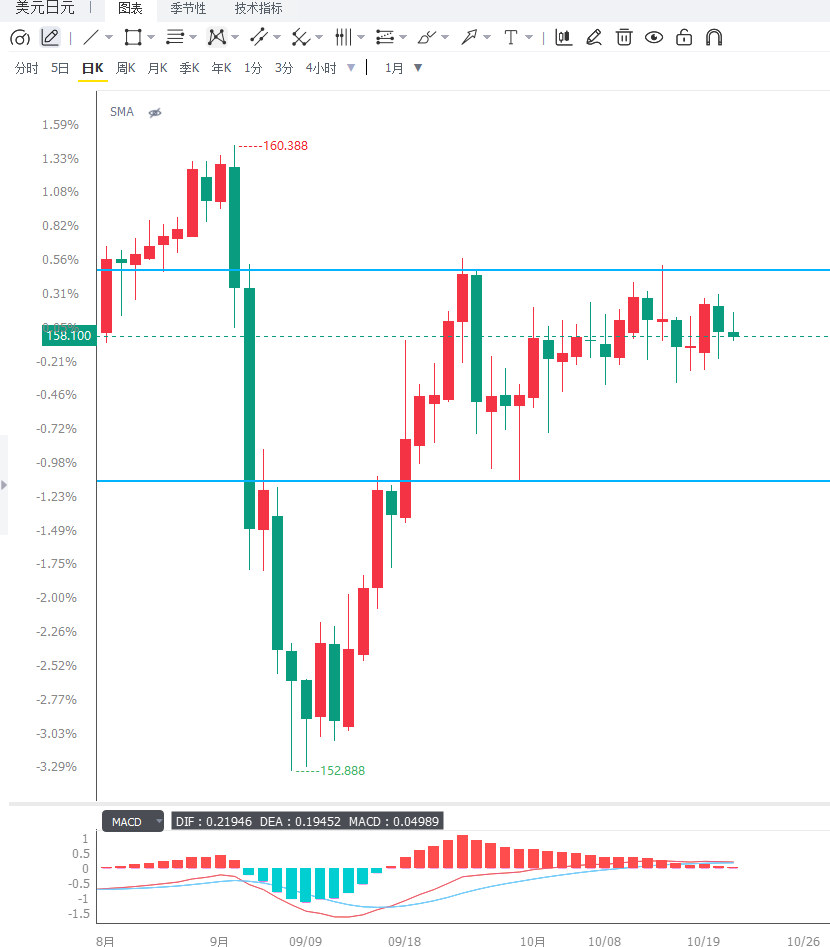 Editor's Summary : The core logic behind the USD/JPY exchange rate in the short term lies in the weakening of the yen due to Japan's trade deficit and rising energy costs, coupled with the Fed's hawkish narrative maintaining the USD/JPY interest rate advantage. This two-way driver gives the exchange rate a certain inertia for a bullish trend. Going forward, three key variables need to be monitored: first, the situation regarding passage through the Strait of Hormuz and the trend of oil prices, which directly determine the magnitude of imported inflation and trade pressures on Japan; second, the coordinated statements from the Bank of Japan and the Ministry of Finance. If Kazuo Ueda or Katsunobu Kato releases further tightening or intervention signals, the yen may rebound rapidly; and third, the final confirmation of the Fed's year-end policy path, which remains the key to the medium-term direction of the dollar. In the medium term, as long as the level above 158.08 is not effectively broken, the exchange rate is more likely to maintain a volatile but slightly bullish pattern. Confirmation of the trend still depends on the Bank of Japan's policy stance and the final clarity of the Fed's year-end interest rate hike path.
Looking at trade data, Japan's Ministry of Finance released its September merchandise trade balance, showing a deficit of 536.6 billion yen. While this figure is significantly smaller than August's 1.1119 trillion yen, it greatly exceeded market expectations of 181 billion yen, marking the fifth consecutive month of trade deficit. Breaking it down, imports increased by 18.9% year-on-year, a slower pace than August's 28.0% and lower than the expected 19.6%, the slowest growth since May. Exports grew by 16.7%, also below the expected 20.1%, recording the slowest expansion in five months. Notably, despite the overall slowdown in import growth, crude oil imports surged by 51.1% year-on-year. This directly reflects Japan's increased procurement efforts to ensure energy security amid escalating geopolitical tensions in the Middle East—at least 18 merchant ships have been attacked in the Strait of Hormuz in the past two weeks, pushing Brent crude oil to a multi-month high of $111.2. The rigid rise in energy costs has not only eroded terms of trade but also compressed the Bank of Japan's policy space through imported inflation. This is the core reason why the yen has struggled to find substantial buying support during the current overall pullback in the US dollar. On the policy front, Japanese Finance Minister Katsunobu Kato stated on Wednesday that the government is maintaining close coordination with the Bank of Japan, and there are no major disagreements on inflation outlook and monetary policy. She also pointed out that while tax cuts will boost demand and push up prices, the government will ensure the implementation of an active and responsible fiscal policy, expanding supply capacity while avoiding accelerating inflation. The key implication of this statement is that the fiscal and monetary authorities have not shown any significant policy rift due to rising inflation, and the likelihood of supporting the yen through "verbal intervention" or fiscal tightening commitments in the short term is low. Combined with Bank of Japan Governor Kazuo Ueda's previous statement that potential inflation is "very close" to the 2% target, market expectations for further monetary tightening remain, but these expectations are more focused on a gradual approach, lacking a catalyst sufficient to quickly narrow the US-Japan interest rate differential. The logic on the US side is relatively clearer. Last week's September CPI rose 3.7% year-on-year, indicating persistent inflation stickiness. Federal Reserve Chairman Warsh explicitly stated he would not "predict" interest rate decisions, offering no clear signal on whether the October meeting would see a rate hike or remain on hold. According to the CME FedWatch tool, traders are currently pricing in a 16.1% probability of a 25 basis point rate hike at the October 27-28 meeting, while pricing in a December rate hike is over 90%, with most policymakers expecting at least one more rate hike this year. This combination of "clear direction, delayed timing" allows the dollar's interest rate advantage to continue while avoiding a reversal of risk aversion triggered by overly hawkish rhetoric. For USD/JPY, this is a relatively favorable macroeconomic environment: interest rate differentials provide bottom support, while stable risk appetite suppresses safe-haven buying of the yen. Warsh's recent speeches scored 5.6/10 on FXS Speechtracker, slightly below the historical average of 6.1/10, indicating a more moderate communication style than usual, but the overall tone remains constructive. He described himself as "too traumatized by the global financial crisis," highlighting his continued vigilance regarding financial stability despite emphasizing structural growth, surging investment, and the boosting effect of artificial intelligence on data and policy confidence. The FXS Fed Sentiment Index remained high at 127.51, well above the neutral benchmark, indicating that the overall policy narrative remains firmly hawkish. This means that despite the lack of incremental signals in his speech, policy support for the dollar has not weakened. As long as the index remains above 127 and the year-end tightening path is not disproven, the pullback in USD/JPY is more likely a technical correction than a trend reversal. From a global market perspective, the current USD/JPY movement is essentially a result of the transmission of the "energy cost—inflation—interest rate differential" chain. High oil prices, on the one hand, suppress the Bank of Japan's easing space through imported inflation, and on the other hand, reinforce the Fed's hawkish stance by pushing up US inflation readings. This two-way effect naturally favors the upward movement of USD/JPY. However, investors should be aware that if the situation in the Middle East deteriorates sharply, triggering a plunge in global risk appetite, the safe-haven appeal of the yen may be reactivated, thus exerting downward pressure on the exchange rate. Furthermore, political turmoil in France (widening the Franco-German interest rate differential to approximately 150 basis points) and European political uncertainty will also indirectly affect the short-term rhythm of the exchange rate through the US dollar index. On the daily chart, USD/JPY is trading above the 9-day exponential moving average and the 50-day EMA, with short-term moving averages in a bullish alignment, supporting the overall upward trend. The RSI is around 54, above the 50 neutral line and not yet in overbought territory, indicating a moderate release of upward momentum and room for further buying. Meanwhile, the high reading of the Federal Reserve sentiment index also provides a supportive backdrop for policy. Support levels to watch are the 9-day EMA at approximately 158.20, the 50-day EMA at approximately 158.08, and 157.50. These two moving averages together form a recent demand zone. As long as the price holds above this area, the technical bias favors further upward movement. However, if the daily candlestick closes below 158.08, it indicates a loss of momentum and a potential deeper pullback. Resistance levels to watch are 158.80, 159.50, and the psychological level of 160.00. 160.00 is both a psychological level and a previous area of dense trading; a decisive break above this level is needed to confirm the opening of medium-term upward potential. On the 4-hour chart, the exchange rate is consolidating in a narrow range between 158.10 and 158.60. Short-term moving averages are converging, and the MACD histogram is close to the zero line, indicating neutral momentum. If it retraces to 158.10-158.20 and finds support, there is still a chance for a short-term upward move towards 158.60-158.80. If it breaks below 158.00 with significant volume, it may seek support at 157.50 or even 157.00. An upward breakout would require a statement from the Bank of Japan or confirmation from US data. Editor's Summary : The core logic behind the USD/JPY exchange rate in the short term lies in the weakening of the yen due to Japan's trade deficit and rising energy costs, coupled with the Fed's hawkish narrative maintaining the USD/JPY interest rate advantage. This two-way driver gives the exchange rate a certain inertia for a bullish trend. Going forward, three key variables need to be monitored: first, the situation regarding passage through the Strait of Hormuz and the trend of oil prices, which directly determine the magnitude of imported inflation and trade pressures on Japan; second, the coordinated statements from the Bank of Japan and the Ministry of Finance. If Kazuo Ueda or Katsunobu Kato releases further tightening or intervention signals, the yen may rebound rapidly; and third, the final confirmation of the Fed's year-end policy path, which remains the key to the medium-term direction of the dollar. In the medium term, as long as the level above 158.08 is not effectively broken, the exchange rate is more likely to maintain a volatile but slightly bullish pattern. Confirmation of the trend still depends on the Bank of Japan's policy stance and the final clarity of the Fed's year-end interest rate hike path.
- Risk Warning and Disclaimer
- The market involves risk, and trading may not be suitable for all investors. This article is for reference only and does not constitute personal investment advice, nor does it take into account certain users’ specific investment objectives, financial situation, or other needs. Any investment decisions made based on this information are at your own risk.