Dual Straits Alert: The Strait of Hormuz remains closed, and the Bab el-Mandeb Strait is now under emergency. Will the world's energy lifeline be cut off at the same time?
2026-10-21 15:18:22
Geopolitical risks in the Middle East are spreading from a single chokepoint to multiple maritime lifelines. Since the outbreak of the Iran-Iraq War, the Strait of Hormuz has been the most sensitive observation point for the global energy market. In recent weeks, the international community's attention has turned to the Bab el-Mandeb Strait, which connects the Red Sea and the Indian Ocean. These two channels carry different but equally crucial oil, gas, and commodity trade. If risks overlap, energy prices, shipping security, and global supply chains could all face greater pressure. 
 (Brent crude oil daily chart, source: FX678) According to media reports, at the HSBC Future Forum in Dubai on Tuesday, Al-Hadi stated that the disruption is prompting Gulf states to accelerate investment in alternative logistics infrastructure, particularly pipelines connecting energy production facilities and export ports outside the Strait of Hormuz. He believes such investments could significantly reduce the region's dependence on the Strait of Hormuz within the next five years. Al-Hadi stated at the forum that the region's ability to recover and continue developing will require substantial investment; while there is hope and expectation for a resolution to the conflict, the Strait of Hormuz may become redundant in five years. His remarks suggest a potential long-term transformation in the Gulf region's energy infrastructure, with governments seeking to diversify export routes and strengthen supply chains to withstand future geopolitical instability. Despite the significant capital expenditure required to develop alternative pipelines and port facilities, Al-Hadi expressed confidence in the region's ability to recover from conflict and maintain economic growth.
The shadow of a potential blockade of the Strait of Hormuz has not yet dissipated.
Since the outbreak of the Iran-Iraq War, the world's attention has been focused on a key point on the map: the Strait of Hormuz. As of February, approximately 25% of global oil and gas shipments passed through this sea route. Now, due to Tehran's blockade in response to the military actions of the United States and Israel, very few ships pass through the route. This change not only exposes the vulnerability of the Strait of Hormuz in global energy transport but also fuels market concerns about supply disruptions in the Middle East. Reports indicate that the Strait of Hormuz previously handled about one-fifth of global oil and liquefied natural gas trade, and its passage directly impacts crude oil prices, shipping insurance, and the supply security of energy-importing countries.The Bab el-Mandeb Strait has become a new focal point of conflict.
In recent weeks, international attention has shifted to another conflict zone in the Middle East: the Bab el-Mandeb Strait. This strategic waterway, connecting the Red Sea and the Indian Ocean, carries 12% to 15% of global trade. Now, it is also threatened by the advance of the Houthi rebels in Yemen. The Houthis, an Iranian-backed Shiite militia, launched a lightning offensive within Yemen, seizing key territories including the port of Mocha and Perim Island, thus gaining control of the Bab el-Mandeb Strait. However, the Houthis have not yet fully secured control of the strait, as the Saudi-backed Yemeni government forces have launched a counter-offensive. Nevertheless, it is not impossible for them to eventually gain control of this vital maritime passage. In fact, during the 2023 Gaza War, the militia launched several attacks on merchant ships in protest against Israeli military action, jeopardizing navigation in the Bab el-Mandeb Strait.Houthi deterrence tactics and fog of objectives
If the Houthis successfully consolidate their control of the Bab el-Mandeb Strait, the impact on international finance could be catastrophic. The threat of the strait's closure would exacerbate the already volatile energy markets severely affected by the strait blockade. Similar to Iran's situation in the Strait of Hormuz, the Houthis do not require a large-scale military deployment to disrupt traffic in the Bab el-Mandeb Strait; they can maintain a sustained and effective threat using only missiles and drones. Currently, the Houthis claim their sole target is Saudi Arabian vessels, attacking Saudi Arabia because of its support for the Yemeni government. However, the actions of this militia are unpredictable. If war with Iran breaks out again, the Houthis may take aggressive action in the region, as this Yemeni guerrilla group is a staunch ally of Tehran. The situation is volatile, and anything can happen; whether the United States will ultimately become involved in the conflict remains to be seen. Currently, the United States has deliberately maintained a distance, which has greatly disappointed Saudi Arabia. Given the current inability to contain the insurgents, many analysts fear the worst-case scenario.A long-term shift is occurring in energy markets and alternative routes.
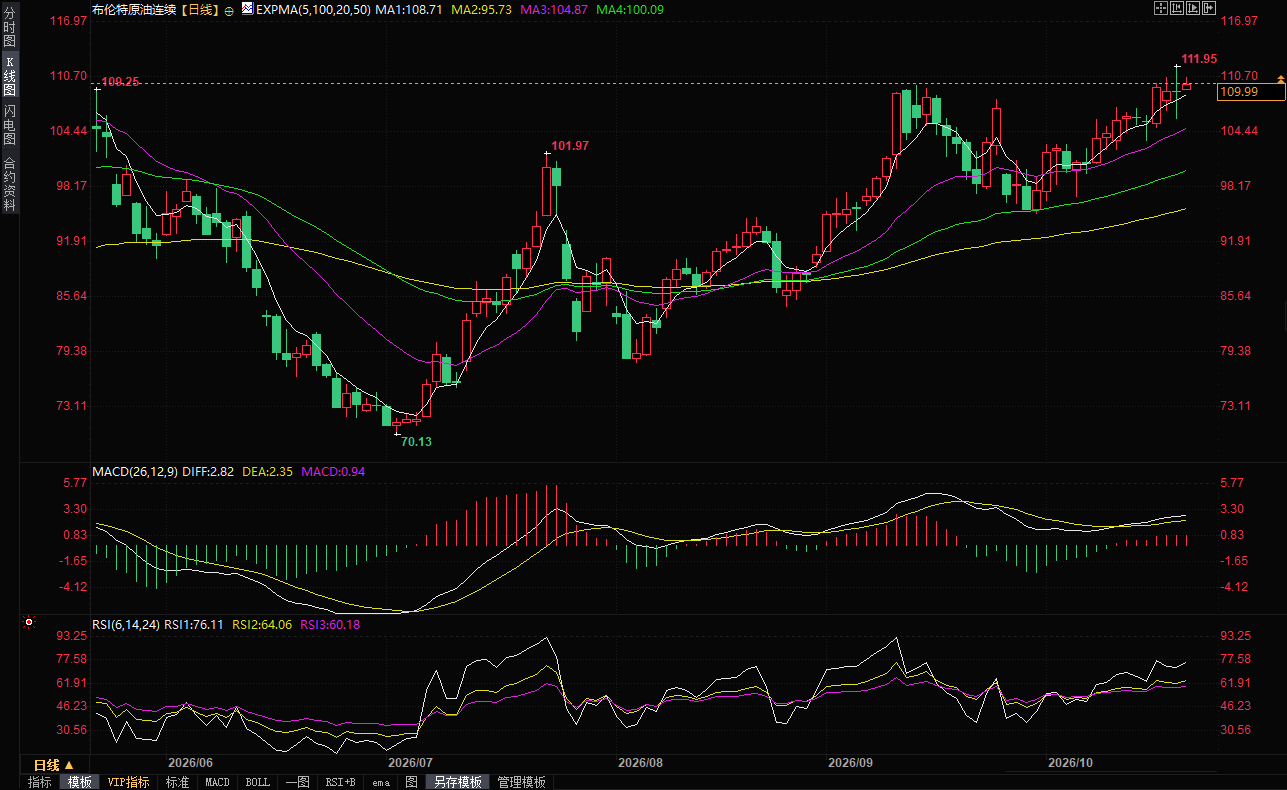
Amid renewed supply concerns, HSBC CEO George El-Hadi stated that the Strait of Hormuz could become redundant within five years as Gulf states accelerate investment in alternative energy export routes following the Iran-Iraq war. Meanwhile, Brent crude oil prices were at $110 a barrel this week on Wednesday, after hitting a five-month high of $111.95 a barrel on Tuesday. In Asian trading on Wednesday (October 21), Brent crude was trading around $110 a barrel, up about 0.8%; West Texas Intermediate crude was trading around $98.88 a barrel, up about 1%. Traders are weighing the growing risks to Middle Eastern energy supplies, Red Sea shipping, and Saudi Arabian oil infrastructure. The latest gains reflect the continued uncertainty surrounding energy transport in the Gulf region, with the conflict exposing the vulnerability of the Strait of Hormuz. (Brent crude oil daily chart, source: FX678) According to media reports, at the HSBC Future Forum in Dubai on Tuesday, Al-Hadi stated that the disruption is prompting Gulf states to accelerate investment in alternative logistics infrastructure, particularly pipelines connecting energy production facilities and export ports outside the Strait of Hormuz. He believes such investments could significantly reduce the region's dependence on the Strait of Hormuz within the next five years. Al-Hadi stated at the forum that the region's ability to recover and continue developing will require substantial investment; while there is hope and expectation for a resolution to the conflict, the Strait of Hormuz may become redundant in five years. His remarks suggest a potential long-term transformation in the Gulf region's energy infrastructure, with governments seeking to diversify export routes and strengthen supply chains to withstand future geopolitical instability. Despite the significant capital expenditure required to develop alternative pipelines and port facilities, Al-Hadi expressed confidence in the region's ability to recover from conflict and maintain economic growth.Shipping security risks are escalating in tandem with US-Israel negotiations.
Meanwhile, new incidents involving merchant ships highlight the ongoing security risks in the Strait of Hormuz region. According to Iranian media reports, the Iranian Revolutionary Guard Navy stated on Tuesday that a supertanker caught fire after striking a mine south of the island of Hormuz, allegedly in violation of Iranian regulations. This incident comes amid a series of attacks on merchant ships in the region. Ship tracking company Kpler reported on Monday that at least 18 ship attacks have been reported in the past two weeks. These latest developments come as Washington and Israel continue high-level consultations on Iran. Three Israeli officials stated that US Defense Secretary Peter Hegses discussed Iran with Israeli Prime Minister Benjamin Netanyahu during a surprise visit to Israel on Monday. Netanyahu's spokesman, Doron Spilman, later confirmed that the two leaders met at the Ufda Air Base in the Negev Desert in southern Israel. Overall, the shadow of a potential blockade of the Strait of Hormuz has not yet dissipated, and the Bab el-Mandeb Strait has become a new point of risk due to the advance of the Houthi rebels. The combined risks of these two maritime routes could further drive up energy prices, increase shipping insurance costs, and exacerbate uncertainty in global supply chains. The key to the future situation lies in whether the Houthis can consolidate their control of the Bab el-Mandeb Strait, the progress of alternative pipeline and port facilities construction in the Gulf states, whether the United States will change its deliberate distancing stance, and whether US-Israel consultations can create room for de-escalation on the Iranian issue. Against the backdrop of a highly volatile situation, any unforeseen event could become a new variable affecting markets and regional security.Frequently Asked Questions
Q: Why is the Bab el-Mandeb Strait considered the next Strait of Hormuz? A: The Bab el-Mandeb Strait connects the Red Sea and the Indian Ocean, carrying 12% to 15% of global trade, and is a vital shipping route for Eurasian energy transport. The Strait of Hormuz is already severely congested due to its blockade, and the Bab el-Mandeb Strait is threatened by the Houthi advance. The combined risks of these two vital waterways have made it a new high-risk node. Q: Has the Houthi rebels completely controlled the Bab el-Mandeb Strait? A: Reports indicate that the Houthis have seized key territories such as Moka and Perim Island, gaining some control of the strait, but not complete control. The Saudi-backed Yemeni government forces have launched a counter-offensive, so control of the strait remains uncertain, although it is not impossible for the Houthis to eventually gain control of this crucial passage. Q: What will happen to oil prices and financial markets if the Bab el-Mandeb Strait is controlled? A: The threat of closing the Bab el-Mandeb Strait will exacerbate the already volatile energy market, which is affected by the Hormuz blockade. Brent crude has broken through $110 per barrel, and WTI is approaching $100 per barrel. Shipping insurance, supply chain costs, and inflation expectations are all likely to rise, and the impact on international finance could be severe. Q: Why did HSBC CEO say the Strait of Hormuz might be "redundant" in five years? A: HSBC Group CEO El-Hadi believes the conflict has prompted Gulf states to accelerate investment in alternative logistics infrastructure, especially pipelines connecting energy production facilities to export ports outside the Strait. Such investments could significantly reduce dependence on the Strait of Hormuz within five years, but require substantial capital expenditure and depend on the region's recovery. Q: What do the US-Israel consultations mean? A: US Defense Secretary Hergesse's surprise visit to Israel to discuss Iran with Netanyahu indicates that Washington and Israel are maintaining high-level coordination on the Iranian situation. However, the US's previous deliberate distancing from the conflict disappointed Saudi Arabia. Whether the consultations signify deeper US involvement remains to be seen. At 15:15 Beijing time, Brent crude oil was trading at $110.07 per barrel.- Risk Warning and Disclaimer
- The market involves risk, and trading may not be suitable for all investors. This article is for reference only and does not constitute personal investment advice, nor does it take into account certain users’ specific investment objectives, financial situation, or other needs. Any investment decisions made based on this information are at your own risk.