Rumors of US-Iran negotiations persist, oil prices fluctuate wildly, and attacks on oil tankers further raise risk premiums.
2026-10-21 17:08:20
On Wednesday (October 21), during the Asian and European sessions, international oil prices continued to rebound slightly. The previous trading day saw significant volatility, with prices rising and then falling back, driven entirely by news of Middle East mediation . Reports of a compromise settlement between the US and Iran emerging from Qatar and Pakistan, coupled with simultaneous US intervention signals in the Russia-Ukraine negotiations and on the diesel supply side, quickly eased market expectations, causing oil prices to fall from their highs. Subsequently, news refuted the claims of an imminent agreement; shortly after, a supertanker carrying over 2 million barrels of oil struck a mine and exploded in the southern Strait of Hormuz, leading to a reassessment of shipping risks and a renewed recovery in risk premiums, causing oil prices to rebound. 
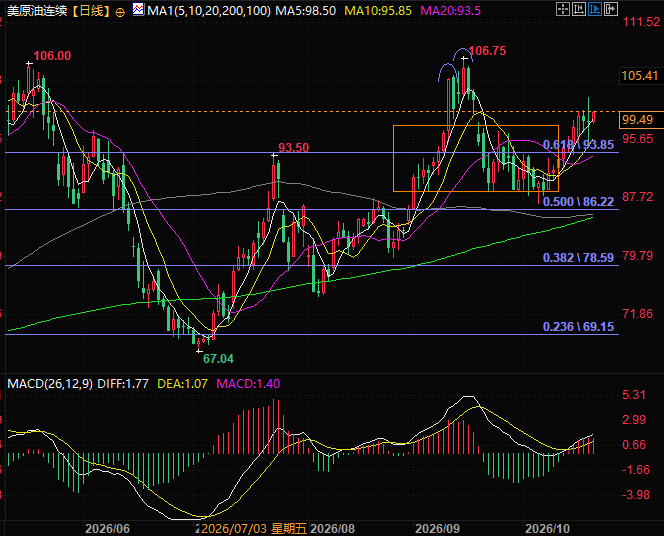 (WTI crude oil futures daily chart, source: EasyTrade) At 17:02 Beijing time, WTI crude oil futures are currently trading at $99.46 per barrel.
Spot market constraints: High freight and insurance premiums are unlikely to subside in the short term.
The core contradiction in the current crude oil spot market lies in the continuously rising shipping costs and war insurance premiums along the Gulf route. The premium stems from the uncertainty surrounding navigation security in the Strait of Hormuz. Only when the situation in the Middle East substantially eases and shipping certainty is restored will these additional costs systematically decline. In an environment of frequent attacks, shipowners have a strong desire to hedge, making the spot premium highly sticky. JPMorgan's commodities team suggests that the main market contradiction has shifted from a crude oil supply gap to transportation bottlenecks. Lloyd's of London marine insurance data shows a significant increase in war insurance rates along the Gulf route; Goldman Sachs estimates that current oil prices have already partially priced in the risk premium of short-term disruptions to shipping through the Strait of Hormuz. As long as attacks continue, freight and insurance costs will be embedded in spot prices.Key theme: Tight supply and demand balance in diesel, crack spread driving crude oil valuation.
Compared to crude oil, the supply-demand gap in diesel is the underlying theme of this round of price increases. Middle East ship attacks, the Russia-Ukraine conflict over energy infrastructure, and refineries delaying maintenance to maximize profits have all contributed to the surge in diesel prices, with the price increase consistently outpacing crude oil. Short-term easing measures focus on two areas: coordinated release of diesel reserves in Europe and a US-Russia agreement to ease diesel sanctions. If oil prices decline and geopolitical tensions ease, shipping and insurance costs will fall, creating conditions for diesel refineries to resume production. Morgan Stanley's Martijn Rats team predicts that even if direct supply disruptions from the war ease, the tight balance of refined oil products is likely to continue until mid-2027. By the second quarter of next year, refinery maintenance will result in a capacity loss of 3.4 million barrels per day, 2.5 times the normal level. Maintenance cannot be postponed indefinitely, making strong diesel cracking a key medium- to long-term trend. The IEA has also issued a warning that diesel inventory replenishment will be a lengthy process; Goldman Sachs points out that refining capacity faces hard constraints, requiring diesel prices to remain high to suppress end-user demand and prevent overcapacity.Forward market signals: Increased volume in distant-month contracts, market speculation on shale oil supply.
On the market front, trading volume in crude oil futures contracts for June next year is expected to increase significantly, with funds anticipating expectations of high oil prices driving North American shale oil production expansion. This potential increase is a key force suppressing a one-sided upward trend in oil prices in the medium to long term. EIA and shale oil tracking agencies analyze that the increased volume in longer-term contracts reflects market expectations of a recovery in capital expenditure, but the release of shale oil production capacity has a 6-12 month time lag, making it difficult to alleviate the tight spot market in the short term. BNY interprets this as follows: from a price perspective, the contango structure of near-month contracts strengthening due to geopolitical shocks and longer-term contracts weakening indicates that the market has not priced in long-term permanent supply losses, with longer-term contracts forming natural upward pressure.Trading Tracking Anchor: Two main lines run in parallel; crude oil should not be viewed in isolation.
The short-term market focus is on the diplomatic negotiations between the US and Iran. Closed-door mediation between Qatar and Pakistan continues, but public information on these negotiations is scarce. The key observation is whether the mediators can come up with a compromise that balances the bottom lines and demands of both sides. Currently, significant differences exist: Iran insists on seven preconditions and the retention of nuclear materials within its borders; the US demands that Iran significantly reduce its uranium enrichment capacity, making a consensus difficult to reach. Meanwhile, crude oil pricing cannot be assessed in isolation from diesel: a stronger crack spread indicates stable refinery demand for crude oil, supporting the price floor; however, if diesel supply eases and crack spreads weaken, the upside potential for crude oil will be limited. Leading traders generally agree that the current market pricing anchor has shifted to diesel crack spreads, and a weakening crack spread will directly drag down refinery demand for crude oil and crude oil valuations. Institutions warn that the conflicting preconditions between the US and Iran mean that negotiations are likely to be protracted and difficult, making a comprehensive agreement unlikely in one step. A window of opportunity for easing tensions, with temporary ceasefires and partial concessions, is more probable.Additional Risks and Cross-Asset Interactions: Reserves Bottoming Out, US Treasury Constraints Worth Noting
US strategic petroleum reserves have fallen to a 44-year low, significantly narrowing policy buffer space. Citigroup's cross-asset model suggests that a trend of declining oil prices is a necessary prerequisite for US Treasury yields to peak and decline. Given the normalization of geopolitical risks, betting solely on oil or US Treasuries is too aggressive; a neutral wait-and-see approach is a more prudent choice. In addition, the Russia-Ukraine ceasefire negotiations, the UK's provision of urban defense patrols to Saudi Arabia, and the ongoing Houthi attacks are all secondary disturbances that will intermittently affect risk appetite. Overall, trading should prioritize two key indicators: the progress of US-Iran negotiations and marginal changes in diesel supply. Citigroup's quantitative cross-asset team stated that a neutral stance on US Treasuries should be maintained until oil prices and inflation expectations trend downwards, and blindly going long is not advisable. The EIA also warned that the SPR buffer space is limited, and the policy's ability to support the market will be significantly weakened should another supply shock occur.Summary and Technical Analysis:
In terms of trading, institutions believe that the US-Iran negotiations are in a closed-door state, with alternating true and false news amplifying intraday volatility. The market exhibits a "predictions first, then disproven" characteristic, making a range-bound trading strategy more suitable in the short term, and avoiding chasing highs and lows. This aligns with previous assessments of the US-Iran situation: rising oil prices cause concern for the US, while falling prices cause concern for Iran. Currently, the US is more concerned, while Iran holds the upper hand. Breakwave Advisors adds that the ongoing attack on ships in the Strait of Hormuz continues to push up the call premium for options, indicating that geopolitical tail risks have not been cleared, and rumors remain the core source of short-term oil price volatility. Technically, international oil prices have recently experienced significantly increased intraday volatility, showing a huge divergence between bulls and bears. The long upper shadow of the previous trading day may be a false breakout; pay attention to the 5-day moving average, a break below which would trigger a reversal of the upward trend. (WTI crude oil futures daily chart, source: EasyTrade) At 17:02 Beijing time, WTI crude oil futures are currently trading at $99.46 per barrel.
- Risk Warning and Disclaimer
- The market involves risk, and trading may not be suitable for all investors. This article is for reference only and does not constitute personal investment advice, nor does it take into account certain users’ specific investment objectives, financial situation, or other needs. Any investment decisions made based on this information are at your own risk.