The upward momentum of WTI and Brent crude oil prices is waning.
2026-10-21 18:06:20
On Wednesday (October 21), during the European session, WTI crude oil was trading at $99.44 per barrel, up 1.66%. Brent crude oil was trading at $110.32 per barrel, up 1.14%. West Texas Intermediate (WTI) and Brent crude oil had previously experienced a significant surge. Looking at the WTI daily chart, oil prices rose to $101.37 before encountering resistance and falling back, finding resistance below the previous September high of $106.75. The appearance of a long upper shadow candlestick at the high, coupled with the RSI indicator approaching overbought territory and cautious investor sentiment, all suggest that the risk of a price correction is accumulating.  WTI and Brent Crude Oil: Upward Momentum Fades After Encountering Resistance Two weeks ago, the market anticipated a rebound in crude oil prices, suggesting a potential recovery from support levels. At that time, oil prices had fallen for three consecutive weeks, with WTI holding above the $86.86 low and stabilizing around the mid-to-long-term moving averages; Brent crude had also broken out of its downward correction channel. Two weeks later, both types of crude oil have seen substantial rebounds. However, from a technical analysis perspective, the market is now questioning whether oil prices can maintain their upward momentum. If supply disruptions recur in the Middle East or elsewhere, oil prices still have the potential to surge rapidly, as geopolitical conflicts remain the most explosive external driver of oil prices. If the market experiences another supply disruption (especially a sudden event in the Middle East), oil prices could certainly continue to rise; however, the market also believes that, in the absence of new positive catalysts, crude oil is currently in overbought territory. Even though shorting crude oil carries higher risks, bullish traders should at least heed these warning signs, remain cautious, and avoid chasing the already significant upward move—unless a sufficiently strong bullish driver emerges. Continuing to chase rallies in an overbought environment will significantly worsen the risk-reward ratio. If the market reverses, long positions entered at higher levels will face rapid unrealized losses. WTI and Brent crude oil technical outlook.
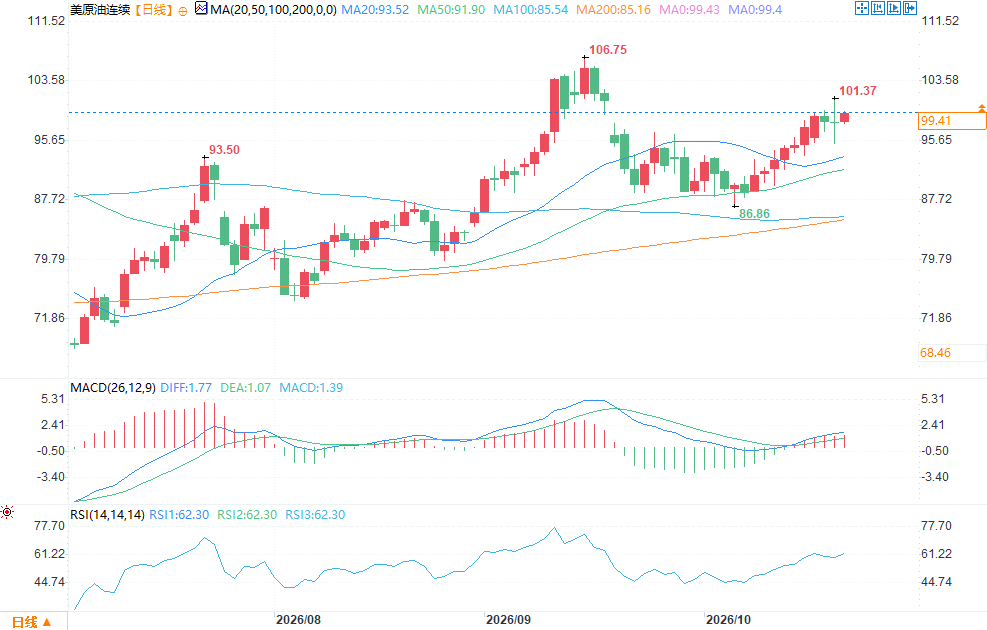 (WTI crude oil daily chart source: EasyForex) From the WTI daily chart, this round of rebound is supported by the moving average system. The MA20 (93.52), MA50 (91.90), and MA100 (85.54) form layers of support. The oil price rebounded from the low of 86.86 and tested the stage high of 101.37. The current price has retraced to around 99.41 and has not yet touched the previous high of 106.75. In terms of indicators, the MACD indicator DIFF remains above DEA and the red bars are still present, but the upward momentum has slowed down; the RSI (14) reading is 62.30, close to the 70 overbought threshold, and the marginal momentum of the rise has weakened. The price has reached a new stage high, but the upward slope of the indicators has slowed down, and there are potential signs of top divergence. At present, WTI has completed the gap filling around $99. The 101.37 above is a strong short-term resistance, and the further strong pressure is at the historical high of 106.75. However, both types of crude oil closed with long upper shadows near the highs of this rebound, which is a risk signal for bulls: it indicates intense competition between bulls and bears near the cycle highs, with bulls encountering resistance and selling pressure dissipating. Coupled with the RSI indicator approaching overbought levels and signs of bearish divergence between price and indicators, this suggests that the bullish momentum in this upward trend is weakening. The combination of high-level resistance and bearish RSI divergence is a typical warning combination in technical analysis, often indicating that the upward momentum of the previous uptrend is gradually being exhausted. If oil prices begin to pull back, short sellers should prioritize WTI Brent crude oil, as its stronger performance in this round could potentially lure bulls into a trap. Meanwhile, Brent crude oil faces numerous resistance levels, which will suppress bullish buying interest. In general, the market will wait for more confirmation signals from a pullback before reconsidering a bullish strategy. If oil prices show signs of decline, Brent crude oil, due to its stronger performance, will be more advantageous for buying on dips; conversely, if the upward momentum turns downward, short-term short positions should prioritize WTI. While both are highly correlated in terms of fundamentals, their volatility and sensitivity to capital differ. During periods of divergence, the weaker commodity tends to exhibit greater downside potential when trends reverse. WTI Crude Oil: Oil Prices Rise, but Market Positions Remain Cautious Despite the recent rebound in oil prices, large speculators have been continuously increasing their short positions in WTI crude oil; long positions are also being reduced. Compared to three weeks prior to the start of this rally, net long positions have decreased. The change in positions is not significant, but it indicates that even with ongoing concerns about Middle East geopolitical events, the market as a whole is not betting on a sustained rise in oil prices. This cautious attitude from capital flows and the short-term price increase create a clear divergence, reflecting institutional traders' doubts about the sustainability of this rebound and their reluctance to significantly increase long positions.
WTI and Brent Crude Oil: Upward Momentum Fades After Encountering Resistance Two weeks ago, the market anticipated a rebound in crude oil prices, suggesting a potential recovery from support levels. At that time, oil prices had fallen for three consecutive weeks, with WTI holding above the $86.86 low and stabilizing around the mid-to-long-term moving averages; Brent crude had also broken out of its downward correction channel. Two weeks later, both types of crude oil have seen substantial rebounds. However, from a technical analysis perspective, the market is now questioning whether oil prices can maintain their upward momentum. If supply disruptions recur in the Middle East or elsewhere, oil prices still have the potential to surge rapidly, as geopolitical conflicts remain the most explosive external driver of oil prices. If the market experiences another supply disruption (especially a sudden event in the Middle East), oil prices could certainly continue to rise; however, the market also believes that, in the absence of new positive catalysts, crude oil is currently in overbought territory. Even though shorting crude oil carries higher risks, bullish traders should at least heed these warning signs, remain cautious, and avoid chasing the already significant upward move—unless a sufficiently strong bullish driver emerges. Continuing to chase rallies in an overbought environment will significantly worsen the risk-reward ratio. If the market reverses, long positions entered at higher levels will face rapid unrealized losses. WTI and Brent crude oil technical outlook. (WTI crude oil daily chart source: EasyForex) From the WTI daily chart, this round of rebound is supported by the moving average system. The MA20 (93.52), MA50 (91.90), and MA100 (85.54) form layers of support. The oil price rebounded from the low of 86.86 and tested the stage high of 101.37. The current price has retraced to around 99.41 and has not yet touched the previous high of 106.75. In terms of indicators, the MACD indicator DIFF remains above DEA and the red bars are still present, but the upward momentum has slowed down; the RSI (14) reading is 62.30, close to the 70 overbought threshold, and the marginal momentum of the rise has weakened. The price has reached a new stage high, but the upward slope of the indicators has slowed down, and there are potential signs of top divergence. At present, WTI has completed the gap filling around $99. The 101.37 above is a strong short-term resistance, and the further strong pressure is at the historical high of 106.75. However, both types of crude oil closed with long upper shadows near the highs of this rebound, which is a risk signal for bulls: it indicates intense competition between bulls and bears near the cycle highs, with bulls encountering resistance and selling pressure dissipating. Coupled with the RSI indicator approaching overbought levels and signs of bearish divergence between price and indicators, this suggests that the bullish momentum in this upward trend is weakening. The combination of high-level resistance and bearish RSI divergence is a typical warning combination in technical analysis, often indicating that the upward momentum of the previous uptrend is gradually being exhausted. If oil prices begin to pull back, short sellers should prioritize WTI Brent crude oil, as its stronger performance in this round could potentially lure bulls into a trap. Meanwhile, Brent crude oil faces numerous resistance levels, which will suppress bullish buying interest. In general, the market will wait for more confirmation signals from a pullback before reconsidering a bullish strategy. If oil prices show signs of decline, Brent crude oil, due to its stronger performance, will be more advantageous for buying on dips; conversely, if the upward momentum turns downward, short-term short positions should prioritize WTI. While both are highly correlated in terms of fundamentals, their volatility and sensitivity to capital differ. During periods of divergence, the weaker commodity tends to exhibit greater downside potential when trends reverse. WTI Crude Oil: Oil Prices Rise, but Market Positions Remain Cautious Despite the recent rebound in oil prices, large speculators have been continuously increasing their short positions in WTI crude oil; long positions are also being reduced. Compared to three weeks prior to the start of this rally, net long positions have decreased. The change in positions is not significant, but it indicates that even with ongoing concerns about Middle East geopolitical events, the market as a whole is not betting on a sustained rise in oil prices. This cautious attitude from capital flows and the short-term price increase create a clear divergence, reflecting institutional traders' doubts about the sustainability of this rebound and their reluctance to significantly increase long positions.
- Risk Warning and Disclaimer
- The market involves risk, and trading may not be suitable for all investors. This article is for reference only and does not constitute personal investment advice, nor does it take into account certain users’ specific investment objectives, financial situation, or other needs. Any investment decisions made based on this information are at your own risk.