One chart: Baltic Dry Index hits one-week high, Capesize freight rates surge.
2026-10-21 23:00:20
Latest data shows that the Baltic Dry Index (BDI) reached 2680 points on October 21, 2026, a new high since October 13, 2026, up 3.36% month-on-month, the largest increase since September 4, 2026, and marking the third consecutive day of increase (including zero growth). Looking at the short-term charts, the recent 11 BDI data points show: 3 positive increases, 8 negative increases, and 0 zero increases. Specifically, the Panamax Freight Index (BPI) was 2204 points, down 1.91% from the previous value; the Capesize Freight Index (BCI) was 3793 points, up 7.69%; and the Supramax Freight Index (BSI) was 1870 points, up 0.11%. For detailed 720-day and 10-year trend charts of the Baltic Dry Index and its three sub-indices, please refer to the charts specially created by FX678. 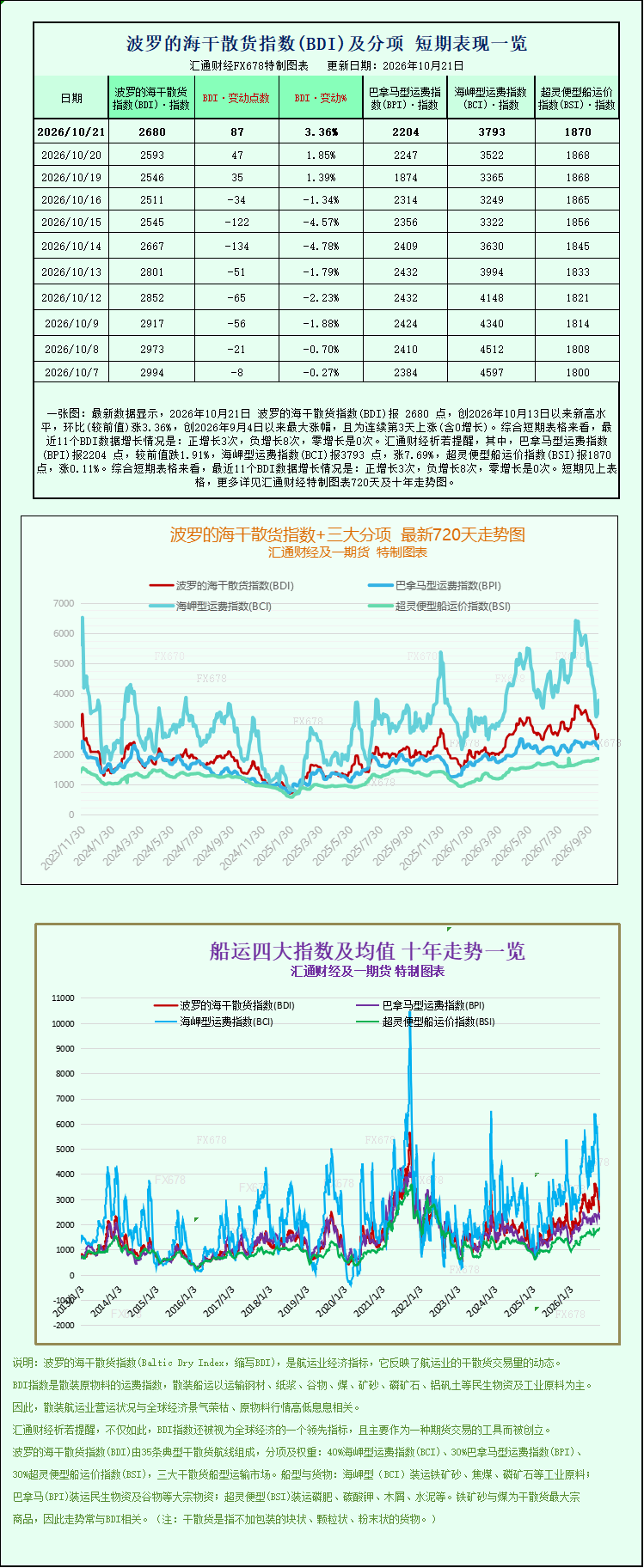 The Baltic Dry Index, which tracks dry bulk shipping rates, rose to its highest level in over a week on Wednesday, primarily driven by a strong surge in Capesize freight rates. The Baltic Dry Index (BDI), which covers Capesize, Panamax, and Supramax vessels, rose 87 points, or 3.36%, to close at 2680 points, a new high since October 13. By vessel type, Capesize vessels were the dominant driver of this rise. The Capesize index surged 271 points, or 7.69%, to 3793 points, becoming the core engine driving the overall index upward. These large vessels, typically carrying 150,000 tons of cargo—mainly including bulk commodities such as iron ore and coal—saw their average daily earnings increase by $2,453 to $30,895, approaching the important psychological threshold of $30,000, indicating a significant recovery in the immediate profitability of large dry bulk ship owners. Market analysts point out that the significant jump in Capesize freight rates is due to a combination of factors. On the one hand, the current short-term supply disruptions at some major mines and ports have led to a temporary imbalance in cargo-shipment matching, prompting charterers to rush to book capacity. On the other hand, although iron ore futures prices remained relatively stable on Wednesday, the rebound in freight rates partially offset the pressure from weak potential demand, increasing market expectations of tighter capacity and further amplifying shipowners' bargaining power. In stark contrast to the strong performance of Capesize vessels, the market for small and medium-sized vessels showed significant divergence. The Panamax index fell 43 points, or 1.91%, to close at 2204 points. Panamax vessels, which typically carry 60,000 to 70,000 tons of coal or grain, saw their average daily earnings decrease by $387 to $19,836, reflecting a temporary weakening in demand for grain and coal cargoes and relatively ample supply of capacity, which suppressed the upward potential of freight rates for small and medium-sized vessels. Among smaller vessel types, the Supramax index remained relatively stable, rising slightly by 2 points, or 0.11%, to 1870 points, with limited overall fluctuation. This divergence clearly outlines the structural characteristics of the current dry bulk shipping market: large ore carriers face tight capacity and high freight rate elasticity, while small and medium-sized bulk carriers are constrained by cargo structure and their performance is relatively flat. The Baltic Dry Index (BDI) is a leading indicator of the global dry bulk shipping market, calculated by the Baltic Exchange based on the weighted average of spot freight rates for major vessel types such as Capesize, Panamax, and Supramax. Because dry bulk shipping is deeply tied to the global trade volume of basic commodities such as iron ore, coal, and grain, the rise and fall of the BDI is often considered a key leading indicator of global trade sentiment and even macroeconomic expectations, attracting widespread attention from shipping, commodity, and financial institutions. From an industry perspective, the dry bulk market exhibits typical strong cyclical characteristics, with freight rates extremely sensitive to marginal changes in supply and demand. Any change in the shipping schedule of major mining areas, increased port congestion, or short-term mismatch of shipping capacity can trigger sharp fluctuations in freight rates. Capesize vessels, as the mainstay of ore transportation, exhibit particularly high freight rate elasticity. Therefore, it is reasonable that they have seen a much larger increase than other vessel types recently, driven by both the recovery in iron ore trading activity and supply-side disruptions. Looking ahead, market participants remain divided. Optimists believe that with the arrival of winter in the Northern Hemisphere, restocking demand for energy commodities such as coal is expected to support the market for small and medium-sized vessels. Coupled with the strong performance of Capesize freight rates, the Baltic Dry Index (BDI) is expected to continue its upward trend. However, cautious observers warn that global economic growth momentum remains moderate, and there has been no fundamental improvement in end-user demand for iron ore. Short-term supply disruptions are considered temporary disturbances, and the risk of a decline in freight rates once shipping capacity recovers cannot be ignored. Furthermore, the divergence between different vessel types suggests that the price fluctuations of a single vessel type may not represent a trend change in overall shipping demand. Overall, the rise in the BDI this period is largely due to a structural market trend driven by tight Capesize vessel capacity. Whether this trend can continue depends on the evolution of multiple factors, including subsequent cargo volume, port operations, and macroeconomic fundamentals. For participants in the shipping industry chain, during periods of high freight rate volatility, managing the matching of capacity and cargo volume effectively and prudently assessing long-term capacity supply remain key to controlling operational risks.
- Risk Warning and Disclaimer
- The market involves risk, and trading may not be suitable for all investors. This article is for reference only and does not constitute personal investment advice, nor does it take into account certain users’ specific investment objectives, financial situation, or other needs. Any investment decisions made based on this information are at your own risk.