Debunking Myths About the Latest Oil Prices
2026-10-22 00:16:20
After the outbreak of the Russia-Ukraine conflict, I realized one thing: the global oil industry (including Occidental Petroleum companies, shipowners, and oil-producing countries) is extremely resistant to anything that disrupts its business model. In 2022, the industry was almost hesitant to express this publicly, as it sounded like a compromise with Russia. Thus, predictions were rampant at the time that if the G7 implemented a price cap on Russian oil, prices could soar to $380 per barrel.  Ultimately, the price cap policy was implemented, and these predictions proved completely wrong. In essence, they weren't predictions at all; they were merely lobbying tactics employed by the industry to create panic. This year's doomsday oil price predictions, claiming prices would rise to $150 or even $200 per barrel, followed the same pattern. These views stemmed from a resistance: an unwillingness to see any intervention in the oil market, as such intervention would harm the profit margins of vested interest groups. The instinctive opposition to the Iranian oil embargo also falls into this category. It's worth noting that within just a few weeks of the Iranian oil embargo being implemented, countless energy analysts asserted that the policy was "doomed from the start," and a few weeks is clearly insufficient to draw definitive conclusions. Ultimately, just like in 2022: these doomsday oil price predictions and opposition to the blockade policy have ulterior motives beneath the surface. They are simply lobbying rhetoric packaged as industry analysis. I have previously written several articles about the oil market and debunking related rumors; this article is an updated version. Before we begin, let me state three points: First, I don't want people to think I'm ignoring the risks of a significant rise in oil prices. I believe oil prices will not return to $125 per barrel—a peak suggested by Paul Krugman in his March article, which I also fully analyzed in previous articles. However, I am aware that my analysis may be flawed, so these "debunking" articles are essentially a review of the current debates to examine the validity of my arguments. Second, those advocating for an oil price doomsday scenario constantly change their rhetoric. In early 2026, they claimed that spot Brent crude (i.e., immediate Brent) was the true price of oil, while near-month futures prices were artificially manipulated. But after the sharp drop in spot Brent prices, they shifted their focus to refined oil products. In their eyes, the crisis is perpetual; but the truth is, they have been deliberately obfuscating and concealing the truth. This group's constantly changing criteria are problematic in themselves. Of course, this does not mean my views are necessarily correct, but I hope that in the long run, my rigorous and coherent analytical logic can bring some value. Third, the current high level of anxiety in the oil market is partly due to the significant depletion of emergency crude oil reserves. As I explained in a previous article, the decline in inventories will not change my judgment that Brent crude oil will peak at $125 per barrel, so I won't repeat that point here. Below are a few oil price myths that need to be dispelled in this round: Myth 1: Spot Brent crude oil is the true oil price.
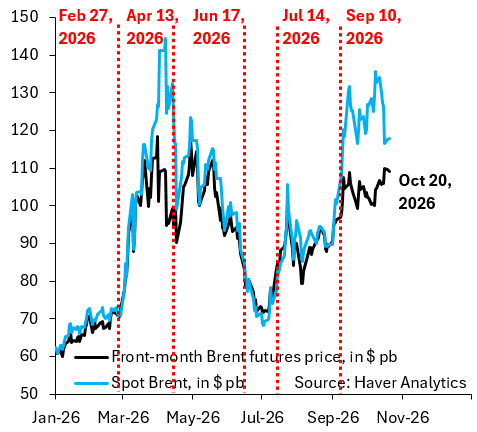 This argument has recently resurfaced, with some suggesting that the more liquid and widely traded near-month futures prices are merely a matter of "subjective sentiment." As the chart above shows, this resurgence is due to the fact that spot Brent crude prices have been significantly higher than near-month futures prices in recent weeks. However, shortly after this view gained traction again, spot Brent crude prices plummeted, falling back to levels close to near-month futures, mirroring what happened in April. This myth has clearly been debunked. It's just a shame that this kind of argument initially garnered so much attention. Myth 2: December 2027 futures prices are the key indicator.
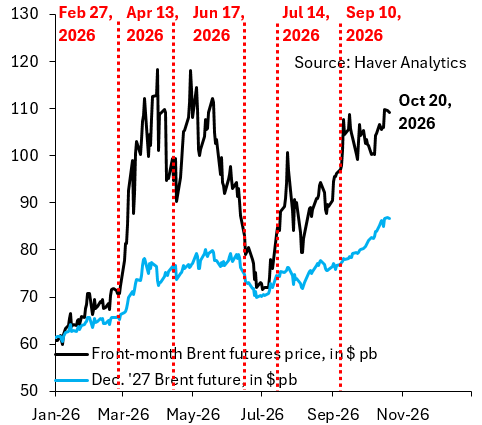 The same group of people who previously claimed that near-month futures were merely "products of sentiment" are now saying that only December 2027 futures are meaningful. This clearly shows that their arguments are inconsistent and based on mere speculation. Since the logic of Brent crude oil futures doesn't work, they turn to December 2027 futures. A rigorous analysis should examine whether December 2027 futures prices can predict the trend of near-month futures. As can be seen from the chart above: even if the December 2027 futures price is relatively stable, near-month futures still fluctuate significantly. This forward contract offers no predictive signal. If near-month futures are merely "sentiment," then the same applies to December 2027 futures. Myth 3: The recovery in tanker shipping volume is a false claim.
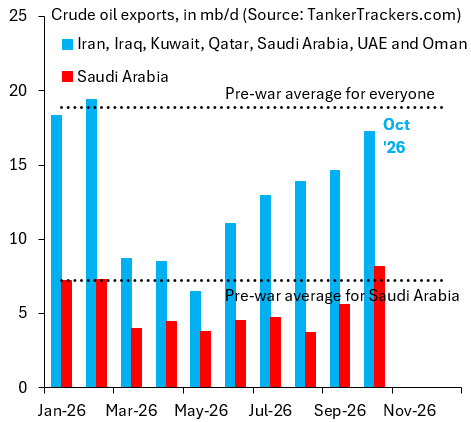 In my article last Saturday, I mentioned that there is now a broad market consensus: tanker traffic in the Strait of Hormuz has almost returned to pre-war levels. The chart above, from the excellent platform Tanker Trackers, is sufficient evidence of this. The blue curve represents total Persian Gulf exports, which are 10% lower than pre-war levels; the red curve represents Saudi exports, which are 10% higher than pre-war levels. The current context is that, under US sanctions, Iranian oil exports have fallen to zero. All reliable data indicate that oil supply has essentially returned to normal. Myth 4: High oil prices indicate that supply has not returned to normal.
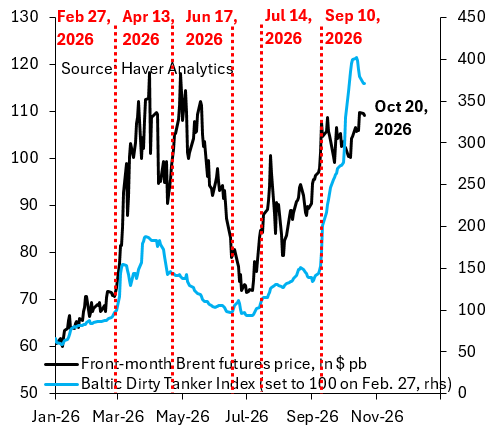 As I stated in my article last Saturday, high oil prices do not convey this signal. The chart above shows that the attack on Saudi Arabia's East-West oil pipeline on September 10th caused a sharp rise in crude oil shipping costs, and subsequent attacks by the Iranian Revolutionary Guard further increased freight rates. The US has the capability to quell the Iranian Revolutionary Guard's attacks in the Strait of Hormuz and reverse this situation. However, the US chose to remain inactive before the midterm elections, fearing that renewed conflict would further drive up oil prices. This logic is actually backwards: what is currently driving up oil prices is precisely the US's lack of military action. As long as the harassment by Iranian Revolutionary Guard gunboats is suppressed, oil prices will fall. This conflict is far from over. If the situation escalates into another hot war, oil prices may rise for some time. But we have already seen that many rumors have been debunked, most importantly the doomsday oil price predictions of $150 or $200. Ultimately, I believe Iran has lost control of the Strait of Hormuz—its most crucial bargaining chip is gone. Blockades and US sanctions are the best means to force Iran to return to the negotiating table in good faith.
Ultimately, the price cap policy was implemented, and these predictions proved completely wrong. In essence, they weren't predictions at all; they were merely lobbying tactics employed by the industry to create panic. This year's doomsday oil price predictions, claiming prices would rise to $150 or even $200 per barrel, followed the same pattern. These views stemmed from a resistance: an unwillingness to see any intervention in the oil market, as such intervention would harm the profit margins of vested interest groups. The instinctive opposition to the Iranian oil embargo also falls into this category. It's worth noting that within just a few weeks of the Iranian oil embargo being implemented, countless energy analysts asserted that the policy was "doomed from the start," and a few weeks is clearly insufficient to draw definitive conclusions. Ultimately, just like in 2022: these doomsday oil price predictions and opposition to the blockade policy have ulterior motives beneath the surface. They are simply lobbying rhetoric packaged as industry analysis. I have previously written several articles about the oil market and debunking related rumors; this article is an updated version. Before we begin, let me state three points: First, I don't want people to think I'm ignoring the risks of a significant rise in oil prices. I believe oil prices will not return to $125 per barrel—a peak suggested by Paul Krugman in his March article, which I also fully analyzed in previous articles. However, I am aware that my analysis may be flawed, so these "debunking" articles are essentially a review of the current debates to examine the validity of my arguments. Second, those advocating for an oil price doomsday scenario constantly change their rhetoric. In early 2026, they claimed that spot Brent crude (i.e., immediate Brent) was the true price of oil, while near-month futures prices were artificially manipulated. But after the sharp drop in spot Brent prices, they shifted their focus to refined oil products. In their eyes, the crisis is perpetual; but the truth is, they have been deliberately obfuscating and concealing the truth. This group's constantly changing criteria are problematic in themselves. Of course, this does not mean my views are necessarily correct, but I hope that in the long run, my rigorous and coherent analytical logic can bring some value. Third, the current high level of anxiety in the oil market is partly due to the significant depletion of emergency crude oil reserves. As I explained in a previous article, the decline in inventories will not change my judgment that Brent crude oil will peak at $125 per barrel, so I won't repeat that point here. Below are a few oil price myths that need to be dispelled in this round: Myth 1: Spot Brent crude oil is the true oil price. This argument has recently resurfaced, with some suggesting that the more liquid and widely traded near-month futures prices are merely a matter of "subjective sentiment." As the chart above shows, this resurgence is due to the fact that spot Brent crude prices have been significantly higher than near-month futures prices in recent weeks. However, shortly after this view gained traction again, spot Brent crude prices plummeted, falling back to levels close to near-month futures, mirroring what happened in April. This myth has clearly been debunked. It's just a shame that this kind of argument initially garnered so much attention. Myth 2: December 2027 futures prices are the key indicator. The same group of people who previously claimed that near-month futures were merely "products of sentiment" are now saying that only December 2027 futures are meaningful. This clearly shows that their arguments are inconsistent and based on mere speculation. Since the logic of Brent crude oil futures doesn't work, they turn to December 2027 futures. A rigorous analysis should examine whether December 2027 futures prices can predict the trend of near-month futures. As can be seen from the chart above: even if the December 2027 futures price is relatively stable, near-month futures still fluctuate significantly. This forward contract offers no predictive signal. If near-month futures are merely "sentiment," then the same applies to December 2027 futures. Myth 3: The recovery in tanker shipping volume is a false claim. In my article last Saturday, I mentioned that there is now a broad market consensus: tanker traffic in the Strait of Hormuz has almost returned to pre-war levels. The chart above, from the excellent platform Tanker Trackers, is sufficient evidence of this. The blue curve represents total Persian Gulf exports, which are 10% lower than pre-war levels; the red curve represents Saudi exports, which are 10% higher than pre-war levels. The current context is that, under US sanctions, Iranian oil exports have fallen to zero. All reliable data indicate that oil supply has essentially returned to normal. Myth 4: High oil prices indicate that supply has not returned to normal. As I stated in my article last Saturday, high oil prices do not convey this signal. The chart above shows that the attack on Saudi Arabia's East-West oil pipeline on September 10th caused a sharp rise in crude oil shipping costs, and subsequent attacks by the Iranian Revolutionary Guard further increased freight rates. The US has the capability to quell the Iranian Revolutionary Guard's attacks in the Strait of Hormuz and reverse this situation. However, the US chose to remain inactive before the midterm elections, fearing that renewed conflict would further drive up oil prices. This logic is actually backwards: what is currently driving up oil prices is precisely the US's lack of military action. As long as the harassment by Iranian Revolutionary Guard gunboats is suppressed, oil prices will fall. This conflict is far from over. If the situation escalates into another hot war, oil prices may rise for some time. But we have already seen that many rumors have been debunked, most importantly the doomsday oil price predictions of $150 or $200. Ultimately, I believe Iran has lost control of the Strait of Hormuz—its most crucial bargaining chip is gone. Blockades and US sanctions are the best means to force Iran to return to the negotiating table in good faith.
- Risk Warning and Disclaimer
- The market involves risk, and trading may not be suitable for all investors. This article is for reference only and does not constitute personal investment advice, nor does it take into account certain users’ specific investment objectives, financial situation, or other needs. Any investment decisions made based on this information are at your own risk.