The USD/JPY exchange rate remained range-bound as the interest rate differential between the US and Japan fluctuated against the Bank of Japan's cautious stance.
2026-10-22 14:46:21
On Thursday during the Asian session, the USD/JPY pair traded above 157.00, with a significantly narrowed trading range, continuing its sideways consolidation trend since the beginning of the month. The core contradiction in the current exchange rate lies in the fact that the USD/JPY interest rate differential and the Bank of Japan's cautious stance continue to suppress the yen, while Kazuo Ueda's hawkish statements and expectations of intervention prevent a one-sided weakening of the yen; meanwhile, the dollar itself lacks offensive momentum due to the decline in US Treasury yields. These three forces intertwine, resulting in a typical "ceiling and floor" pattern in the exchange rate.  From the perspective of the yen, the divergence in policy paths remains the dominant factor. The wide interest rate differential between the US and Japan, coupled with the Bank of Japan's cautious stance, has kept yen bulls on the defensive, providing a tailwind for the USD/JPY exchange rate. According to sources, Bank of Japan officials currently favor avoiding a rare consecutive rate hike this month. This inclination directly weakens market bets on tightening in October and is a key reason why the yen has struggled to attract substantial buying interest during this round of overall dollar pullback. However, Bank of Japan Governor Kazuo Ueda pointed out earlier this week that underlying inflation is very close to the central bank's 2% target, suggesting a possible rate hike as early as December. This statement preserves medium-term support for the yen and creates a clear time lag with the expectation of no rate hike this month: the combination of short-term easing and medium-term tightening makes the yen's movement more dependent on data verification rather than sentiment-driven. At the same time, market speculation that Japanese authorities might intervene to support the yen has effectively curbed aggressive short-selling of the yen. This expectation of intervention creates an invisible ceiling at the technical level—once the exchange rate rises rapidly and approaches key psychological levels, the risk of intervention increases significantly, thus suppressing the willingness of bulls to chase the rally. For USD/JPY, this means that any upward breakout is more likely to encounter policy resistance, further compressing the exchange rate's trading range. Furthermore, the dollar itself is hovering near the three-week low reached on Tuesday, and the decline in US Treasury yields has weakened its appeal, further limiting the upside potential for USD/JPY. Geopolitical uncertainty provides support from the other side. The market's growing acceptance of the view that the Federal Reserve will raise interest rates again amid inflationary concerns triggered by oil price volatility limits a deep pullback in the dollar. Meanwhile, escalating tensions in the Middle East keep geopolitical risk premiums in place, providing a tailwind for the safe-haven dollar and limiting the downside for USD/JPY. At least 18 attacks on merchant ships have occurred in the Strait of Hormuz in the past two weeks, and Brent crude oil has held above $109.55. High oil prices have pushed up global inflation readings through the cost channel, reinforcing the case for major central banks to maintain high interest rates, thereby raising the central level of real interest rates. For USD/JPY, this creates an environment of "supported interest rate differentials and no collapse in risk appetite": as long as the year-end tightening path is not disproven, any pullback in the exchange rate is more of a technical correction than a trend reversal. The timing of event risks further exacerbates market caution. The Federal Reserve is scheduled to announce its interest rate decision after concluding its two-day monetary policy meeting on October 28, followed by the Bank of Japan's meeting on October 29-30. Traders appear reluctant to establish aggressive directional positions before the decisions of these two central banks, choosing instead to wait on the sidelines. This outlook will play a key role in providing meaningful impetus to the dollar index and will help determine the next directional move. In other words, at this current time window, any unilateral breakout is more likely to be interpreted as position adjustments rather than fundamental drivers, which is the direct reason why the exchange rate has been hovering around 158.00 without much fluidity. For investors, this means that before the meeting concludes, a range-bound approach is more prudent than a trend-following approach, significantly reducing the success rate of chasing highs and lows. From a global market perspective, the current USD/JPY fluctuations are essentially a confluence of three factors: first, the proactive weakening of the dollar due to falling US Treasury yields and expectations of no rate hikes next week; second, the passive support from safe-haven buying driven by high oil prices and the Middle East situation; and third, the structural weakness of the yen shaped by the Bank of Japan's gradual path of "no rate hike this month, but a possibility in December." It's worth noting that this week's fiscal turmoil in the Eurozone (the French 10-year OAT yield rose above 5% intraday) and the expectation of a Bank of England rate hike triggered by UK inflation reaching an 11-month high are also indirectly affecting the short-term exchange rate movement through the dollar index. This multi-faceted cross-currency pull suggests that USD/JPY is more likely to digest its differences within a wide range rather than developing a smooth, one-sided trend. On the daily chart, USD/JPY is trading below the 100-day simple moving average and the 50.0% Fibonacci retracement level of the latest range of 152.91-164.06, indicating that the rebound remains capped by this upper barrier. As long as the price stays below this level, the upside remains fragile. Resistance levels to watch are the 50% retracement around 158.48, the 61.8% Fibonacci retracement around 159.80, and 161.67, with the recent high at 164.06 further up. Only a decisive break above 158.48 on the daily chart would alleviate the current bearish bias and open up space for an attack on 159.80. Support levels to watch are first the 38.2% retracement around 157.00, then 155.54, with a structural bottom anchored at 152.91. A break below this level would open up further downside potential. On the 4-hour chart, the exchange rate is consolidating in a narrow range between 157.000 and 158.30. Short-term moving averages are converging, and the MACD histogram is close to the zero axis, indicating neutral momentum. If the price breaks below 157.00 with significant volume, it may seek support at 156.50. An upward breakout would require the coordination of the Bank of Japan's decision and signals from the Federal Reserve. Until then, it is advisable to treat the price within the range and avoid chasing highs and lows.
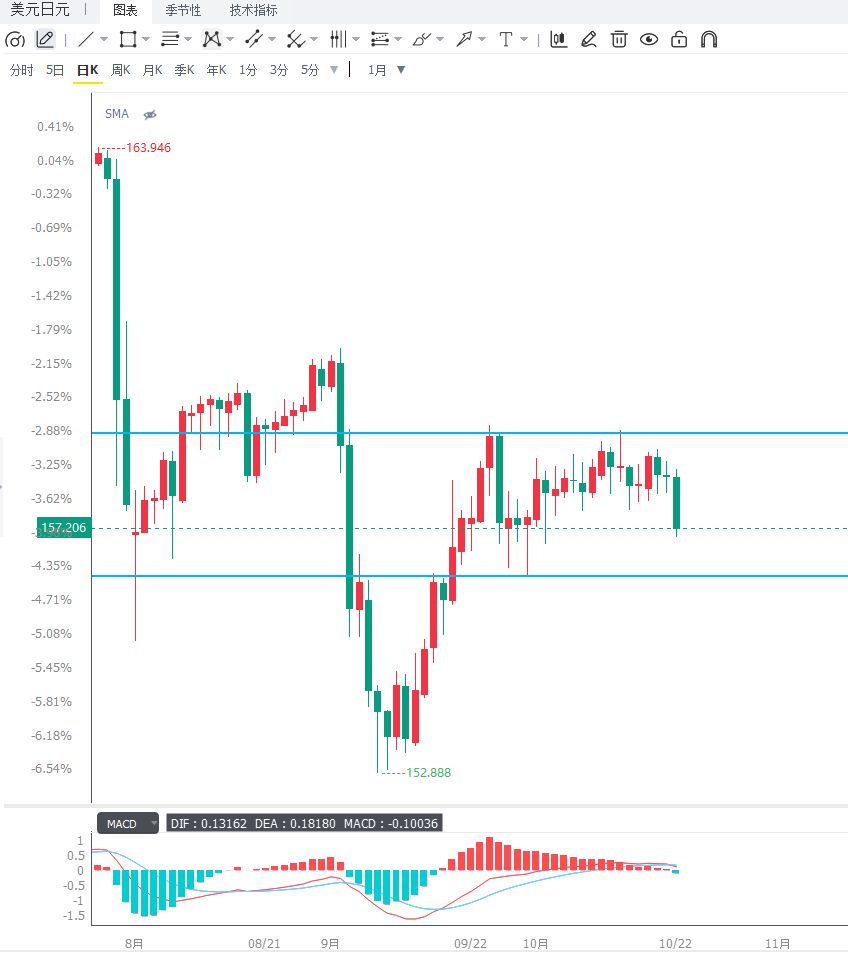 Editor's Summary: The core contradiction in the short-term USD/JPY exchange rate lies in the interest rate differential between the US and Japan, coupled with the Bank of Japan's cautious stance suppressing the yen. Meanwhile, Kazuo Ueda's hawkish statements, intervention expectations, and geopolitical premiums limit the exchange rate's downside. This two-way dynamic makes the exchange rate more likely to consolidate within the 157.00-158.48 range, awaiting a central bank breakout. Three key variables need to be monitored: first, the Fed's decision and statement on October 28th, which will be crucial for the dollar's medium-term direction; second, the Bank of Japan meeting on October 29th-30th, where Ueda's stance on the December rate hike path will directly determine the strength of the yen's rebound; and third, the situation regarding passage through the Strait of Hormuz and the progress of US-Iran negotiations, any substantial escalation of which could potentially revitalize the dollar through inflation and safe-haven demand. In the medium term, until the 157.00-158.48 range is effectively broken, the exchange rate will maintain a consolidation pattern. Confirmation of a trend direction still requires the final clarification of the policy stances of the two major central banks and the year-end rate hike path.
From the perspective of the yen, the divergence in policy paths remains the dominant factor. The wide interest rate differential between the US and Japan, coupled with the Bank of Japan's cautious stance, has kept yen bulls on the defensive, providing a tailwind for the USD/JPY exchange rate. According to sources, Bank of Japan officials currently favor avoiding a rare consecutive rate hike this month. This inclination directly weakens market bets on tightening in October and is a key reason why the yen has struggled to attract substantial buying interest during this round of overall dollar pullback. However, Bank of Japan Governor Kazuo Ueda pointed out earlier this week that underlying inflation is very close to the central bank's 2% target, suggesting a possible rate hike as early as December. This statement preserves medium-term support for the yen and creates a clear time lag with the expectation of no rate hike this month: the combination of short-term easing and medium-term tightening makes the yen's movement more dependent on data verification rather than sentiment-driven. At the same time, market speculation that Japanese authorities might intervene to support the yen has effectively curbed aggressive short-selling of the yen. This expectation of intervention creates an invisible ceiling at the technical level—once the exchange rate rises rapidly and approaches key psychological levels, the risk of intervention increases significantly, thus suppressing the willingness of bulls to chase the rally. For USD/JPY, this means that any upward breakout is more likely to encounter policy resistance, further compressing the exchange rate's trading range. Furthermore, the dollar itself is hovering near the three-week low reached on Tuesday, and the decline in US Treasury yields has weakened its appeal, further limiting the upside potential for USD/JPY. Geopolitical uncertainty provides support from the other side. The market's growing acceptance of the view that the Federal Reserve will raise interest rates again amid inflationary concerns triggered by oil price volatility limits a deep pullback in the dollar. Meanwhile, escalating tensions in the Middle East keep geopolitical risk premiums in place, providing a tailwind for the safe-haven dollar and limiting the downside for USD/JPY. At least 18 attacks on merchant ships have occurred in the Strait of Hormuz in the past two weeks, and Brent crude oil has held above $109.55. High oil prices have pushed up global inflation readings through the cost channel, reinforcing the case for major central banks to maintain high interest rates, thereby raising the central level of real interest rates. For USD/JPY, this creates an environment of "supported interest rate differentials and no collapse in risk appetite": as long as the year-end tightening path is not disproven, any pullback in the exchange rate is more of a technical correction than a trend reversal. The timing of event risks further exacerbates market caution. The Federal Reserve is scheduled to announce its interest rate decision after concluding its two-day monetary policy meeting on October 28, followed by the Bank of Japan's meeting on October 29-30. Traders appear reluctant to establish aggressive directional positions before the decisions of these two central banks, choosing instead to wait on the sidelines. This outlook will play a key role in providing meaningful impetus to the dollar index and will help determine the next directional move. In other words, at this current time window, any unilateral breakout is more likely to be interpreted as position adjustments rather than fundamental drivers, which is the direct reason why the exchange rate has been hovering around 158.00 without much fluidity. For investors, this means that before the meeting concludes, a range-bound approach is more prudent than a trend-following approach, significantly reducing the success rate of chasing highs and lows. From a global market perspective, the current USD/JPY fluctuations are essentially a confluence of three factors: first, the proactive weakening of the dollar due to falling US Treasury yields and expectations of no rate hikes next week; second, the passive support from safe-haven buying driven by high oil prices and the Middle East situation; and third, the structural weakness of the yen shaped by the Bank of Japan's gradual path of "no rate hike this month, but a possibility in December." It's worth noting that this week's fiscal turmoil in the Eurozone (the French 10-year OAT yield rose above 5% intraday) and the expectation of a Bank of England rate hike triggered by UK inflation reaching an 11-month high are also indirectly affecting the short-term exchange rate movement through the dollar index. This multi-faceted cross-currency pull suggests that USD/JPY is more likely to digest its differences within a wide range rather than developing a smooth, one-sided trend. On the daily chart, USD/JPY is trading below the 100-day simple moving average and the 50.0% Fibonacci retracement level of the latest range of 152.91-164.06, indicating that the rebound remains capped by this upper barrier. As long as the price stays below this level, the upside remains fragile. Resistance levels to watch are the 50% retracement around 158.48, the 61.8% Fibonacci retracement around 159.80, and 161.67, with the recent high at 164.06 further up. Only a decisive break above 158.48 on the daily chart would alleviate the current bearish bias and open up space for an attack on 159.80. Support levels to watch are first the 38.2% retracement around 157.00, then 155.54, with a structural bottom anchored at 152.91. A break below this level would open up further downside potential. On the 4-hour chart, the exchange rate is consolidating in a narrow range between 157.000 and 158.30. Short-term moving averages are converging, and the MACD histogram is close to the zero axis, indicating neutral momentum. If the price breaks below 157.00 with significant volume, it may seek support at 156.50. An upward breakout would require the coordination of the Bank of Japan's decision and signals from the Federal Reserve. Until then, it is advisable to treat the price within the range and avoid chasing highs and lows. Editor's Summary: The core contradiction in the short-term USD/JPY exchange rate lies in the interest rate differential between the US and Japan, coupled with the Bank of Japan's cautious stance suppressing the yen. Meanwhile, Kazuo Ueda's hawkish statements, intervention expectations, and geopolitical premiums limit the exchange rate's downside. This two-way dynamic makes the exchange rate more likely to consolidate within the 157.00-158.48 range, awaiting a central bank breakout. Three key variables need to be monitored: first, the Fed's decision and statement on October 28th, which will be crucial for the dollar's medium-term direction; second, the Bank of Japan meeting on October 29th-30th, where Ueda's stance on the December rate hike path will directly determine the strength of the yen's rebound; and third, the situation regarding passage through the Strait of Hormuz and the progress of US-Iran negotiations, any substantial escalation of which could potentially revitalize the dollar through inflation and safe-haven demand. In the medium term, until the 157.00-158.48 range is effectively broken, the exchange rate will maintain a consolidation pattern. Confirmation of a trend direction still requires the final clarification of the policy stances of the two major central banks and the year-end rate hike path.- Risk Warning and Disclaimer
- The market involves risk, and trading may not be suitable for all investors. This article is for reference only and does not constitute personal investment advice, nor does it take into account certain users’ specific investment objectives, financial situation, or other needs. Any investment decisions made based on this information are at your own risk.