UK inflation hit an 11-month high, fueling expectations of an interest rate hike and sending the pound higher against the dollar.
2026-10-22 15:06:22
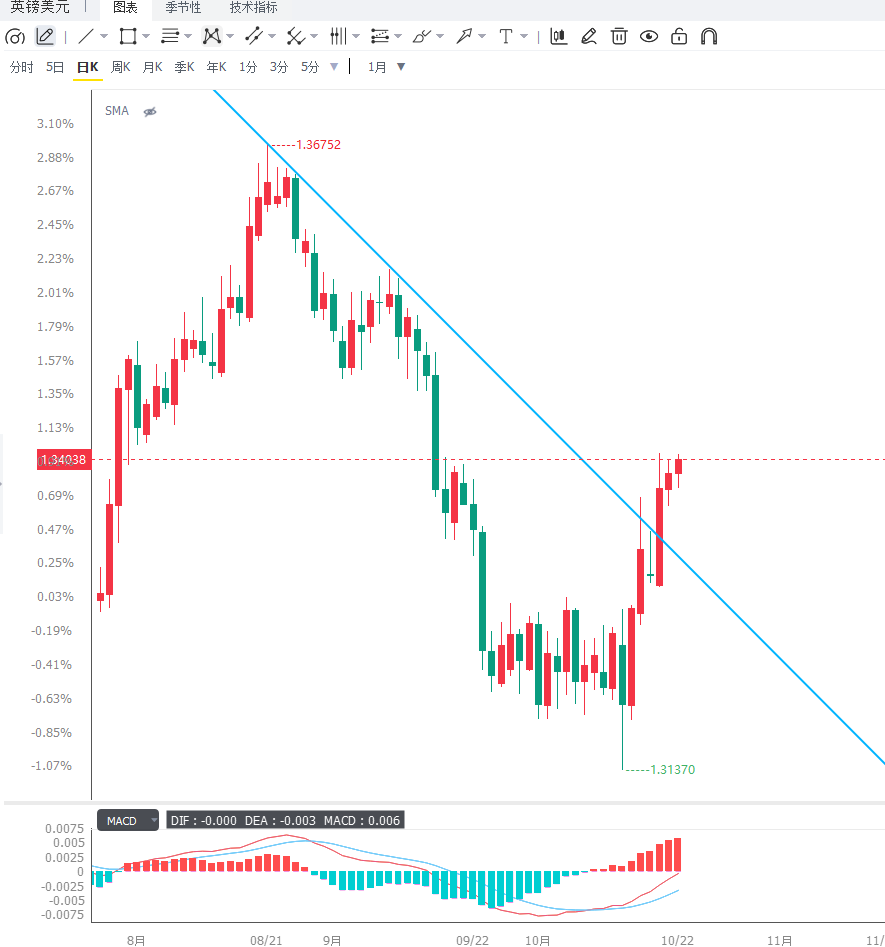
On Thursday during Asian trading hours, the pound traded near the 1.3400 level against the dollar, continuing its week-long upward trend and consolidating at higher levels. The core contradiction in the current exchange rate lies in the strengthening fundamental support for the pound, while the dollar maintains a floor due to the undisproven expectation of a year-end interest rate hike. The combination of these two factors results in a "moving but slow" consolidation pattern in the exchange rate.  From the perspective of the pound, the fundamentals clearly favor the bulls. The UK's September consumer price index rose to an 11-month high, reinforcing market expectations that the Bank of England will raise interest rates in November. Meanwhile, the dollar struggled to attract substantial buying due to falling US Treasury yields and hovered near a three-week low. This combination provided a tailwind for the pound against the dollar and validated the previous bullish outlook. The resilience of the labor market also provided support – the previously released ILO unemployment rate fell to a 15-month low of 4.7%, average private sector wage growth rebounded slightly, and while job vacancies fell by 5.1% year-on-year, real and nominal wages remained stable. Market analysis points out that "small businesses may stop hiring due to rising labor costs," highlighting the persistence of wage pressures; combined with oil prices rising to their highest level since May, the Bank of England has almost no reason to pause. This tightening expectation, driven by both inflation and wages, is more persistent than purely political or emotional factors and is key to the pound's ability to hold above the 100-day moving average in this round of rebound. The logic on the dollar side, however, constitutes a reverse constraint. Despite the decline in US Treasury yields diminishing the dollar's appeal, geopolitical risk premiums continue to play a role. Iranian Foreign Minister Araqchi stated that Tehran is prepared to give diplomacy another chance if it sees strong evidence of a genuine willingness from the US to seek a just solution; the US and Israel have also formulated plans for a possible new round of strikes against Iran after the midterm elections. This "negotiation door open, military option in hand" intermediate state provides a floor for oil prices, thereby increasing inflation risks and reaffirming market bets on an imminent Fed rate hike. According to the CME FedWatch tool, traders are currently pricing in a roughly 90% probability of a Fed rate hike in December. This helps limit the downside for the safe-haven dollar and prevents traders from establishing new long positions in GBP/USD or positioning for further gains. For the exchange rate, this means that the dollar's pullback is more of a technical correction than a trend reversal—as long as the year-end tightening path is not disproven, the pound's upside is more likely to encounter profit-taking resistance. Federal Reserve Chairman Warsh's recent speech received a score of 5.6/10, slightly below the historical average of 6.1/10, indicating a more moderate communication style than usual. He acknowledged that he was "deeply traumatized by the global financial crisis," highlighting a continued risk-averse tendency while emphasizing structural growth and the surge in investment driven by "good policies." He also viewed artificial intelligence as a short-term demand shock (its impact on employment remains uncertain) and planned to harness the technological dividend through on-site hearings and a new task force, while guarding against tail risks and potential financial instability. The FXS Fed Sentiment Index remained unchanged at a high of 127.51, well above the neutral benchmark of 100. This means that despite the lack of incremental signals in his speech, the overall policy narrative remains firmly in the hawkish range, and the market should interpret it as a framework of "high easing threshold." For the pound against the dollar, this is a combination of "pound catalysts and dollar floor," suggesting that the exchange rate is more likely to consolidate within a range rather than embark on a smooth one-sided breakout. From a global market perspective, the current volatility of the pound against the dollar is essentially a combination of two independent logics: on one hand, proactive strengthening driven by UK inflation and wage-driven expectations of central bank tightening; on the other hand, passive support for the dollar from Middle East geopolitical premiums through oil prices and inflation. It's worth noting that the recent fiscal turmoil in the Eurozone (the French 10-year OAT yield rising above 5% intraday and the Franco-German interest rate differential remaining at a high of around 150 basis points) did not trigger a synchronized weakening of the pound as in the past, indicating a breakdown in cross-currency correlations. This phenomenon suggests that investors should not simply apply historical experience for linear extrapolation—when traditional transmission chains fail, exchange rate fluctuations are more driven by positions and sentiment. Once the shock exceeds market expectations, the pricing mechanism may quickly revert to old patterns and amplify volatility. Furthermore, next week's autumn budget remains a potential source of unilateral risk; if fiscal discipline falls short of expectations, pressure on long-term interest rates could quickly offset the support from interest rate hikes. On the daily chart, GBP/USD is holding above the 100-day simple moving average (around 1.3389), indicating a short-term neutral bias and initial signs of bottoming above this dynamic support. The price is compressed between the 50.0% Fibonacci retracement level of 1.3404 and the 38.2% retracement level of 1.3341, suggesting the market is in a consolidation phase awaiting a directional breakout. Further resistance levels to watch are the 61.8% retracement level around 1.3467, the 78.6% retracement level around 1.3557, and the previous high of 1.3672. Only a decisive break above 1.3404 on the daily chart would confirm the end of the consolidation and open the way for an upward move towards 1.3467. The first support level to watch is the 100-day moving average at around 1.3389, followed by the 38.2% Fibonacci retracement level at around 1.3341. A break below this level would expose the 23.6% Fibonacci retracement level at around 1.3263, with the next structural low anchored at 1.3137.
 Editor's Summary: The core logic for the GBP/USD exchange rate in the short term lies in the support provided by UK inflation and wage-driven expectations of interest rate hikes, coupled with the expectation of a tightening dollar at the end of the year. This two-way drive makes the exchange rate more likely to consolidate within a narrow range of 1.3341-1.3404, awaiting a data-driven breakout. Three variables need to be closely watched going forward: first, inflation and wage data before the Bank of England's November meeting, which directly determines whether the interest rate hike path will materialize; second, the evolution of the probability of a Fed rate hike in December, which is crucial for the dollar's medium-term direction; and third, the status of passage through the Strait of Hormuz and the progress of US-Iran negotiations, as any substantial escalation could reignite global inflation concerns through oil prices. In the medium term, as long as 1.3341 is not effectively broken, the exchange rate is more likely to maintain a slightly bullish, volatile pattern. Confirmation of the trend direction still depends on the Bank of England's November meeting and the final clarity of the Fed's year-end policy path.
From the perspective of the pound, the fundamentals clearly favor the bulls. The UK's September consumer price index rose to an 11-month high, reinforcing market expectations that the Bank of England will raise interest rates in November. Meanwhile, the dollar struggled to attract substantial buying due to falling US Treasury yields and hovered near a three-week low. This combination provided a tailwind for the pound against the dollar and validated the previous bullish outlook. The resilience of the labor market also provided support – the previously released ILO unemployment rate fell to a 15-month low of 4.7%, average private sector wage growth rebounded slightly, and while job vacancies fell by 5.1% year-on-year, real and nominal wages remained stable. Market analysis points out that "small businesses may stop hiring due to rising labor costs," highlighting the persistence of wage pressures; combined with oil prices rising to their highest level since May, the Bank of England has almost no reason to pause. This tightening expectation, driven by both inflation and wages, is more persistent than purely political or emotional factors and is key to the pound's ability to hold above the 100-day moving average in this round of rebound. The logic on the dollar side, however, constitutes a reverse constraint. Despite the decline in US Treasury yields diminishing the dollar's appeal, geopolitical risk premiums continue to play a role. Iranian Foreign Minister Araqchi stated that Tehran is prepared to give diplomacy another chance if it sees strong evidence of a genuine willingness from the US to seek a just solution; the US and Israel have also formulated plans for a possible new round of strikes against Iran after the midterm elections. This "negotiation door open, military option in hand" intermediate state provides a floor for oil prices, thereby increasing inflation risks and reaffirming market bets on an imminent Fed rate hike. According to the CME FedWatch tool, traders are currently pricing in a roughly 90% probability of a Fed rate hike in December. This helps limit the downside for the safe-haven dollar and prevents traders from establishing new long positions in GBP/USD or positioning for further gains. For the exchange rate, this means that the dollar's pullback is more of a technical correction than a trend reversal—as long as the year-end tightening path is not disproven, the pound's upside is more likely to encounter profit-taking resistance. Federal Reserve Chairman Warsh's recent speech received a score of 5.6/10, slightly below the historical average of 6.1/10, indicating a more moderate communication style than usual. He acknowledged that he was "deeply traumatized by the global financial crisis," highlighting a continued risk-averse tendency while emphasizing structural growth and the surge in investment driven by "good policies." He also viewed artificial intelligence as a short-term demand shock (its impact on employment remains uncertain) and planned to harness the technological dividend through on-site hearings and a new task force, while guarding against tail risks and potential financial instability. The FXS Fed Sentiment Index remained unchanged at a high of 127.51, well above the neutral benchmark of 100. This means that despite the lack of incremental signals in his speech, the overall policy narrative remains firmly in the hawkish range, and the market should interpret it as a framework of "high easing threshold." For the pound against the dollar, this is a combination of "pound catalysts and dollar floor," suggesting that the exchange rate is more likely to consolidate within a range rather than embark on a smooth one-sided breakout. From a global market perspective, the current volatility of the pound against the dollar is essentially a combination of two independent logics: on one hand, proactive strengthening driven by UK inflation and wage-driven expectations of central bank tightening; on the other hand, passive support for the dollar from Middle East geopolitical premiums through oil prices and inflation. It's worth noting that the recent fiscal turmoil in the Eurozone (the French 10-year OAT yield rising above 5% intraday and the Franco-German interest rate differential remaining at a high of around 150 basis points) did not trigger a synchronized weakening of the pound as in the past, indicating a breakdown in cross-currency correlations. This phenomenon suggests that investors should not simply apply historical experience for linear extrapolation—when traditional transmission chains fail, exchange rate fluctuations are more driven by positions and sentiment. Once the shock exceeds market expectations, the pricing mechanism may quickly revert to old patterns and amplify volatility. Furthermore, next week's autumn budget remains a potential source of unilateral risk; if fiscal discipline falls short of expectations, pressure on long-term interest rates could quickly offset the support from interest rate hikes. On the daily chart, GBP/USD is holding above the 100-day simple moving average (around 1.3389), indicating a short-term neutral bias and initial signs of bottoming above this dynamic support. The price is compressed between the 50.0% Fibonacci retracement level of 1.3404 and the 38.2% retracement level of 1.3341, suggesting the market is in a consolidation phase awaiting a directional breakout. Further resistance levels to watch are the 61.8% retracement level around 1.3467, the 78.6% retracement level around 1.3557, and the previous high of 1.3672. Only a decisive break above 1.3404 on the daily chart would confirm the end of the consolidation and open the way for an upward move towards 1.3467. The first support level to watch is the 100-day moving average at around 1.3389, followed by the 38.2% Fibonacci retracement level at around 1.3341. A break below this level would expose the 23.6% Fibonacci retracement level at around 1.3263, with the next structural low anchored at 1.3137. Editor's Summary: The core logic for the GBP/USD exchange rate in the short term lies in the support provided by UK inflation and wage-driven expectations of interest rate hikes, coupled with the expectation of a tightening dollar at the end of the year. This two-way drive makes the exchange rate more likely to consolidate within a narrow range of 1.3341-1.3404, awaiting a data-driven breakout. Three variables need to be closely watched going forward: first, inflation and wage data before the Bank of England's November meeting, which directly determines whether the interest rate hike path will materialize; second, the evolution of the probability of a Fed rate hike in December, which is crucial for the dollar's medium-term direction; and third, the status of passage through the Strait of Hormuz and the progress of US-Iran negotiations, as any substantial escalation could reignite global inflation concerns through oil prices. In the medium term, as long as 1.3341 is not effectively broken, the exchange rate is more likely to maintain a slightly bullish, volatile pattern. Confirmation of the trend direction still depends on the Bank of England's November meeting and the final clarity of the Fed's year-end policy path.
- Risk Warning and Disclaimer
- The market involves risk, and trading may not be suitable for all investors. This article is for reference only and does not constitute personal investment advice, nor does it take into account certain users’ specific investment objectives, financial situation, or other needs. Any investment decisions made based on this information are at your own risk.