The decline in US Treasury yields and the expectation that the Federal Reserve will hold rates steady put downward pressure on the dollar index, leaving it without clear direction and resulting in slight fluctuations.
2026-10-22 15:00:21
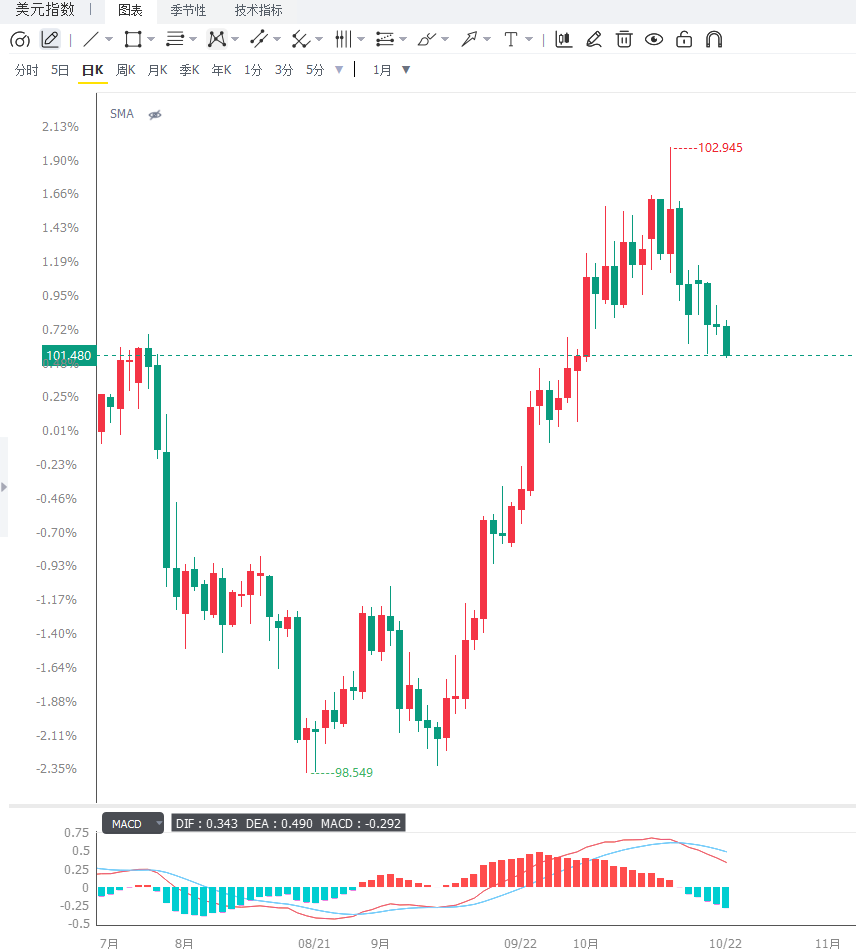
On Thursday during Asian trading hours, the US dollar index traded around 101.50, little changed from the previous trading day's close, continuing its consolidation pattern after retreating from its 18-month high. The core contradiction currently lies in the fact that the pullback in yields and expectations of no interest rates next week have weakened the dollar's offensive potential, while the undisproven tightening path at the end of the year and the persistent geopolitical premium have preserved a defensive floor. This combination results in a tug-of-war pattern where the index is "unable to fall deeply or rise significantly."  From the perspective of the US dollar, bulls are facing double pressure. US Treasury yields have continued their pullback from multi-year highs, directly weakening the dollar's interest rate attractiveness. Simultaneously, market acceptance of the Federal Reserve maintaining interest rates next week is rising, further putting dollar bulls on the defensive. This pullback, driven by interest rate expectations, reflects traders' cautious attitude before the short-term policy path becomes clearer. However, this does not mean the trend has reversed—according to the CME FedWatch tool, traders are currently pricing in a roughly 90% probability of a Fed rate hike in December. This year-end tightening expectation constitutes a key support for the index and is the fundamental reason why this pullback has failed to break below the near three-week low. For the dollar index, this is a combination of "lack of short-term catalysts and unbroken medium-term logic": as long as the December rate hike path is not substantially disproven by data, the current pullback is closer to a technical correction than a trend reversal. Geopolitical uncertainties provide support from another angle. Iranian Foreign Minister Araqchi stated that Tehran is prepared to give diplomacy another chance if it sees strong evidence of a genuine willingness from the United States to seek a solution. Meanwhile, according to the New York Times, the US and Israel have formulated plans for a possible new round of strikes against Iran after the midterm elections. This intermediate state of "leaving the door open for negotiations while holding military options" is precisely the scenario most difficult for the market to price – it is neither sufficient to disprove the risk of supply disruptions nor to provide a clear path to easing tensions. In the past two weeks, at least 18 merchant ships have been attacked in the Strait of Hormuz, and Brent crude oil has remained above $109.55. High oil prices have pushed up inflation readings through the cost channel, strengthening the central bank's rationale for maintaining high interest rates, thereby raising the central level of real interest rates; at the same time, it has also amplified the demand for safe-haven assets. The timing of these events has further exacerbated market uncertainty. Traders appear hesitant and may choose to remain on the sidelines until the key central bank events next week are resolved – the focus being the outcome of the two-day Federal Open Market Committee meeting on October 28. In addition, market participants will be watching the US Personal Consumption Expenditures (PCE) price index and the preliminary Q3 GDP figures released next Thursday for further clues about the Fed's future policy path. This outlook will play a key role in providing meaningful impetus to the dollar index and will help determine the next directional move. In other words, at this current time window, any unilateral breakout is more likely to be interpreted as position adjustments rather than fundamental drivers, which is the direct reason why the index has been hovering around 101.50 without much smoothness. For investors, this means that before the meeting and data release, a range-bound approach is more prudent than a trend-following approach, and the success rate of chasing highs and lows has significantly decreased. From a global market perspective, the current fluctuations in the US dollar index are essentially a confluence of three factors: first, the proactive weakening driven by the pullback in US Treasury yields and expectations of no interest rate action next week; second, the passive support from safe-haven buying provided by high oil prices and the situation in the Middle East; and third, the indirect push to the index through weighted channels by fiscal disturbances in the Eurozone (the French 10-year OAT yield rose above 5% intraday, and the Franco-German interest rate differential remained at a high level of around 150 basis points). In other words, the relative strength of the US dollar stems more from the structural weakness of non-US currencies than from a strong improvement in its own fundamentals. This kind of rise driven by counterparties often lacks sustainability, and once the situation in France calms down or the Bank of Japan signals further tightening, the support for the index may quickly weaken. Meanwhile, the rise in UK inflation to an 11-month high and the market pricing in a Bank of England rate hike in November also mean that the strengthening of the pound will exert a reverse restraint on the index; this is a key cross-variable to monitor this week. On the 4-hour chart, the US dollar index is holding above the 200-period simple moving average, indicating a mildly bullish short-term bias and showing initial signs of bottoming out above this moving average. However, the price is capped by the 23.6% Fibonacci retracement level at 101.92, which acts as direct resistance to any rebound. Only a decisive recovery above this level can confirm the end of the consolidation and open up space for a move towards higher retracement levels. Key resistance levels to watch are 101.92, the previous support level at 102.40, and the psychological level of 103.00. Support levels to watch are first the 38.2% retracement level around 101.28, followed by the 200-period moving average around 101.00. A clear break below this moving average on the daily chart would weaken the emerging bullish bias and expose a deeper risk of a pullback, with further downside targets at the psychological levels of 100.80 and 100.00. On the daily chart, the index has been consolidating slowly along the short-term moving average after falling from its high. The MACD histogram is close to the zero line, with the fast and slow lines repeatedly intertwined, indicating neutral momentum. Currently, the price is fluctuating narrowly between 101.60 and 102.00. If it retraces to 101.50-101.70 and finds support, there is still a chance for a short-term upward move towards 101.92-102.00. If it breaks below 101.40 with high volume, it may seek support at 101.28 or even 101.00. An upward breakout will require confirmation from the FOMC meeting results and PCE data.
 Editor's Summary: The core contradiction for the US dollar index in the short term lies in the decline in US Treasury yields and the expectation of no interest rates next week suppressing the bulls. Meanwhile, the expectation of a December rate hike and the geopolitical premium maintaining a bottom line, driving the index to likely consolidate within the 101.28-101.92 range, awaiting a breakthrough in key events. Three variables need to be closely watched: first, the outcome and wording of the FOMC meeting on October 28th, which will be the most crucial directional catalyst in the near term; second, the US PCE price index and preliminary Q3 GDP figures next Thursday, whose performance will directly determine whether a year-end rate hike path will materialize; and third, the situation regarding passage through the Strait of Hormuz and the progress of US-Iran negotiations, any substantial escalation could potentially revitalize the dollar through inflation and safe-haven flows. In the medium term, before a significant breakout from the 101.00-101.92 range, the index will maintain a consolidation pattern. Confirmation of the trend direction still requires the tone set by inflation data and the final clarity of the Fed's year-end policy path.
From the perspective of the US dollar, bulls are facing double pressure. US Treasury yields have continued their pullback from multi-year highs, directly weakening the dollar's interest rate attractiveness. Simultaneously, market acceptance of the Federal Reserve maintaining interest rates next week is rising, further putting dollar bulls on the defensive. This pullback, driven by interest rate expectations, reflects traders' cautious attitude before the short-term policy path becomes clearer. However, this does not mean the trend has reversed—according to the CME FedWatch tool, traders are currently pricing in a roughly 90% probability of a Fed rate hike in December. This year-end tightening expectation constitutes a key support for the index and is the fundamental reason why this pullback has failed to break below the near three-week low. For the dollar index, this is a combination of "lack of short-term catalysts and unbroken medium-term logic": as long as the December rate hike path is not substantially disproven by data, the current pullback is closer to a technical correction than a trend reversal. Geopolitical uncertainties provide support from another angle. Iranian Foreign Minister Araqchi stated that Tehran is prepared to give diplomacy another chance if it sees strong evidence of a genuine willingness from the United States to seek a solution. Meanwhile, according to the New York Times, the US and Israel have formulated plans for a possible new round of strikes against Iran after the midterm elections. This intermediate state of "leaving the door open for negotiations while holding military options" is precisely the scenario most difficult for the market to price – it is neither sufficient to disprove the risk of supply disruptions nor to provide a clear path to easing tensions. In the past two weeks, at least 18 merchant ships have been attacked in the Strait of Hormuz, and Brent crude oil has remained above $109.55. High oil prices have pushed up inflation readings through the cost channel, strengthening the central bank's rationale for maintaining high interest rates, thereby raising the central level of real interest rates; at the same time, it has also amplified the demand for safe-haven assets. The timing of these events has further exacerbated market uncertainty. Traders appear hesitant and may choose to remain on the sidelines until the key central bank events next week are resolved – the focus being the outcome of the two-day Federal Open Market Committee meeting on October 28. In addition, market participants will be watching the US Personal Consumption Expenditures (PCE) price index and the preliminary Q3 GDP figures released next Thursday for further clues about the Fed's future policy path. This outlook will play a key role in providing meaningful impetus to the dollar index and will help determine the next directional move. In other words, at this current time window, any unilateral breakout is more likely to be interpreted as position adjustments rather than fundamental drivers, which is the direct reason why the index has been hovering around 101.50 without much smoothness. For investors, this means that before the meeting and data release, a range-bound approach is more prudent than a trend-following approach, and the success rate of chasing highs and lows has significantly decreased. From a global market perspective, the current fluctuations in the US dollar index are essentially a confluence of three factors: first, the proactive weakening driven by the pullback in US Treasury yields and expectations of no interest rate action next week; second, the passive support from safe-haven buying provided by high oil prices and the situation in the Middle East; and third, the indirect push to the index through weighted channels by fiscal disturbances in the Eurozone (the French 10-year OAT yield rose above 5% intraday, and the Franco-German interest rate differential remained at a high level of around 150 basis points). In other words, the relative strength of the US dollar stems more from the structural weakness of non-US currencies than from a strong improvement in its own fundamentals. This kind of rise driven by counterparties often lacks sustainability, and once the situation in France calms down or the Bank of Japan signals further tightening, the support for the index may quickly weaken. Meanwhile, the rise in UK inflation to an 11-month high and the market pricing in a Bank of England rate hike in November also mean that the strengthening of the pound will exert a reverse restraint on the index; this is a key cross-variable to monitor this week. On the 4-hour chart, the US dollar index is holding above the 200-period simple moving average, indicating a mildly bullish short-term bias and showing initial signs of bottoming out above this moving average. However, the price is capped by the 23.6% Fibonacci retracement level at 101.92, which acts as direct resistance to any rebound. Only a decisive recovery above this level can confirm the end of the consolidation and open up space for a move towards higher retracement levels. Key resistance levels to watch are 101.92, the previous support level at 102.40, and the psychological level of 103.00. Support levels to watch are first the 38.2% retracement level around 101.28, followed by the 200-period moving average around 101.00. A clear break below this moving average on the daily chart would weaken the emerging bullish bias and expose a deeper risk of a pullback, with further downside targets at the psychological levels of 100.80 and 100.00. On the daily chart, the index has been consolidating slowly along the short-term moving average after falling from its high. The MACD histogram is close to the zero line, with the fast and slow lines repeatedly intertwined, indicating neutral momentum. Currently, the price is fluctuating narrowly between 101.60 and 102.00. If it retraces to 101.50-101.70 and finds support, there is still a chance for a short-term upward move towards 101.92-102.00. If it breaks below 101.40 with high volume, it may seek support at 101.28 or even 101.00. An upward breakout will require confirmation from the FOMC meeting results and PCE data. Editor's Summary: The core contradiction for the US dollar index in the short term lies in the decline in US Treasury yields and the expectation of no interest rates next week suppressing the bulls. Meanwhile, the expectation of a December rate hike and the geopolitical premium maintaining a bottom line, driving the index to likely consolidate within the 101.28-101.92 range, awaiting a breakthrough in key events. Three variables need to be closely watched: first, the outcome and wording of the FOMC meeting on October 28th, which will be the most crucial directional catalyst in the near term; second, the US PCE price index and preliminary Q3 GDP figures next Thursday, whose performance will directly determine whether a year-end rate hike path will materialize; and third, the situation regarding passage through the Strait of Hormuz and the progress of US-Iran negotiations, any substantial escalation could potentially revitalize the dollar through inflation and safe-haven flows. In the medium term, before a significant breakout from the 101.00-101.92 range, the index will maintain a consolidation pattern. Confirmation of the trend direction still requires the tone set by inflation data and the final clarity of the Fed's year-end policy path.
- Risk Warning and Disclaimer
- The market involves risk, and trading may not be suitable for all investors. This article is for reference only and does not constitute personal investment advice, nor does it take into account certain users’ specific investment objectives, financial situation, or other needs. Any investment decisions made based on this information are at your own risk.