Seven oil tankers attacked in the Strait of Hormuz; US embassy in Saudi Arabia evacuated; risk of conflict in the Middle East rises.
2026-10-22 16:08:21
International oil prices accelerated their upward trend again on Thursday (Asia-Europe session), with the WTI crude oil futures contract currently up over 2.5%, trading around 99.6. Although yesterday brought positive news regarding a potential ceasefire between Russia and Ukraine, the geopolitical situation in the Gulf clearly deteriorated. The Strait of Hormuz was again subjected to concentrated attacks on ships, US-Iran negotiations reached a deadlock, and the US and Israel increased their military deployments. Meanwhile, Iran's overseas floating crude oil inventories were completely depleted, leaving a crucial buffer for global oil supply. Under the combined influence of these multiple variables, the center of gravity of oil pricing continues to tilt towards the risk premium of escalating conflict, significantly increasing the tail risk of a supply shock. 
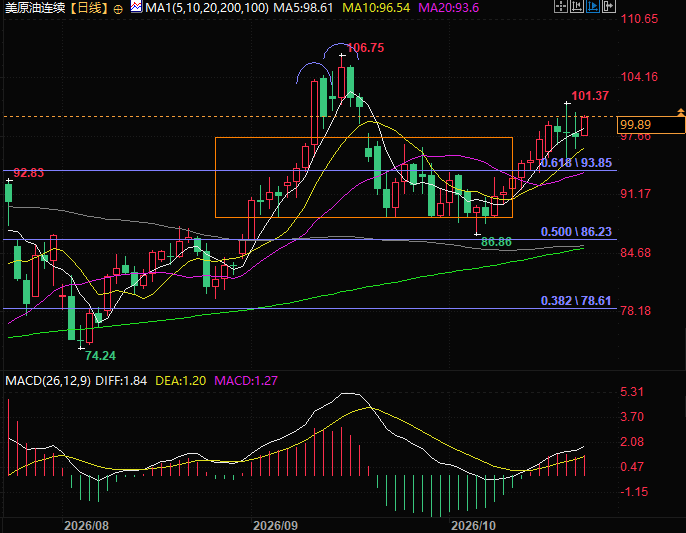 (WTI crude oil futures daily chart, source: EasyTrade) At 16:03 Beijing time, WTI crude oil futures are currently trading at $99.84 per barrel.
Saudi Arabia faces sustained attacks on ships in the Strait of Hormuz, and the US issues evacuation order for embassy personnel.
The increasing frequency of attacks on shipping lanes has raised international concerns. Iran's Revolutionary Guard reported that seven oil tankers were damaged in the Strait of Hormuz on Thursday night: four oil tankers were attacked and caught fire, and three were disabled by mines. This is the highest number of ships damaged in a single day since the conflict began on February 28. Iran warned that if the US guides oil tankers through so-called "illegal passages," its retaliation will cover US military bases in the Gulf. Meanwhile, the Houthi rebels, supported by Iran, launched near-daily attacks on Saudi Arabia. The four-year ceasefire in Yemen, which expired in June, has broken down, reigniting the conflict. In this round of attacks, a drone targeting the Shaybai oil field was intercepted by air defense systems, but the falling debris killed two Filipino and Nepalese workers and injured two others. An attack on Dammam airport resulted in one death and eight injuries. The Saudi-led coalition intercepted a total of six incoming drones that day. The US State Department immediately ordered the evacuation of non-essential staff and their families from the US Embassy in Saudi Arabia. A US spokesperson clarified that the mandatory evacuation order only covered Saudi Arabia. Middle East diplomatic sources mentioned that some US embassy families in the UAE, Jordan, Qatar, and Bahrain were also evacuating, but this was not part of an officially mandated arrangement. Historically, the US has carried out evacuations of personnel in the Gulf twice, before the planned attack on Iran in late February and before the planned strikes in July. Additionally, multiple explosions were heard in the Sirik region of Hormozgan province, Iran, on Wednesday evening. This area faces the Strait of Hormuz, breaking the brief period of calm in the region. The nature of the explosions and the perpetrators have not yet been confirmed. ING commented that even without immediate production shutdowns, the market is already pricing in the risk of continued shipping disruptions; normalized attacks on ships will drive up insurance and detour freight costs, increasing refineries' actual procurement costs and affecting more than just oil prices. Goldman Sachs also pointed out that each concentrated attack on ships in the Strait of Hormuz increases the risk premium corresponding to short-term supply disruptions.The mutually exclusive terms of the US-Iran negotiations dashed expectations of de-escalation.
Iran's foreign minister and president have both stated that they do not trust the US's sincerity for peace and that negotiations are contingent on the US lifting its maritime blockade and sanctions. The US, on the other hand, insists that Iran must first make nuclear concessions before considering easing the blockade. With no common ground between the two sides, a ceasefire is unlikely in the short term. Eurasia Group and FT foreign policy analysts believe that there is no room for gradual compromise between these two preconditions, making reconciliation unlikely, and the market needs to continue pricing in a protracted conflict. Eurasia Group has raised its probability of escalation in the Persian Gulf conflict to 65%, judging that the current stalemate is unsustainable for the US in the long term.With the implementation of US-Israeli strike plans and the forward deployment of forces, the risk of strikes on US soil has increased.
The US and Israel have formulated a new strike plan following the midterm elections, intending to conduct short, high-intensity airstrikes targeting Iranian nuclear facilities, oil infrastructure, missile and drone arsenals, and have completed simulated strike exercises over Iraq. The US military is deploying the USS Roosevelt carrier strike group and the 13th Marine Expeditionary Force to the Middle East, adding approximately 10,000 troops. The carrier is expected to arrive by the end of November. There is a possibility that the conflict could escalate from naval attacks on ships to targeted strikes against Iran's core production capacity. Goldman Sachs and Wells Fargo have provided scenario assessments: if only nuclear and missile facilities are attacked without damaging oil fields, oil prices will likely surge by $5-10, before falling back after the premium is realized; if oil production and export hubs are directly attacked, the market will enter a supply shock pricing phase, with Brent crude potentially hitting the $120-150 range. Wells Fargo adds that Iran's primary countermeasures are to blockade the Straits and attack oil production facilities in the Gulf, highlighting significant cascading risks.Iran's overseas floating storage has been depleted, its buffer has disappeared, and the intensity of the game has increased.
The core fundamental change in this round of market movements: Iran's overseas floating crude oil inventories have been depleted. Before the war, Iran stored 135 million barrels of crude oil near Singapore and Malaysia, using these shadow tankers to circumvent the blockade and sell discounted crude oil to Asia as a fiscal buffer. After the blockade began in April, inventories continued to decline, reaching 90 million barrels during a brief window in June; after the blockade was reinstated in July, replenishment was impossible, with only sales and no replenishment. By mid-October, the floating storage was empty, and Iranian crude oil loading almost came to a standstill in August and September. The US estimates that the loss of oil revenue exceeded $25 billion. Trucking and land transportation could only cover 5-7% of the original seaborne exports, and pipelines and Caspian ports could not fill the gap. Foreign exchange earnings plummeted, and domestic inflation approached 90%. With the buffer gone, Iran's policy maneuvering space narrowed, and economic pressure was more easily transformed into a hardline response in the Strait. Homayoun Falakshahi, head of crude oil at Kpler, stated that these offshore floating storage facilities were the most important sales buffer during the conflict with Iran. Now that the buffer has disappeared, Iran has lost the pressure relief valve of "shipping while enduring," and the intensity of subsequent retaliatory actions will significantly increase. Vortexa tanker tracking data corroborates Kpler's findings, indicating that Iran has limited channels to resume large-scale seaborne exports in the short term.The predicament of refined oil products remains unresolved.
Currently, there is no substantial global supply shortage. Gulf oil-producing countries such as Saudi Arabia and the UAE are increasing exports to supplement their supplies, and Asian buyers can also choose Brazilian and West African crude oil to replace Middle Eastern sources. However, the oil composition cannot be perfectly replaced: Iranian crude oil is mostly medium- and heavy acid oil, a key raw material for diesel and jet fuel refining, while Brazilian and West African crude oil is mainly light oil. After switching sources, the purchase premium will increase, and the cracking profit of independent refineries will continue to be under pressure. The tightness of refined oil products will, in turn, amplify the risk premium of crude oil. ING and Kpler pointed out that the theoretical upper limit of the diversion of Red Sea onshore pipelines is very high, but the actual increase in transport capacity is limited and cannot offset the gap caused by the long-term shutdown of the Strait of Hormuz.Summary and Technical Analysis
The deadlock in US-Iran negotiations and the escalating attacks in the Gulf have significantly increased the risk of further conflict, continuing to suppress major asset classes such as equities and gold. With Iran's overseas floating crude oil inventories completely depleted, the safety net that previously buffered exports and eased supply and demand tensions through floating storage has disappeared. Iran's policy maneuvering space has shrunk considerably, and if tensions escalate, it could easily lead to a blockade of shipping lanes, rapidly rigidifying crude oil supply constraints. Continued attention should be paid to whether the US and Israel can use force to push for talks, whether Iran will comprehensively tighten navigation restrictions in the Strait of Hormuz, and whether Saudi oil and gas facilities will be directly attacked. Simultaneously, watch for any positive signals from either side regarding the negotiations, whether the frequency of Houthi attacks has significantly decreased, and monitor Iranian crude oil shipments, tanker traffic in the Strait of Hormuz, and changes in the crude oil forward price spread structure. Technically, WTI crude oil futures broke upwards after consolidating near the previous downward gap for several days, and the price remains bullish as it trades above the 5-day moving average. (WTI crude oil futures daily chart, source: EasyTrade) At 16:03 Beijing time, WTI crude oil futures are currently trading at $99.84 per barrel.
- Risk Warning and Disclaimer
- The market involves risk, and trading may not be suitable for all investors. This article is for reference only and does not constitute personal investment advice, nor does it take into account certain users’ specific investment objectives, financial situation, or other needs. Any investment decisions made based on this information are at your own risk.