Oil prices pushing up inflation expectations, coupled with a liquidity crunch, are putting short-term pressure on gold.
2026-10-22 17:24:22
On Thursday (October 22), spot gold weakened significantly during the Asian and European sessions, falling as much as 1.8% to $4066.67 per ounce, approaching a three-and-a-half-month low of $4066.34. Yesterday's article warned of a potential turning point in the moving averages, indicating significant downward pressure, and today's sharp decline was indeed expected. A noteworthy anomaly is the simultaneous decline in the US dollar index and US Treasury bonds, which should have provided support for gold, yet gold prices followed suit. The current market movement is primarily driven by a confluence of factors: rising oil prices pushing up inflation expectations, coupled with a contraction in risk appetite and a global liquidity crunch leading to a sell-off. Equity assets have experienced significant pullbacks, and traders often prioritize selling gold, which tends to fall more slowly. Simultaneously, sovereign nations facing oil shortages need to convert to dollars, further contributing to gold sales. In other words, when global funds are trapped in the stock market, real estate market, and AI, while high-yield, risk-free assets like US Treasury bonds are also vying for funds, any asset adjustment, such as AI underperforming expectations, can lead to a sudden liquidity crunch. It's worth noting that when geopolitical conflicts drive up oil prices, gold often loses its safe-haven appeal and falls along with other major asset classes. Furthermore, in a high-inflation, high-interest-rate environment, dollar-denominated assets offer a higher safe-haven value than non-interest-bearing gold in certain periods. 
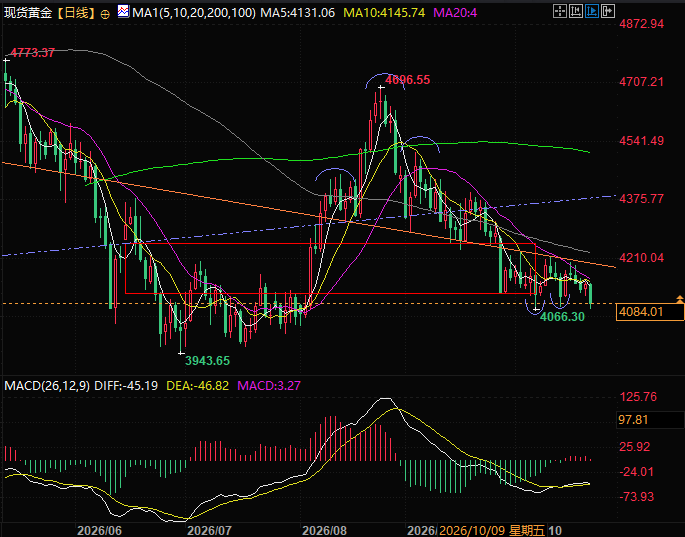 (Spot gold daily chart, source: EasyTrade) At 17:20 Beijing time, spot gold is currently trading at $4085 per ounce.
Two geopolitical drivers continue to drive up energy risk premiums, reinforcing inflation resilience.
Tensions remain high in the Middle East, with frequent attacks on ships in the Strait of Hormuz and Houthi attacks on Saudi oil and gas facilities and airports. The US has ordered the evacuation of non-essential personnel from its embassy in Saudi Arabia. The market is beginning to price in the tail risks of deteriorating oil supply and escalating conflict. Currently, the buffer against rising oil prices is narrowing globally (global crude oil reserves continue to decline, and Iran's overseas oil reserves are depleting). If the Strait is blocked, oil prices could surge rapidly. The Russia-Ukraine negotiations have also encountered further setbacks. Following the meeting between Putin and Trump's special envoy Witkov, Russia launched 21 ballistic missiles at Kyiv in three rounds, damaging infrastructure, residential and commercial buildings, and killing at least two people. Previously, Ukraine had signaled its willingness to freeze the front lines in exchange for a ceasefire, leading the market to speculate on a temporary peace. This attack indicates that Russia's stance has not changed, and the negotiations remain uncertain. The ongoing Russia-Ukraine conflict continues to put pressure on diesel supply, and rising diesel prices will directly increase logistics and manufacturing costs, limiting the Federal Reserve's room for further easing. Goldman Sachs believes that diesel crack spreads are a more persistent source of inflation than crude oil; with global refinery capacity nearing its limits and refining facilities under continuous attack, the diesel shortage is unlikely to be quickly resolved. JPMorgan's commodities team also judges that the tightness in refined oil supply is more resilient than that of crude oil. Even if crude oil supply recovers temporarily, the diesel shortage may continue into next year, further raising the inflation rate.Interest rate expectations are being repriced: October is likely to see no change, while expectations for a December rate hike are rising.
Strong energy prices continue to push up inflation expectations, further delaying interest rate cuts. CME Group's FedWatch data shows that the market expects only a 15% probability of a rate hike at the Fed's October 27-28 meeting, but the probability of a December rate hike has risen to 91%. Although officials have expressed a cautious wait-and-see attitude and are not inclined to aggressively tighten monetary policy, the persistent inflation brought about by high oil prices continues to postpone the window for easing, suppressing gold, a non-interest-bearing asset. The US PCE price index, to be released next week, is a key anchor for verifying inflation resilience and revising interest rate pricing. JPMorgan's Natasha Kaneva analyzes that the risks in the Strait of Hormuz are directly linked to inflation and interest rate expectations. With oil prices remaining high, the Fed is unlikely to shift to easing, making it easier for real interest rates to rise than fall, continuously suppressing gold valuations. Institutions say the current market pricing logic is "short-term wait-and-see, year-end tightening." If the PCE is higher than expected, the expectation of a December rate hike will be further revised upwards, increasing pressure on gold prices.AI capital expenditure cycle slows, global risk appetite enters contraction phase.
Fundamental changes in equities are simultaneously suppressing market risk appetite. Earnings reports from the seven major US AI giants indicate that the two-year-long high-growth cycle of computing power capital expenditure is slowing. Microsoft, Meta, Amazon, and Google have previously invested heavily in data centers and computing power, consuming a large amount of free cash flow, with some companies experiencing negative free cash flow in a single quarter. The latest earnings reports and consensus forecasts show that the growth rate of capital expenditure by these giants has declined, and the second derivative of computing power investment growth has peaked. AI capital expenditure is the core engine of this round of US stock market rally; the slowdown in growth means a weakening of the underlying growth logic of risky assets, leading to a decline in global risk appetite. Goldman Sachs' Delta One team commented that the cessation of accelerated capital expenditure by the seven giants itself weakens the growth narrative, shifting the market focus from competing on investment to assessing returns, leading to a downward adjustment in equity valuations and dragging down overall risk appetite. Apollo Global Management warns that the capital intensity of computing power investment has reached a high level, and the marginal returns of continued investment are diminishing. Equity earnings expectations need to be reassessed, and funds are actively reducing their risk exposure. At the same time, when funds flee from assets such as equities and gold, they do not immediately return because the interest rate on risk-free US Treasury bonds is very high, continuously siphoning off market funds and making the market's liquidity very fragile.The unique logic behind the decline in gold prices: passive selling due to a liquidity crunch.
This is also the core reason why gold has broken away from the traditional safe-haven framework: when the market enters a systemic risk-reduction phase, gold is one of the most liquid asset classes. Under margin pressure and portfolio rebalancing constraints, institutions will prioritize selling actively traded gold holdings with existing unrealized profits to recoup funds and cover other position gaps. This passive monetization temporarily overrides the support from geopolitical benefits and a weakening US dollar and Treasury bonds, creating a negative feedback loop where safe-haven assets and risk assets fall simultaneously. Institutions point out that during periods of tight liquidity, gold transforms from a safe-haven asset into a liquid reserve asset; institutions prioritize clearing gold to replenish margin, rendering short-term positive factors ineffective, and a simultaneous decline in both stocks and gold is a typical characteristic. Simultaneously, institutional research confirms that when the VIX rises and VaR constraints tighten, the correlation between gold and risk assets quickly turns positive, triggering indiscriminate selling.The market can be viewed in two phases: short-term pressure, with the sell-off nearing its end and a buying opportunity emerging.
However, this round of decline is a passive sell-off caused by a liquidity pulse squeeze, not a long-term fundamental reversal of gold. The market can be divided into two phases. The first phase is the current deleveraging and liquidity squeeze phase: oil and diesel prices remain high, inflation expectations are high, the Fed's easing expectations continue to be suppressed, and equity selling pressure leads to a passive clearing of gold, making gold prices likely to remain weak, and various positive factors temporarily ineffective. The second phase is the end of the sell-off: after the indiscriminate selling slows down and liquidity pressure is released, the main theme will shift to concerns about US economic growth. At that time, the US dollar and US Treasury bonds will continue to weaken due to recession expectations, and gold, which was previously oversold, will return to its safe-haven and inflation-hedging role, ushering in an allocation window. Bank of America fund manager surveys show that going long on gold is still a crowded trade, and short-term selling pressure needs time to digest; after the liquidity shock ends, recession expectations will dominate the market, and gold's allocation value will be highlighted again. Domestic institutions judge that the liquidity squeeze is a short-term pulse, not a long-term trend; after the pressure recedes, gold pricing will return to the traditional framework of real interest rates, central bank gold purchases, and tail geopolitical risks. Going forward, we will focus on monitoring changes in Middle Eastern oil supply, the Russia-Ukraine negotiations and energy infrastructure battles, PCE inflation data, and the Fed's statements. We will also observe the extent of selling pressure in US stocks and whether gold ETFs experience sustained passive selling. Technically, spot gold's moving averages are in a bearish alignment, with the 5-day moving average turning downwards and breaking below the bottom of the trading range. Currently, we need to patiently wait for the rate of decline in gold prices to slow and for the price to consolidate and reach a turning point after the moving averages have corrected. (Spot gold daily chart, source: EasyTrade) At 17:20 Beijing time, spot gold is currently trading at $4085 per ounce.
- Risk Warning and Disclaimer
- The market involves risk, and trading may not be suitable for all investors. This article is for reference only and does not constitute personal investment advice, nor does it take into account certain users’ specific investment objectives, financial situation, or other needs. Any investment decisions made based on this information are at your own risk.