Global growth concerns are intensifying: Is pressure from short covering in the yen accumulating?
2026-10-22 21:52:21
On Thursday, October 22, the USD/JPY pair fluctuated around 157, a slight pullback from the previous trading days. Market drivers are shifting from inflationary pressures to growth concerns. Despite a 3.7% year-on-year increase in the US Consumer Price Index (CPI) and a 2.6% year-on-year increase in the core index for September, US Treasury yields still declined significantly, with the 10-year yield falling to around 5.08%, indicating a dovish adjustment in interest rate pricing. Long positions in the US dollar, which had been largely accumulated, have begun to be partially liquidated; if growth signals weaken further, this liquidation process may continue. Tomorrow's preliminary US Purchasing Managers' Index (PMI) reading will be a crucial window of observation, as the strength or weakness of the data will directly impact the interaction between growth expectations and long-term US Treasury yields. 
Growth concerns dominate the pricing logic of the US dollar.
The recent movement of the US dollar has been driven more by growth prospects than inflation concerns. Following strong US inflation data last week, US Treasury yields fell instead of rising, indicating a slight adjustment in market pricing for further interest rate hikes and reflecting increased sensitivity to growth. Dollar long positions had previously been stretched, and if growth data falls short of expectations, pressure to unwind these positions could intensify. If the preliminary US Purchasing Managers' Index (PMI) shows continued expansionary momentum, it could temporarily alleviate growth concerns and support the dollar; however, weaker data could reinforce the narrative of slowing growth, further depressing long-term US Treasury yields and dragging down the dollar. This mechanism contrasts with the logic of inflation dominating the dollar in past cycles, highlighting the current market's sensitivity to marginal changes in economic momentum.The safe-haven status of the Japanese yen and the policy path of the Bank of Japan
The Japanese yen has recently begun to exhibit more safe-haven characteristics, with daily fluctuations primarily following changes in risk appetite, while the Bank of Japan's interest rate expectations have remained generally stable. The market widely expects the Bank of Japan to raise interest rates by 25 basis points in December, increasing the policy rate from the current 1.25% to 1.50%, with two more rate hikes planned for 2027. Most observers believe there is a high probability that the Bank of Japan will maintain its current interest rate at its next meeting (ending October 30th). However, if global growth deteriorates significantly, the Bank of Japan may again face the situation of raising interest rates in a slowing environment. Historically, the bank has often delayed action due to deflationary concerns; the current situation may not be entirely different.Daily chart technical pattern observation
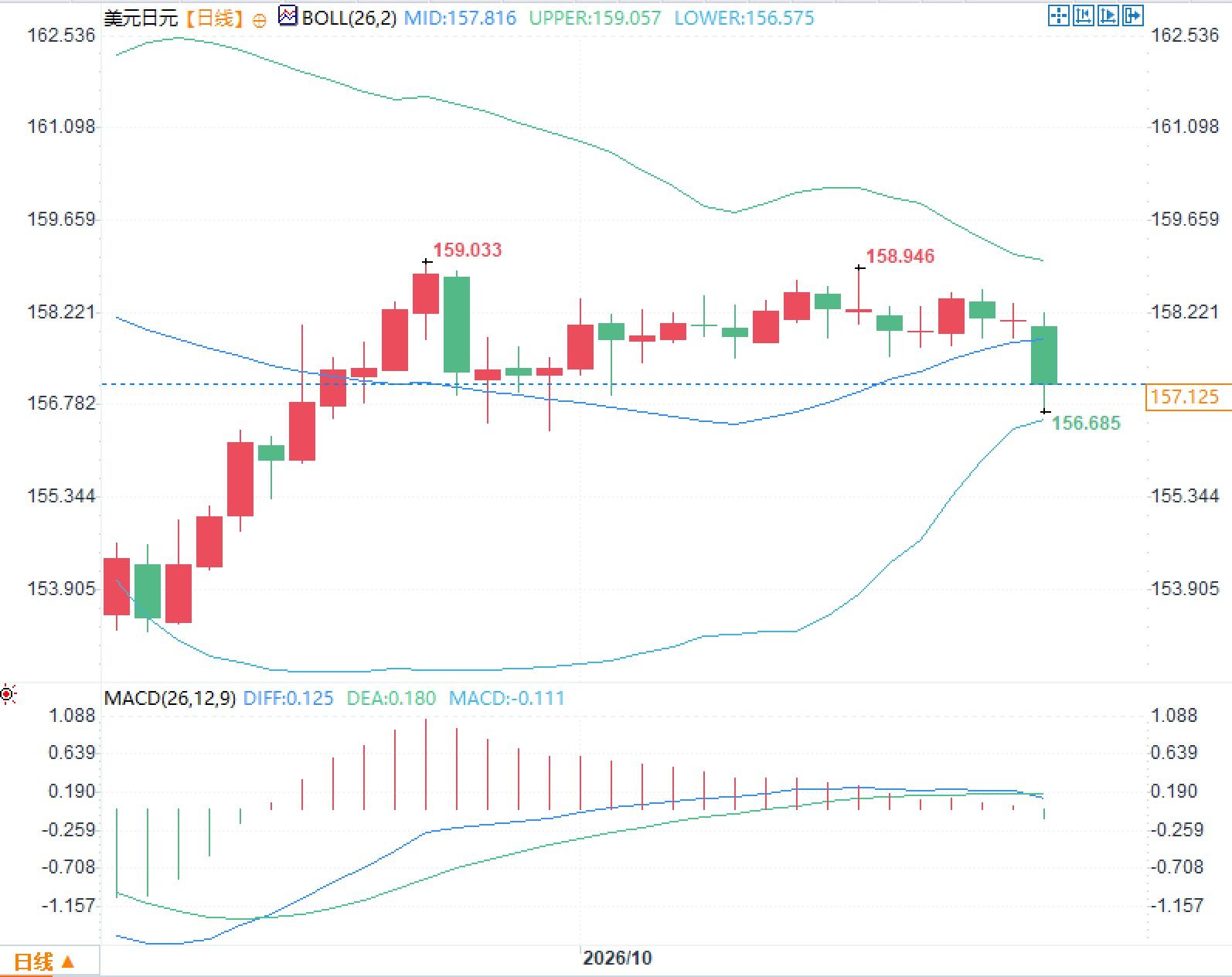
From a daily chart perspective, the USD/JPY price has recently been converging towards the middle Bollinger Band. The middle Bollinger Band is around 157.816, the upper band around 159.057, and the lower band around 156.575. During the pullback, the price is approaching the lower edge of the middle band, and the trading range has narrowed. As for the MACD indicator, the DIFF is at 0.125, the DEA is at 0.180, and the histogram value is approximately -0.111, indicating that momentum is in negative territory.Risk appetite shift and exchange rate fluctuation mechanism
Daily fluctuations in risk appetite have become a significant short-term variable influencing the USD/JPY exchange rate. When growth concerns intensify, funds tend to flow into traditional safe-haven assets, providing relative support for the yen while putting pressure on the dollar to unwind long positions. Conversely, if growth data improves or risk sentiment recovers, the yen's safe-haven premium may recede, while dollar bulls regain momentum. This interaction, coupled with the divergence between the Bank of Japan's gradual interest rate hike expectations and the Federal Reserve's policy path, increases the exchange rate's sensitivity to global growth signals and risk appetite. The decline in long-term US Treasury yields reflects both adjustments in growth expectations and influences the dollar's relative attractiveness through interest rate differentials. Overall, current exchange rate fluctuations reflect a dynamic balance between fundamental expectations and position adjustments, rather than being dominated by a single inflation or policy variable.Frequently Asked Questions
Question 1: Why did the dollar come under pressure after strong US inflation data? Answer: The market is currently more focused on the growth outlook. Rising inflation did not push up US Treasury yields; instead, it was accompanied by long position liquidation, putting pressure on the dollar. Question 2: How will the Bank of Japan's December rate hike expectations affect the yen? Answer: Expectations have been largely priced in. Daily yen fluctuations are driven more by risk appetite and safe-haven demand. The rate hike itself is not a dominant short-term factor. Question 3: What is the key role of the preliminary US Purchasing Managers' Index (PMI) in the exchange rate? Answer: This data directly reflects growth momentum. A weaker reading will strengthen growth concerns and lower long-term yields, while a stronger reading will alleviate concerns and support the dollar.- Risk Warning and Disclaimer
- The market involves risk, and trading may not be suitable for all investors. This article is for reference only and does not constitute personal investment advice, nor does it take into account certain users’ specific investment objectives, financial situation, or other needs. Any investment decisions made based on this information are at your own risk.