French bond market risks pose a double challenge to the euro.
2026-10-22 22:04:22
Recent social unrest in France, coupled with a deteriorating fiscal outlook, has led to a continuous surge in the spread between French and German bond yields, becoming a core risk factor suppressing the euro's performance. Meanwhile, the upcoming European Central Bank (ECB) policy meeting, with its uncertain policy path, further amplifies the volatility of the EUR/USD exchange rate. Two major institutions, BBH and Nordea, have provided their respective assessments of risk boundaries and central bank policy scenarios from a trading perspective. 
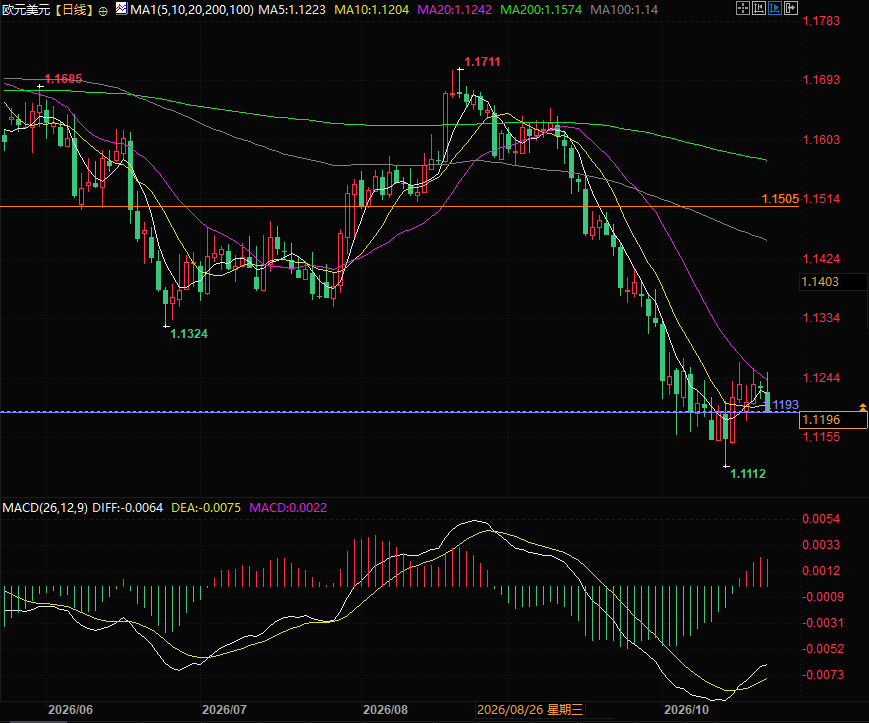 (Euro/USD daily chart, source: FX678) At 21:56 Beijing time, the euro is currently trading at 1.1194/95 against the US dollar.
The Franco-German interest rate differential has widened rapidly, and the risk of the euro falling to 1.1000 warrants attention.
Elias Haddad, an analyst at Brown Brothers Harriman (BBH), pointed out that the continued deterioration of French public finances has driven a sharp rise in the sovereign risk premium of French bonds relative to German bonds. The spread between French 10-year bonds and German bonds has widened by more than 100 basis points since the end of February, currently reaching 175 basis points, just shy of the historical high of approximately 190 basis points during the 2011 European debt crisis. Institutions are using the 2018 Italian budget crisis as a model: if the risks continue to escalate, the spread could potentially reach as high as 250 basis points, at which point the euro/dollar exchange rate would come under downward pressure, testing the 1.1000 level. Currently, the spread has only widened by half of that scenario, meaning there is still room for further deterioration in the bond market. However, institutions also emphasize that the current environment is fundamentally different from the Italian crisis of that time. The sell-off in the Italian market back then was largely driven by market panic over the potential collapse of the euro, while such concerns have significantly subsided currently. The Sentix Euro Disintegration Index was only 2.4% in September, compared to 13% during the Italian crisis in 2018, indicating that the market has not priced in the extreme scenario of France leaving the Eurozone. Meanwhile, the European Central Bank's Transmission Protection Instrument (TPI), launched in 2022, can purchase member state bonds without a predetermined limit under certain fiscal conditions, which can, to some extent, isolate the risk of France's fiscal problems spreading to the entire Eurozone. From a medium- to long-term perspective, the 2027 French presidential election may be a significant turning point, but only if the new government presents a credible deficit reduction plan; before then, French bond spreads will still face upward pressure, and the euro will continue to be suppressed by this risk.ECB faces a policy dilemma: French financing conditions may disrupt the pace of interest rate hikes.
The risks in the French bond market not only affect the exchange rate but have also landed on the European Central Bank's policy table. Jan von Gerich, an analyst at Nordea, noted that the ECB Governing Council meeting on October 29th almost certainly maintained interest rates, with market baseline expectations still pointing to another 25 basis point rate hike in December, followed by another in March 2027, ultimately pushing the deposit rate to 3.00%. However, the variable lies in the sharp fluctuations in the French bond market. Rising French bond yields will push up financing costs across the Eurozone, altering the ECB's policy balance. If financing conditions only tighten moderately, the ECB will likely proceed with the planned December rate hike; however, if a disorderly sell-off occurs in the market, and the risk spreads from France outwards, the December rate hike plan may be shelved. Analysts caution that it is too early to predict a policy shift at this stage and that the spillover effects in the bond market need to be continuously monitored.Euro trading requires close monitoring of two main themes.
For EUR/USD traders, the market is driven by both internal and external forces. Internally, the French sovereign risk premium is a significant downside risk, with each jump in the spread directly pressuring the euro. The TPI tool (the ECB's bond-buying instrument used to curb disorderly increases in Eurozone sovereign bond spreads and ensure smooth monetary policy transmission, subject to fiscal sustainability verification) and the French election are potential signals of risk easing. Externally, expectations surrounding the Fed's policy dictate the strength of the dollar, with US inflation and employment data continuing to influence dollar pricing. In the short term, technically, EUR/USD maintains a bearish bias, trading below the 100-day moving average and the Bollinger Band's middle line. Initial support is at the lower Bollinger Band at 1.1110; a break below this level would open up further downside potential. Resistance is concentrated in the 1.1260-1.1462 range. The market needs to closely monitor whether French society and the bond market deteriorate further, and how the ECB responds to sovereign risk and future interest rate hikes after the meeting. (Euro/USD daily chart, source: FX678) At 21:56 Beijing time, the euro is currently trading at 1.1194/95 against the US dollar.
- Risk Warning and Disclaimer
- The market involves risk, and trading may not be suitable for all investors. This article is for reference only and does not constitute personal investment advice, nor does it take into account certain users’ specific investment objectives, financial situation, or other needs. Any investment decisions made based on this information are at your own risk.