A chart shows the Baltic Dry Index rising for the fourth consecutive day, reaching a more than one-week high, with Capesize bulk carrier freight rates leading the gains.
2026-10-23 01:08:21
The latest data shows that the Baltic Dry Index (BDI) reached 2693 points on October 22, 2026, a new high since October 13, 2026, up 0.49% month-on-month, marking the fourth consecutive day of increase (including zero growth). Looking at the short-term charts, the recent 11 BDI data points show: 4 positive increases, 7 negative increases, and 0 zero increases. Specifically, the Panamax Freight Index (BPI) was 2151 points, down 2.40% from the previous value; the Capesize Freight Index (BCI) was 3848 points, up 1.45%; and the Supramax Freight Index (BSI) was 1890 points, up 1.07%. For detailed 720-day and 10-year trend charts of the Baltic Dry Index and its three main sub-indices, please refer to the charts specially created by FX678. 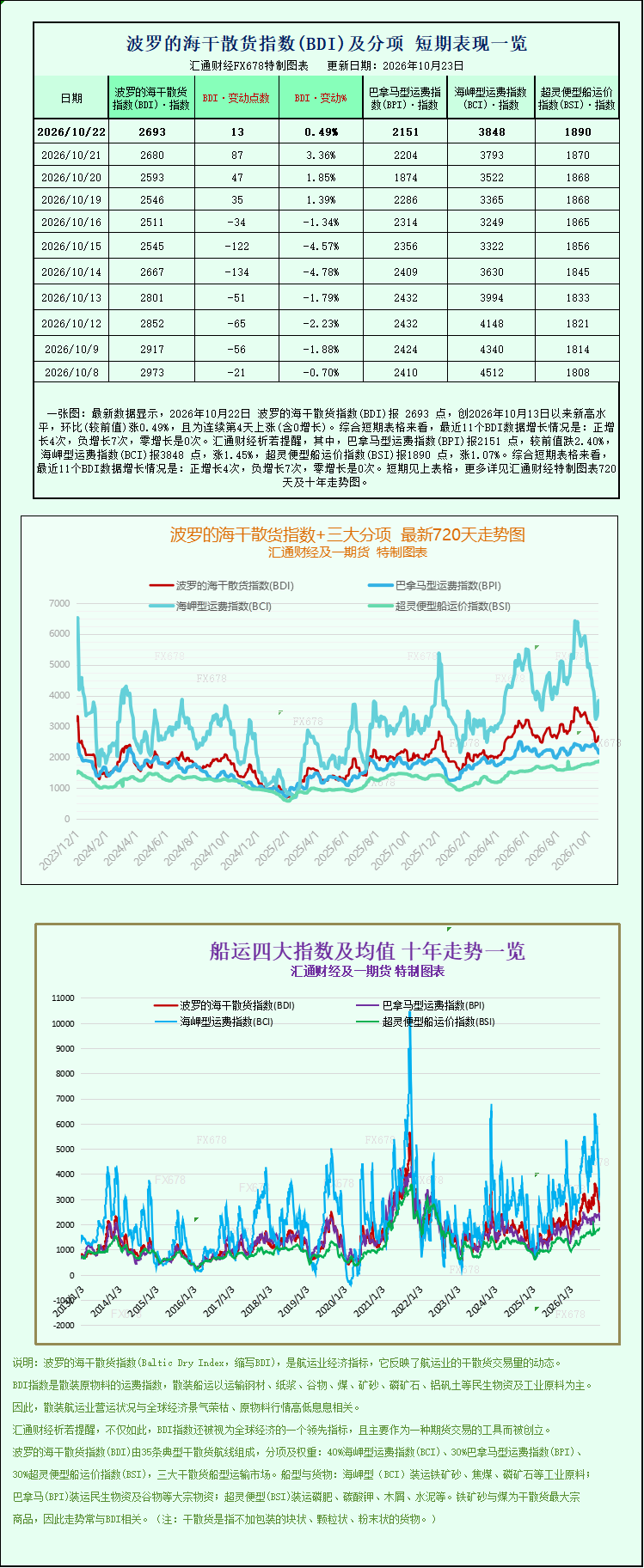 On Thursday, October 22, the Baltic Dry Index (BDI), which tracks dry bulk shipping rates, rose for the fourth consecutive trading day, closing at 2693 points, up 13 points or 0.49% from the previous trading day, reaching its highest level since October 13. This upward trend was primarily driven by a significant increase in freight rates for Capesize vessels carrying bulk raw materials, reflecting a temporary tightening of supply and demand in the large bulk carrier segment. The Baltic Dry Index (BDI) is one of the most closely watched indicators in the international dry bulk shipping market, comprehensively reflecting the overall freight rates for the three main vessel types: Capesize, Panamax, and Supramax. This continued rise in the index is mainly attributed to the significant increase in Capesize vessel freight rates. Capesize freight rates led the gains, with daily earnings surpassing $30,000 As the most heavily weighted component of the Baltic Dry Index (BDI), the Capesize index rose 55 points, or 1.45%, to 3848 points on Thursday, also reaching its highest level in over a week. These vessels typically carry approximately 150,000 tons of cargo, primarily bulk commodities such as iron ore and coal, and are the mainstay of global iron ore maritime transport. Data shows that the average daily earnings of Capesize bulk carriers increased by $501 to $31,396. Average daily earnings are a core indicator of shipowners' actual profitability; this level means that after deducting fuel, port, and related operating costs, shipowners still retain a relatively substantial profit margin. The strength of Capesize freight rates is usually closely related to the activity level of dry bulk trade such as iron ore and coal, and is often considered one of the leading indicators of global economic demand expectations. Iron Ore: New Supply Agreements Secured, Futures Prices Fall It is worth noting that despite the strong performance of Capesize freight rates, iron ore futures prices fell on Thursday. Previously, Chinese state-owned buyers reached a new supply agreement with mining giant Rio Tinto, which the market interpreted as an improvement in long-term supply security. Meanwhile, steel mill profit margins showed little sign of improvement, which to some extent dampened market optimism regarding short-term iron ore demand. Analysts typically observe iron ore prices in conjunction with Capesize freight rates: on the one hand, the volume of iron ore trade directly determines the demand for Capesize vessels; on the other hand, fluctuations in ore prices, in turn, affect the purchasing pace of traders and steel mills. The current divergence between the two trends indicates that the driving logic of freight rates and ore prices is not entirely consistent—freight rates reflect more the immediate supply and demand of shipping capacity and vessel turnover, while ore prices are more influenced by factors such as long-term supply, demand expectations, and profit transmission. The Panamax index weakened, hitting a near two-month low. In contrast to the strength of the Capesize index, the Panamax index fell 53 points, or 2.40%, to 2151 points on Thursday, a new low since August 24. Panamax vessels typically carry 60,000 to 70,000 tons of coal or grain, playing a vital role in the grain and coal trade. The average daily revenue for this vessel type decreased by $478 to $19,358. The weakening of Panamax freight rates is usually related to a temporary decline in grain and coal trade, and may also reflect insufficient cargo volume support on related routes. As a mainstay of the BDI, the divergence between Panamax and Capesize trends indicates that the current upward momentum in the market is not comprehensive or balanced, but rather exhibits a clear structural differentiation. Supramax hits multi-year high, small-tonnage market remains active Among small vessels, the Supramax bulk carrier index performed strongly, rising 20 points, or 1.07%, to 1890 points on Thursday, the highest level since August 2022. Supramax vessels are widely used in the trade of grain, fertilizer, steel, and some small-volume bulk cargoes. Their strong freight rates are usually related to factors such as active regional cargo trade and smooth port turnover. The continued rise in freight rates for this vessel type reflects the relatively tight supply and demand relationship in the small and medium-sized bulk shipping market, providing some support for the overall trend of the BDI. Market Outlook: Moving Forward Amidst Divergence Overall, the current Baltic Dry Index (BDI) exhibits a structural characteristic of "large vessels strong, medium vessels weak, and small vessels active." Capesize freight rates continue to rise, driven by the peak season for shipping demand, while Panamax rates have declined somewhat due to the temporary pressure on grain and coal trade. From a fundamental perspective, changes in the iron ore supply pattern, the profit recovery of Chinese steel mills, and the seasonal rhythm of global coal and grain trade will remain key variables influencing future freight rate trends. It should be noted that the dry bulk shipping market is highly cyclical and volatile. Freight rates are influenced by multiple factors, including weather, port congestion, vessel turnaround, commodity prices, and macroeconomic demand expectations. In the short term, the trends of different vessel types often differ. Whether freight rates can continue to rise depends on the actual pace of iron ore procurement, steel mills' restocking intentions, and changes in cargo volume on various routes.
- Risk Warning and Disclaimer
- The market involves risk, and trading may not be suitable for all investors. This article is for reference only and does not constitute personal investment advice, nor does it take into account certain users’ specific investment objectives, financial situation, or other needs. Any investment decisions made based on this information are at your own risk.