The Federal Reserve will not raise interest rates next week. What conditions would be needed to change this outcome?
2026-10-23 01:22:21
The Federal Reserve raised its policy rate on October 28, but this is unlikely in reality.  My assessment is that the Federal Reserve will keep interest rates unchanged next week. However, let's consider what might happen in the coming days to change this outcome. If oil prices surge, could the Fed be forced to preemptively address a new supply shock and thus raise rates? If the S&P 500 rises sharply, would that trigger another rate hike, as it would indicate overly loose financial conditions? The only scenario I can think of that could prompt a Fed rate hike is an unexpected peace agreement with Iran. In that case, oil prices would plummet, long-term bond yields would decline sharply, and financial conditions would become significantly looser, potentially prompting the Fed to intervene. However, it must be acknowledged that the likelihood of reaching such a peace agreement before the midterm elections is extremely low. For this outcome to be achieved, the US must accept Iran's conditions, and the probability of this happening before November 3rd is zero.
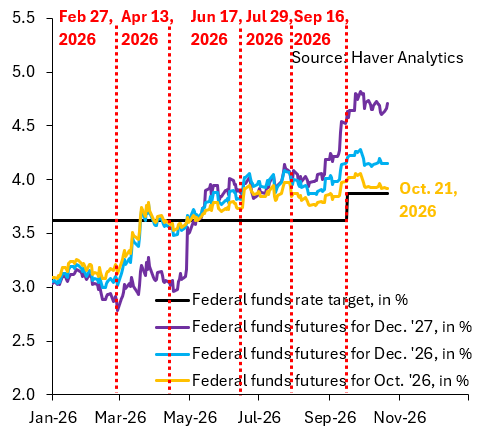 Before analyzing various scenarios, let's discuss the current market situation. The market's calm in the lead-up to next week's interest rate meeting has surprised me. Recalling the eve of the Fed meeting on July 29th, when the core Consumer Price Index (CPI) was flat a few weeks prior, the market was still pricing in a 10 basis point rate hike. Now, as shown by the orange curve in the chart above, with CPI data arguably "overheated," the market is only pricing in a 4 basis point rate hike, almost equivalent to not expecting a rate hike at all. Market sentiment has fundamentally changed compared to a few months ago. Perhaps the unanimous approval of the rate hike in September at least temporarily quelled concerns about the Fed's credibility. This shift in market sentiment means that maintaining the current interest rate is very low-cost. In contrast, the July 29th meeting, where the pause in rate hikes directly triggered a bond market turmoil, which only subsided after the US Treasury issued an unexpected announcement on August 19th, and then Warsh signaled a shift at the Jackson Hole meeting on August 28th. Now let's analyze the different scenarios in detail. Scenario 1: Let's assume Brent crude oil surges from its current price of $110 to $125. On the surface, a price spike might seem to prompt the Federal Reserve to raise interest rates, but I don't think so. A price surge would drastically worsen the French debt crisis, exacerbate market panic regarding AI and data center-related debt, and cause a significant drop in the S&P 500. In this environment, the Fed would not be inclined to raise rates. On the contrary, financial conditions would have tightened considerably, making a rate hike the most inappropriate move. Scenario 2: An unexpected peace agreement is reached, oil prices fall to $85, and there is further downside potential. This would lead to a significant easing of financial conditions: long-term yields would decline, and the S&P 500 would surge. While I would welcome this scenario, and the Fed might indeed choose to raise rates to prevent excessive financial easing, this is unlikely before November 3rd. For this to happen, the US must accept Iran's conditions, and the probability of this happening before the midterm elections is zero. As the old saying goes, don't stir up trouble. The market sentiment is currently calm, and we should align with market expectations: there will be no interest rate hike on October 28th. There will be many more Fed meetings in the future, with situations as chaotic and intense as those on July 29th, but not next week.
My assessment is that the Federal Reserve will keep interest rates unchanged next week. However, let's consider what might happen in the coming days to change this outcome. If oil prices surge, could the Fed be forced to preemptively address a new supply shock and thus raise rates? If the S&P 500 rises sharply, would that trigger another rate hike, as it would indicate overly loose financial conditions? The only scenario I can think of that could prompt a Fed rate hike is an unexpected peace agreement with Iran. In that case, oil prices would plummet, long-term bond yields would decline sharply, and financial conditions would become significantly looser, potentially prompting the Fed to intervene. However, it must be acknowledged that the likelihood of reaching such a peace agreement before the midterm elections is extremely low. For this outcome to be achieved, the US must accept Iran's conditions, and the probability of this happening before November 3rd is zero. Before analyzing various scenarios, let's discuss the current market situation. The market's calm in the lead-up to next week's interest rate meeting has surprised me. Recalling the eve of the Fed meeting on July 29th, when the core Consumer Price Index (CPI) was flat a few weeks prior, the market was still pricing in a 10 basis point rate hike. Now, as shown by the orange curve in the chart above, with CPI data arguably "overheated," the market is only pricing in a 4 basis point rate hike, almost equivalent to not expecting a rate hike at all. Market sentiment has fundamentally changed compared to a few months ago. Perhaps the unanimous approval of the rate hike in September at least temporarily quelled concerns about the Fed's credibility. This shift in market sentiment means that maintaining the current interest rate is very low-cost. In contrast, the July 29th meeting, where the pause in rate hikes directly triggered a bond market turmoil, which only subsided after the US Treasury issued an unexpected announcement on August 19th, and then Warsh signaled a shift at the Jackson Hole meeting on August 28th. Now let's analyze the different scenarios in detail. Scenario 1: Let's assume Brent crude oil surges from its current price of $110 to $125. On the surface, a price spike might seem to prompt the Federal Reserve to raise interest rates, but I don't think so. A price surge would drastically worsen the French debt crisis, exacerbate market panic regarding AI and data center-related debt, and cause a significant drop in the S&P 500. In this environment, the Fed would not be inclined to raise rates. On the contrary, financial conditions would have tightened considerably, making a rate hike the most inappropriate move. Scenario 2: An unexpected peace agreement is reached, oil prices fall to $85, and there is further downside potential. This would lead to a significant easing of financial conditions: long-term yields would decline, and the S&P 500 would surge. While I would welcome this scenario, and the Fed might indeed choose to raise rates to prevent excessive financial easing, this is unlikely before November 3rd. For this to happen, the US must accept Iran's conditions, and the probability of this happening before the midterm elections is zero. As the old saying goes, don't stir up trouble. The market sentiment is currently calm, and we should align with market expectations: there will be no interest rate hike on October 28th. There will be many more Fed meetings in the future, with situations as chaotic and intense as those on July 29th, but not next week.
- Risk Warning and Disclaimer
- The market involves risk, and trading may not be suitable for all investors. This article is for reference only and does not constitute personal investment advice, nor does it take into account certain users’ specific investment objectives, financial situation, or other needs. Any investment decisions made based on this information are at your own risk.