Gold prices plummeted by over 2% due to inflation concerns triggered by the Middle East energy shock.
2026-10-23 02:02:21
On Thursday (October 22), spot gold continued its decline during the US trading session, falling below the $4,100 mark, a drop of over 2%. Tensions in the Middle East have raised concerns about energy inflation, reinforcing market expectations that interest rates will remain high for an extended period. Spot gold traded below $4,050, its lowest level since August 4. Reports indicate that the US and Israel have drafted plans to launch a new round of strikes against Iran after the US midterm elections, potentially targeting Iran's energy infrastructure.  Meanwhile, the conflict between Saudi Arabia and the Houthi rebels continues to escalate, with reports of new attacks on Saudi Arabia's Shaba oil field and King Fahd International Airport. The U.S. State Department has ordered the evacuation of non-essential government employees and their families from Saudi Arabia. These geopolitical developments have fueled market concerns about further disruptions to Middle Eastern energy supplies, keeping oil prices high. West Texas Intermediate (WTI) crude is around $100, near a five-week high. This ongoing energy shock has pushed inflation levels in major economies above central bank targets, forcing policymakers to raise financing costs. Gold itself does not generate interest income, so higher interest rates will diminish its appeal—even though gold has historically been considered a safe-haven asset and an inflation hedge. The longer the conflict continues, the longer central banks may maintain tight monetary policies. Traders are currently awaiting next week's Federal Reserve meeting. The market widely expects the U.S. central bank to hold rates steady at this meeting, following a 25 basis point hike in September. Traders have priced in a new round of interest rate hikes in December, with the CME FedWatch Tool showing an 89% probability. The market will closely watch the Fed's signals regarding the interest rate path. Previously, concerns about artificial intelligence investment dragged down the stock market, leading to a flow of funds into US Treasuries, lowering Treasury yields, and causing the dollar to retreat from multi-month highs. Now, hawkish expectations are supporting bargain hunting and a return of buying interest to the dollar. The dollar index traded around 101.60 after hitting a three-week low of 101.45. The benchmark 10-year US Treasury yield was approximately 4.593%, down 3.22%. Despite recent declines, US Treasury yields remain high. Coupled with a stronger dollar and lingering expectations of interest rate hikes, gold is likely to continue to face pressure; any rebound in gold prices could be met with another round of selling. Technical Analysis: Spot gold broke below the lower Bollinger Band, further strengthening bearish momentum.
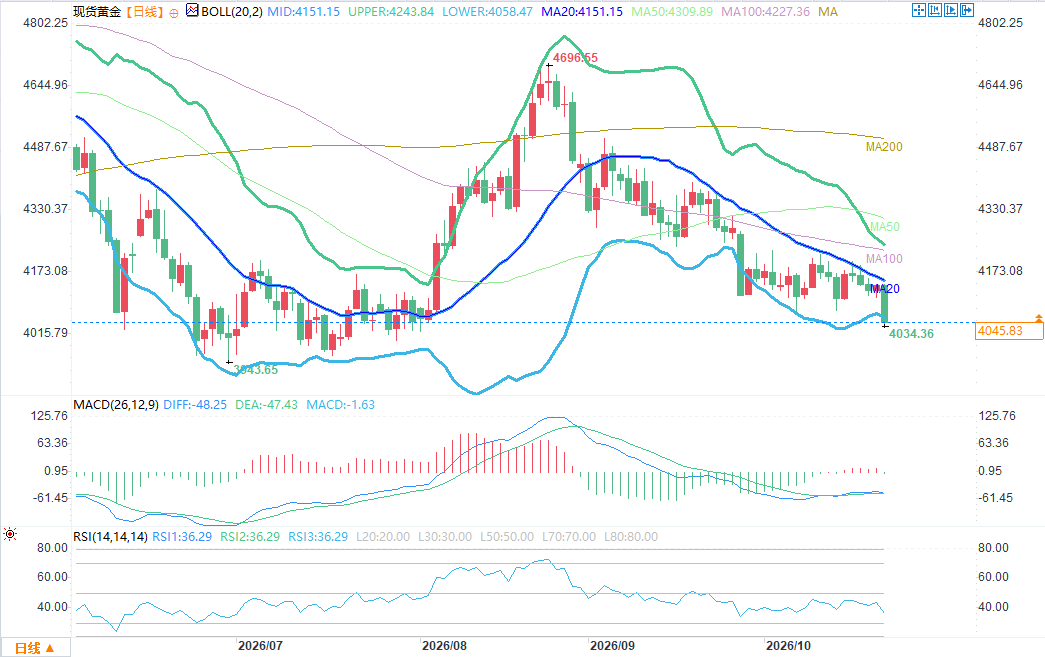 On the daily chart, spot gold has fallen sharply, breaking below the lower Bollinger Band at $4058.50, reaching a low of $4034.36. Gold prices continue to trade below the 20-period simple moving average (SMA) (Bollinger Band middle line, $4151.16), and also below the 50-period and 100-period moving averages (MA50 and MA100), indicating downward pressure from the moving average system and a clearly bearish short-term trend. The Relative Strength Index (RSI) is at 36.30, in the weak zone but not yet deeply oversold, suggesting further downside potential. The MACD indicator has turned bearish, indicating that the previous slight rebound momentum has completely dissipated, and bearish forces are now in control. Resistance levels: The first resistance level is the 20-period simple moving average (Bollinger Band middle line) at $4151.16; the second is the upper Bollinger Band at $4243.82. Only if gold prices can sustain a break above these levels could a larger rebound be possible, targeting the previous high of $4696.55. Support levels: The lower Bollinger Band at $4058.50 has been broken, turning from support into resistance for any rebound; the current intraday low is $4034.36. If prices continue to decline, the next target is the psychological level of $4000, with deeper support at the previous low of $3943.65. Gold prices trading below the lower Bollinger Band represent an extreme deviation, suggesting a possible short-term pullback towards $4058.50; however, if the rebound fails to hold above $4151.16, the overall downtrend remains unchanged, and any rebound is likely to be met with another round of selling. As of 01:58 Beijing time, spot gold was trading at $4046.57 per ounce, down 2.28%.
Meanwhile, the conflict between Saudi Arabia and the Houthi rebels continues to escalate, with reports of new attacks on Saudi Arabia's Shaba oil field and King Fahd International Airport. The U.S. State Department has ordered the evacuation of non-essential government employees and their families from Saudi Arabia. These geopolitical developments have fueled market concerns about further disruptions to Middle Eastern energy supplies, keeping oil prices high. West Texas Intermediate (WTI) crude is around $100, near a five-week high. This ongoing energy shock has pushed inflation levels in major economies above central bank targets, forcing policymakers to raise financing costs. Gold itself does not generate interest income, so higher interest rates will diminish its appeal—even though gold has historically been considered a safe-haven asset and an inflation hedge. The longer the conflict continues, the longer central banks may maintain tight monetary policies. Traders are currently awaiting next week's Federal Reserve meeting. The market widely expects the U.S. central bank to hold rates steady at this meeting, following a 25 basis point hike in September. Traders have priced in a new round of interest rate hikes in December, with the CME FedWatch Tool showing an 89% probability. The market will closely watch the Fed's signals regarding the interest rate path. Previously, concerns about artificial intelligence investment dragged down the stock market, leading to a flow of funds into US Treasuries, lowering Treasury yields, and causing the dollar to retreat from multi-month highs. Now, hawkish expectations are supporting bargain hunting and a return of buying interest to the dollar. The dollar index traded around 101.60 after hitting a three-week low of 101.45. The benchmark 10-year US Treasury yield was approximately 4.593%, down 3.22%. Despite recent declines, US Treasury yields remain high. Coupled with a stronger dollar and lingering expectations of interest rate hikes, gold is likely to continue to face pressure; any rebound in gold prices could be met with another round of selling. Technical Analysis: Spot gold broke below the lower Bollinger Band, further strengthening bearish momentum. On the daily chart, spot gold has fallen sharply, breaking below the lower Bollinger Band at $4058.50, reaching a low of $4034.36. Gold prices continue to trade below the 20-period simple moving average (SMA) (Bollinger Band middle line, $4151.16), and also below the 50-period and 100-period moving averages (MA50 and MA100), indicating downward pressure from the moving average system and a clearly bearish short-term trend. The Relative Strength Index (RSI) is at 36.30, in the weak zone but not yet deeply oversold, suggesting further downside potential. The MACD indicator has turned bearish, indicating that the previous slight rebound momentum has completely dissipated, and bearish forces are now in control. Resistance levels: The first resistance level is the 20-period simple moving average (Bollinger Band middle line) at $4151.16; the second is the upper Bollinger Band at $4243.82. Only if gold prices can sustain a break above these levels could a larger rebound be possible, targeting the previous high of $4696.55. Support levels: The lower Bollinger Band at $4058.50 has been broken, turning from support into resistance for any rebound; the current intraday low is $4034.36. If prices continue to decline, the next target is the psychological level of $4000, with deeper support at the previous low of $3943.65. Gold prices trading below the lower Bollinger Band represent an extreme deviation, suggesting a possible short-term pullback towards $4058.50; however, if the rebound fails to hold above $4151.16, the overall downtrend remains unchanged, and any rebound is likely to be met with another round of selling. As of 01:58 Beijing time, spot gold was trading at $4046.57 per ounce, down 2.28%.
- Risk Warning and Disclaimer
- The market involves risk, and trading may not be suitable for all investors. This article is for reference only and does not constitute personal investment advice, nor does it take into account certain users’ specific investment objectives, financial situation, or other needs. Any investment decisions made based on this information are at your own risk.