Institutions: Gold is not a panacea for inflation; the long-term cycle of commodities is the main theme.
2026-10-23 13:20:22
Gold's underperformance in recent months further confirms that it is not a reliable hedge against inflation. Tim Pickering, president and chief investment officer of Oxfam Capital Advisors, suggests that gold is only suitable as a diversification tool, and that the global economy may be entering a cross-generational commodity supercycle, requiring investors to diversify across a broad range of commodities.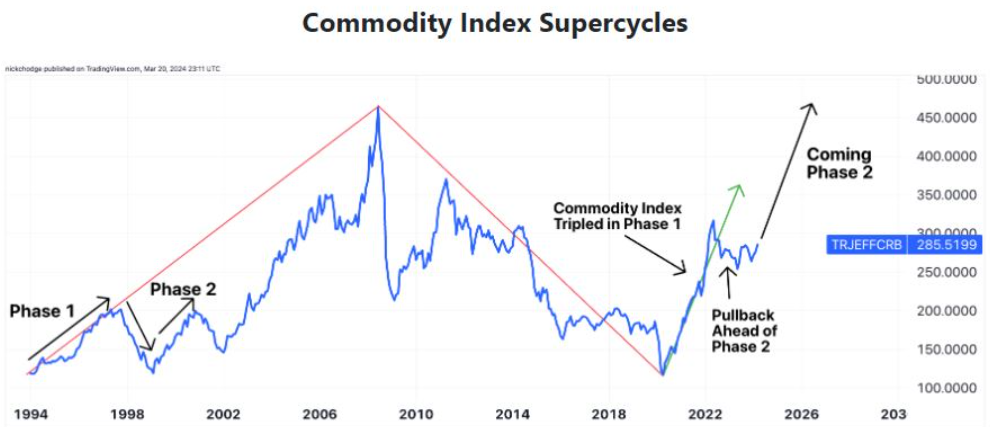 Chart: CRB Commodity Index Supercycle Chart
Gold is merely a diversification tool and cannot directly hedge against inflation.
Pickering stated that while he personally favors gold and silver, he will not be allocating any precious metals at present. The combination of persistent inflation and a high-interest-rate environment is putting significant pressure on precious metals. Gold's biggest weakness lies in its high interest rate sensitivity during periods of rising prices; the weak performance of gold during the period from 2020 to 2022, when US inflation surged to a 40-year high of 9%, is a prime example. He said, "Gold is not a panacea; it's just a diversification asset." He further distinguished between the two types of assets: gold is more driven by policy uncertainty and market sentiment, while energy, industrial metals, and agricultural products are inputs to the global economy and sources of inflation, rather than passive responses to it. Central bank interest rate hikes can suppress demand-side inflation, but they are unlikely to solve the problem of increased supply-side costs due to rising energy, wage, and raw material prices. The future inflation center may remain above the low levels of the decade following the 2008 financial crisis for a long time, with 3% to 4% inflation becoming the norm. Chart: CRB Commodity Index Supercycle ChartFollow the trend and refrain from going long on gold and silver for now.
Pickering's investment framework prioritizes following price trends rather than relying solely on economic forecasts. Auspicious's broad-spectrum commodity strategy covers 12 commodities, currently holding long positions in nine, avoiding gold, silver, and North American natural gas, with holdings concentrated in petroleum products, copper, corn, soybeans, wheat, cotton, and sugar. This doesn't negate the fundamentals of precious metals, but stems from the weak price trend of gold and silver. He said, "I'm bullish on the supply and demand fundamentals of silver, but that doesn't mean I'll go long. If it continues to weaken throughout the year, my task is to protect capital or profit through short positions." The institution significantly reduced its silver positions as early as the end of 2025, essentially liquidating them when silver peaked in January 2026. Only when sustained upward price momentum emerges, forming an upward trend lasting several months, will it reposition itself in gold and silver.The commodity supercycle is still in its early stages, with three long-term driving forces.
According to Pickering, the weakening of gold and silver does not signify the end of the commodity bull market. This supercycle, which has lasted for over two decades, has only been underway for six years and is still in its early stages. The three main structural forces supporting the market are the growth in middle-class consumption in emerging markets, the global energy transition, and the expansion of AI infrastructure and data centers. Strong demand coupled with insufficient capacity investment continues to drive up commodity values. Unlike the market rally at the beginning of this century, which was solely driven by the industrialization of major Asian countries, this cycle is characterized by multiple demand engines working simultaneously, coupled with geopolitical instability and supply chain disruptions, further tightening supply. The situation around the Strait of Hormuz is a typical example. Funds will rotate among various commodities. At the beginning of the year, funds flowed into grains, then shifted to energy after geopolitical tensions, and after a summer correction in energy prices, funds flowed back into agricultural products. A broad and diversified portfolio is far more prudent than betting on a single commodity.High interest rates have exacerbated supply bottlenecks, posing challenges to traditional investment strategies.
High interest rates may suppress precious metals in the short term, but could prolong the commodity bull market. Commodity producers will compete with technology and AI infrastructure projects for capital, leading to higher borrowing costs. Mining and energy companies will struggle to raise funds to expand capacity, further widening the supply-demand gap. Meanwhile, a stronger dollar may not necessarily suppress commodity prices. The drawbacks of the traditional 60/40 stock/bond allocation model continue to emerge; the inflationary environment weakens the diversification effect of bonds, and the simultaneous decline in stocks and bonds in 2022 exposed the system's shortcomings. Pickering believes that central banks will not aggressively raise interest rates to push inflation back to the target range, potentially triggering a deep recession. Policymakers will ultimately tolerate relatively high inflation to avoid supply shocks that could induce a severe economic downturn.Conclusion
Against the backdrop of insufficient supply and investment and continued demand expansion, the upward cycle of broad-spectrum commodities remains supported. Investors need to move beyond the conventional thinking of relying solely on gold as a hedge against inflation and instead adopt trend-following and diversified commodity strategies to adapt to the era of high inflation. At 13:18 Beijing time, spot gold was trading at $4013.54 per ounce.- Risk Warning and Disclaimer
- The market involves risk, and trading may not be suitable for all investors. This article is for reference only and does not constitute personal investment advice, nor does it take into account certain users’ specific investment objectives, financial situation, or other needs. Any investment decisions made based on this information are at your own risk.