Japan's CPI strengthened expectations of an interest rate hike, causing the yen's gains to falter; institutions remain bullish on the medium term.
2026-10-23 14:00:21
On Friday (October 23), the US dollar rebounded against the Japanese yen from a more than one-month low (around 156.00) hit earlier in the Asian session, after Japan released consumer inflation data. However, the exchange rate failed to hold above 157.00 and is still poised for a significant weekly decline. 
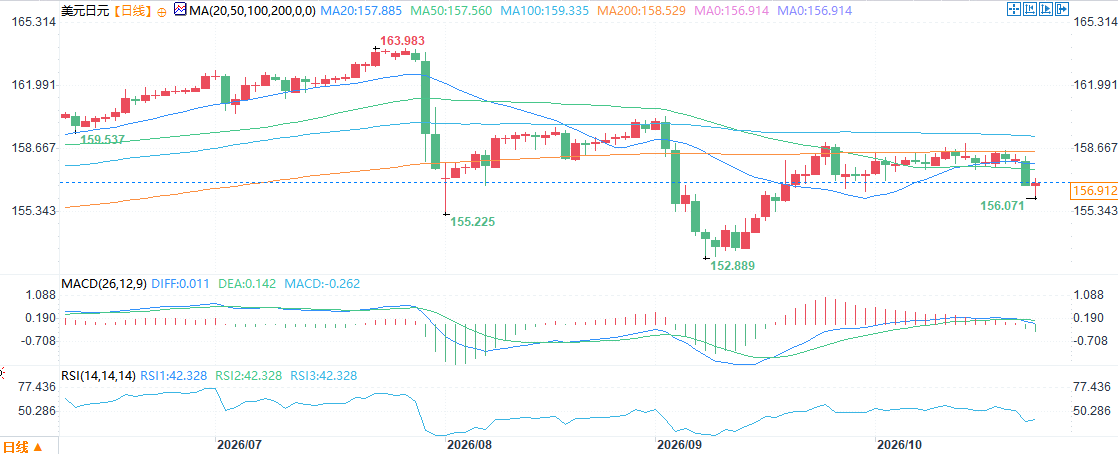 (USD/JPY daily chart, source: FX678) At 13:59 Beijing time, USD/JPY was trading at 156.87/88.
Rising inflation in Japan boosted the yen, but the gains failed to hold.
The latest data from Japan's Ministry of Internal Affairs and Communications shows that the national consumer price index (CPI) rose 2.1% year-on-year in September, up from 1.9% in the previous month. The core CPI, excluding volatile fresh food, also rose 2.1%, the strongest reading since December 2025. Furthermore, the core CPI, excluding fresh food and energy, rose to 2.5% in September, a 10-month high, providing further justification for the Bank of Japan to continue raising interest rates. This boosted the yen to some extent, but the initial market reaction quickly subsided. A slight rebound in the US dollar helped attract some bargain hunting against the yen, with the exchange rate recovering from a more than one-month low near 156.00.Demand for the US dollar is recovering, but upside potential is limited.
Despite recent statements from Federal Reserve officials indicating no immediate urgency to raise interest rates, traders appear confident that the central bank will raise rates again this year. The CME Group's FedWatch tool shows an approximately 80% probability of a December rate hike. Inflation risks from rising energy prices also support the prospect of further Fed tightening. Furthermore, escalating tensions in the Middle East have perpetuated geopolitical risk premiums, boosting demand for the safe-haven dollar and providing a tailwind for the USD/JPY pair. However, upside potential appears limited, as traders seem hesitant ahead of key central bank events next week.Institutional Views
MUFG projects the USD/JPY exchange rate to be 155 by the end of Q4 2026, 153 in Q1 2027, 151 in Q2 2027, and 149 in Q3 2027. The Bank of Japan has already raised its policy rate to 1.25%, with a further rate hike most likely in December, followed by a faster pace to 2% by 2027. MUFG believes that the narrowing US-Japan interest rate differential, the perception of the yen as significantly undervalued by the US, and the potential risk of coordinated intervention will limit a significant rise in the exchange rate. A break above 160 would increase the likelihood of warnings and intervention from both Japanese and US authorities, and the 200-day moving average would also act as resistance. Continued appreciation requires continued interest rate hikes by the Bank of Japan and a restoration of confidence in fiscal discipline. Near-term risks have weakened further, and the yen is expected to gradually strengthen in the medium term. Westpac projects the USD/JPY exchange rate to fall to 156 in December 2026 and further to 151 in December 2027. The yen's recovery is primarily concentrated in 2027 and does not rely on rapid interest rate cuts by the Federal Reserve (assuming US interest rates remain unchanged throughout 2027). Westpac Bank stated that the Bank of Japan's continued normalization and Japanese inflation data supporting further rate hikes will gradually narrow the US-Japan interest rate differential. Meanwhile, the yen's long-term undervaluation and potential capital inflows provide support. In the short term, it may still be affected by US Treasury yields and global risk sentiment, but in the medium to long term, the yen has room to appreciate against the dollar, with an overall path biased towards gradual strengthening.Next week's focus: Federal Reserve and Bank of Japan meetings
The Federal Reserve is scheduled to announce its interest rate decision at the conclusion of its two-day monetary policy meeting on October 28, followed by the highly anticipated Bank of Japan meeting (October 29-30). Traders will also be watching next Thursday's release of the preliminary US Q3 GDP figures and the US Personal Consumption Expenditures (PCE) price index, data that will boost dollar demand and provide meaningful momentum for the USD/JPY pair. Meanwhile, market participants will remain highly vigilant amid speculation that further yen depreciation could trigger direct intervention in the foreign exchange market by Japanese authorities. This could further limit the pair's performance and serve as a reminder of caution for aggressive bullish traders. (USD/JPY daily chart, source: FX678) At 13:59 Beijing time, USD/JPY was trading at 156.87/88.
- Risk Warning and Disclaimer
- The market involves risk, and trading may not be suitable for all investors. This article is for reference only and does not constitute personal investment advice, nor does it take into account certain users’ specific investment objectives, financial situation, or other needs. Any investment decisions made based on this information are at your own risk.