A chart shows that the Baltic Dry Index rose for the second consecutive week, with stronger Capesize bulk carrier freight rates being the main driving factor.
2026-10-23 22:50:22
Latest data shows that on October 23, 2026, the Baltic Dry Index (BDI) closed at 2660 points, a three-day low, down 1.23% from the previous day, marking the largest drop since October 16, 2026. Looking at the short-term charts, the BDI has seen positive growth 4 times, negative growth 7 times, and zero growth 0 times in the last 11 BDI data points. Specifically, the Panamax Freight Index (BPI) closed at 2109 points, down 1.95% from the previous day; the Capesize Freight Index (BCI) closed at 3791 points, down 1.48%; and the Supramax Freight Index (BSI) closed at 1887 points, down 0.16%. For detailed charts of the Baltic Dry Index and its three main sub-indices, including the latest 720-day and 10-year trends, please refer to the charts specially created by FX678. 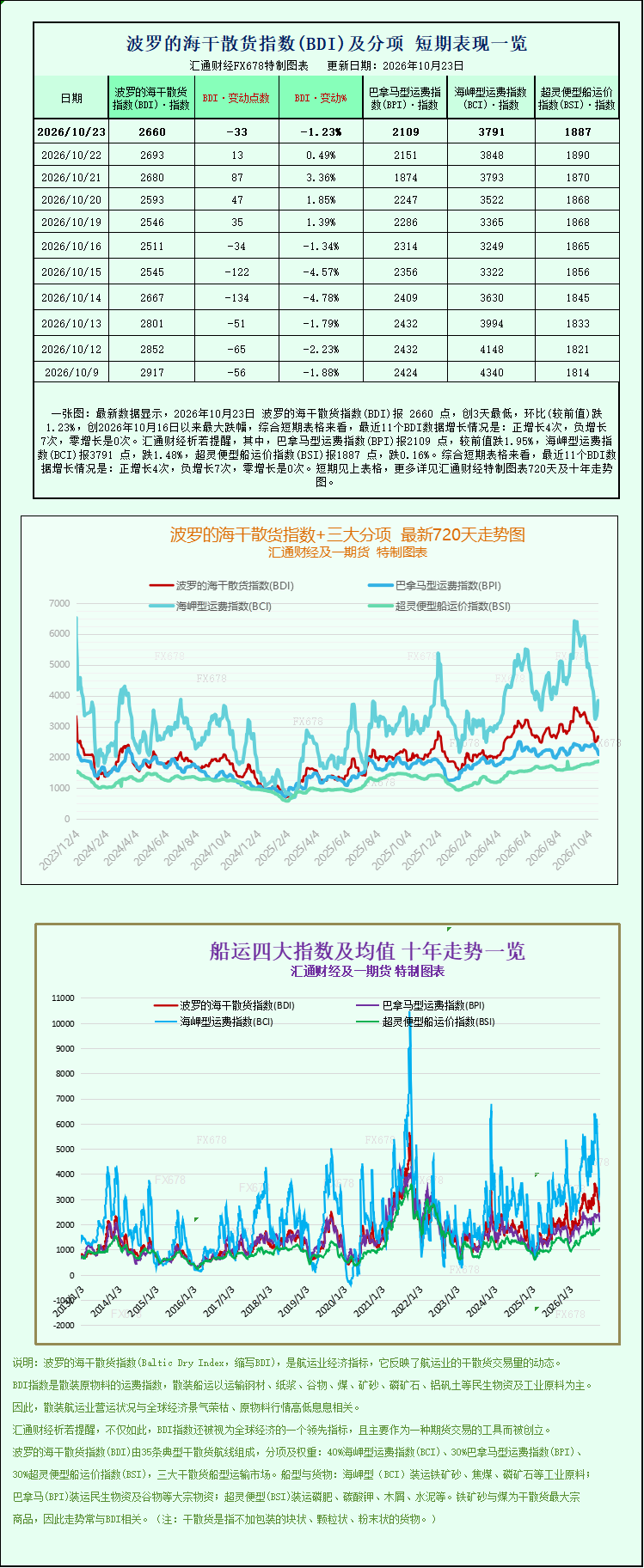 The Baltic Dry Index (BDI) fell on Friday, but supported by a significant increase in Capesize freight rates, it still recorded its second consecutive weekly gain, further extending the recent recovery momentum in the dry bulk shipping market. Data shows that the Baltic Dry Index, which tracks freight rates for the three main vessel types—Capessize, Panamax, and Supramax—fell 33 points, or 1.23%, to close at 2660 points. Despite the weak single-day performance, the index still rose by approximately 5.9% for the week. As a core indicator of the global dry bulk shipping market, the BDI is a weighted average of spot freight rates for different vessel types, and its fluctuations are often seen as a leading indicator of commodity trading activity and even global economic demand expectations. The main driver of this round of index increases remains Capesize vessels. The Capesize index fell 57 points, or 1.48%, to close at 3791, but still achieved its second consecutive week of gains, with a weekly increase of 16.7%, significantly outperforming other vessel types. These large vessels are typically used to transport bulk dry cargoes of 150,000 tons or more, especially iron ore and coal; therefore, their freight rates are highly correlated with global mining trade flows and the purchasing pace of major buyers such as China. The average daily earnings for Capesize vessels fell by $519 to $30,877, a slight decrease from the previous trading day, but still at a relatively high level recently, reflecting the continued strong bargaining power of shipowners. From the demand side, the iron ore market is particularly crucial to Capesize freight rates. On Friday, iron ore futures prices rose, supported by declining inventories at major Chinese ports; however, the contract recorded its seventh consecutive weekly decline as traders continued to weigh the pressure from weak overall demand. This mixed situation explains, to some extent, why Capesize freight rates surged in the short term, but market concerns remain about the sustainability of future demand. As the world's largest iron ore importer, China's steel production pace, port inventory changes, and policy direction are consistently key variables influencing Capesize freight rates. In stark contrast to the strength of Capesize vessels, freight rates for smaller vessels weakened significantly this week. The Panamax index fell 42 points, or 1.95%, to close at 2109 points, its lowest level since August 24th, with a cumulative weekly decline of 8.9%. Panamax vessels typically carry 60,000 to 70,000 tons of coal or grain; the continued decline in their freight rates reflects the current weakness in grain trade and insufficient demand for coal transportation. Average daily earnings for Panamax vessels fell by $377 to $18,981. Among smaller vessels, the Supramax bulk carrier index fell 3 points, or 0.16%, to close at 1887, but still showed a slight weekly increase of 1.18%. Supramax vessels primarily handle small to medium-tonnage bulk cargo, and their freight rates have been relatively resilient, indicating that demand for certain niche cargo types remains somewhat robust. Overall, the current dry bulk shipping market exhibits a divergent pattern of "strong large vessels, weak small vessels": Capesize vessels have continued to strengthen, driven by a temporary recovery in demand for Capesize coal and iron ore, becoming the main force supporting the BDI's upward trend; while Panamax freight rates have fallen to a near two-month low, reflecting the weakness in trade in small and medium-sized commodities such as grains and coal. This structural divergence reflects both the differences in the fundamentals of different cargo types and the uneven recovery in global commodity demand. Looking ahead, the sustainability of Capesize freight rates will continue to depend primarily on the pace of China's iron ore imports and changes in the steel industry's prosperity. Whether small and medium-sized vessels can stabilize will depend on the support from seasonal factors such as the South American grain export season. The market generally believes that short-term freight rate volatility may intensify, and investors need to closely monitor marginal changes in supply and demand for various cargo types.
- Risk Warning and Disclaimer
- The market involves risk, and trading may not be suitable for all investors. This article is for reference only and does not constitute personal investment advice, nor does it take into account certain users’ specific investment objectives, financial situation, or other needs. Any investment decisions made based on this information are at your own risk.