The Bank of Japan may hold rates steady this week, but its policy approach has subtly shifted, leaving the possibility of a December rate hike uncertain.
2026-10-26 08:20:22
On Monday (October 26) during Asian trading hours, the USD/JPY pair fluctuated slightly higher, currently trading around 157, remaining in the low range since late September. Market attention has shifted to the upcoming Bank of Japan (BOJ) meeting results, with a forward-looking report from Daiwa Securities providing an important reference for judging policy direction. Daiwa Securities expects the BOJ to maintain interest rates this month but will announce that underlying inflation has reached 2%, shifting the policy focus to stabilizing inflation at that level. Board member Takada may again propose a rate hike, and Ueda Kazuo's wording will be closely watched for clues about a December rate hike.  The central bank is expected to raise the official cash rate to 3% before the election, as high oil prices and a weak New Zealand dollar are pushing up inflation.
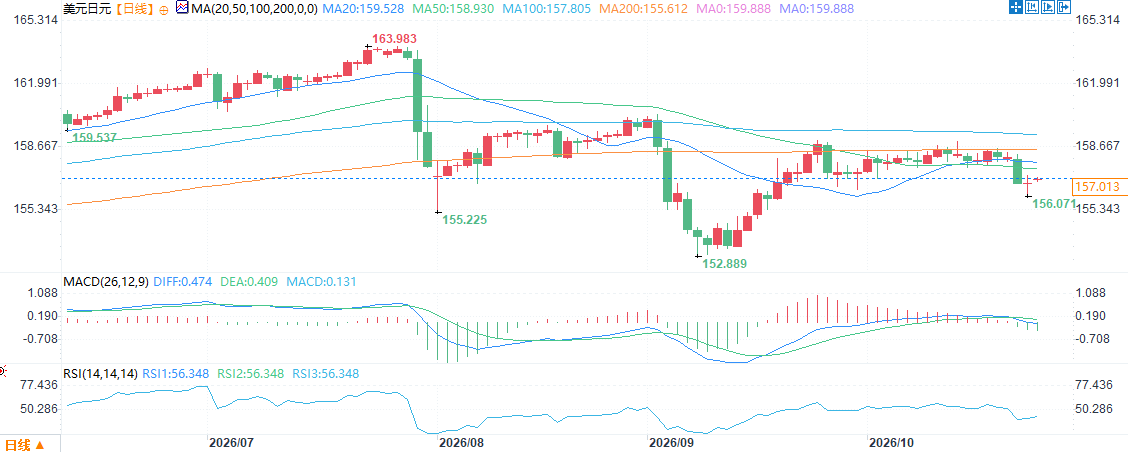 (USD/JPY daily chart, source: EasyForex) At 8:15 Beijing time, USD/JPY was trading at 157.03/04.
The central bank is expected to raise the official cash rate to 3% before the election, as high oil prices and a weak New Zealand dollar are pushing up inflation.Key takeaway: Interest rates remain unchanged, but policy direction subtly shifts.
The Bank of Japan (BOJ) is expected to keep interest rates unchanged at its October meeting, but this decision could still mark a significant shift in its policy thinking. According to a forward-looking report by Daiwa Securities, the BOJ board is expected to conclude that underlying inflation has reached 2%—a step that would signify a shift from "pushing inflation to the target" to "stabilizing inflation around that level." In short, while the BOJ appears to be holding rates steady, it has subtly shifted its policy objective: from "raising inflation" to "preventing inflation from going too far," which keeps the possibility of a December rate hike firmly in place.The rationale for maintaining the current policy stance is that economic and price trends are in line with expectations, and inflation expectations have cooled somewhat.
Daiwa Securities, citing media reports, stated that since September, economic conditions and prices have consistently aligned with the Bank of Japan's outlook, and policymakers believe that upside inflation risks are insufficient to justify a back-to-back interest rate hike. A survey released in October also showed that inflation expectations among households and businesses have eased. Nevertheless, concerns about inflation overshooting remain high: cost pass-throughs are widening on the consumer side, rising oil prices have reignited upstream price pressures, and some within the Bank of Japan expect the pass-through effect to accelerate next year.Policy shift: From "pushing up inflation" to "stabilizing inflation"
Governor Kazuo Ueda signaled a shift in tone earlier this month, stating that with underlying inflation approaching 2%, the central bank can no longer tolerate further increases in inflation and aims to stabilize it. Daiwa Securities expects the Outlook Report to replace the previous statement "inflation is approaching 2%" with "inflation is broadly in line with the target," and notes that if the report continues to highlight upside inflation risks, it will provide a basis for considering an earlier rate hike.Committee Divided: Takada may raise interest rates again, Tamura is expected to support maintaining rates.
Daiwa Securities expects that policymaker Hajime Takada will vote against raising interest rates, just as he did in July, citing strong global demand, including for AI-related products. Daiwa Securities also stated that policymaker Naoki Tamura, who previously advocated for rate hikes every few months towards a neutral level of around 2%, is expected to support maintaining the current interest rate shortly after a September rate hike.Economic and Inflation Forecast Adjustments: Upward revision of growth and core CPI, downward revision of core CPI
In terms of forecasts, Daiwa Securities expects the committee to raise its fiscal 2026 growth forecast from 0.6% to 0.8%, and its fiscal 2027 core CPI forecast from 2.4% to 2.5% to reflect the impact of rising oil prices, while slightly lowering its fiscal 2026 core CPI forecast to 2.4%. The report is unlikely to include a planned reduction in the food consumption tax—Daiwa estimates this move could lower core inflation by approximately 1.5 percentage points in fiscal 2027.Key points from the press conference: Did Ueda's wording refer to the "next meeting"?
The press conference following Kazuo Ueda's meeting will be crucial. Daiwa Securities will be watching closely to see if he continues to describe the interest rate decision as "a judgment made at every meeting," or shifts to wording that hints at "the next meeting"—the latter could be interpreted by the market as a stronger signal of a December rate hike. Given that the policy rate is already above the lower end of the Bank of Japan's estimated neutral range (approximately 1% to 2.5%), Ueda's assessment of the financial situation will also influence market expectations regarding the pace of subsequent tightening.Summarize
Daiwa Securities expects the Bank of Japan to keep interest rates unchanged at its October meeting, but will announce that underlying inflation has reached 2%, shifting its policy focus from pushing up inflation to stabilizing it. A December rate hike remains within reach. Hajime Takada may propose a rate hike again, and Kazuo Ueda's wording—especially whether it shifts from "every meeting" to hinting at "the next meeting"—will be key to the market pricing in December action. Upside risks to oil prices and concerns about inflation overshooting provide hawkish support, while if Ueda emphasizes a comprehensive assessment of financial conditions, it could lower rate hike expectations and put pressure on the yen. (USD/JPY daily chart, source: EasyForex) At 8:15 Beijing time, USD/JPY was trading at 157.03/04.
- Risk Warning and Disclaimer
- The market involves risk, and trading may not be suitable for all investors. This article is for reference only and does not constitute personal investment advice, nor does it take into account certain users’ specific investment objectives, financial situation, or other needs. Any investment decisions made based on this information are at your own risk.