Analysts: Last week's sharp drop in gold prices was more of a trading-driven disturbance and did not reverse the long-term fundamentals of gold.
2026-10-26 11:38:24
On the eve of the weekend, international gold prices fell below a key support level, putting significant pressure on the market. Even as the yield on the 10-year US Treasury note fell below 5%, gold failed to halt its decline. Several market analysts analyzed the logic behind this round of gold selling from technical, liquidity, Federal Reserve policy, and geopolitical perspectives, leading to differing opinions among institutions regarding future market trends.
Gold prices faced their heaviest selling pressure in six weeks, pressured by both inflation and liquidity constraints.
Persistently high inflation has dragged down the gold bull market. Sticky inflation is forcing the Federal Reserve to begin a tightening cycle, pushing up interest rates and real yields, thus increasing the opportunity cost of holding gold, a non-interest-bearing asset. Last Thursday, market funds flowed into US long-term bonds for safety, causing the 10-year Treasury yield to fall, which should theoretically be beneficial for gold. However, technical selling and cross-asset liquidity pressures dominated the market. Spot gold fell 3.99% last week, the most severe decline since early June, with the selling mainly concentrated on Thursday.
"It's clear that the current situation is a battle between short-term technical traders and long-term investors," said Ole Hansen, head of commodities strategy at Saxo Bank. "Short-term funds are taking advantage of the decline to short, but the underlying demand from long-term funds remains solid." He added that market concerns about a liquidity crisis amplified the sell-off, triggering numerous stop-loss orders after gold prices fell below $4,065, with the next key support level at $3,970. He also noted that speculative positions may have entered extreme ranges, and a rapid rebound in gold prices is possible after a technical correction.
Institutional opinions are divided, with most analysts not believing the trend has turned bearish.
Roukaya Ibrahim, chief commodities strategist at BCA Research, said last week's gold price decline was disappointing, but it does not signal the start of a new deep downtrend. She believes Thursday's drop was event-driven, stemming from tightening liquidity across the market and assets, rather than a fundamental change in gold's fundamentals. Panic near key support levels further amplified the decline.
Ibrahim added that gold prices have shown resilience despite negative macroeconomic factors. The recent decline has pushed gold into oversold territory, with the price deviation from the 200-day moving average returning to levels seen in late July, when gold rebounded after finding a temporary low. However, a stronger dollar and persistent inflation will limit the upside potential. She predicts that gold prices will likely remain range-bound, unlikely to experience a significant one-sided surge or a sustained sharp decline.
Neil Welsh, head of metals at British Global Markets, also believes that the recent decline is merely a change in market trading structure and does not alter the long-term investment logic for gold. He cautions that if the stock market further declines, investors may be forced to liquidate their positions to meet margin calls, potentially leading to a new round of selling pressure on gold. However, the continued bullish stance of many funds, coupled with ongoing gold purchases by central banks worldwide, should provide support for gold prices.
The Federal Reserve's policy path becomes a key variable, with central banks around the world entering their interest rate decision week.
Rob Haworth, senior investment strategist at Bank of America Wealth Management, believes that the Fed's tightening cycle will continue to support the dollar, putting downward pressure on gold prices. He said, "The Fed is very determined to fight inflation, but it will not take aggressive rate hikes."
The market expects the Federal Reserve to hold off on raising interest rates at this week's meeting, but retain the option of a December rate hike. Economists at the bank predict further rate hikes in December and March of the following year. This gradual tightening path, even if US Treasury yields do not rise significantly, will support the US dollar and limit the upside potential of gold. In addition to the Federal Reserve, the Bank of Canada, the European Central Bank, and the Bank of Japan will also hold monetary policy meetings this week, leading to a concentrated release of global central bank policies and increasing market volatility risk.
The situation in the Middle East is affecting liquidity, but there is still a chance for a rebound in the market at the end of the year.
Simon-Peter Massabni, head of business development at XS, stated that for gold prices to ease downward pressure, the Middle East needs to achieve sustainable stability and avoid repeated shocks to the energy market. The tensions in the Middle East not only push up US inflation and Treasury yields but also drain liquidity from the Middle East and Asia, and the current geopolitical situation is unlikely to improve in the short term.
Ole Hansen added that the continued accumulation of net short positions by hedge funds has actually laid the groundwork for a rapid rebound in gold prices, but gold needs to rise above $4,230 to confirm the end of this round of correction. After the December futures contracts expire at the end of November, positioning and liquidity pressures are expected to ease, and supported by demand for diversification and fiscal and geopolitical risks, gold prices still have a chance to stage a year-end rebound.
Conclusion
Short-term liquidity panic and expectations of a tighter Federal Reserve policy are driving gold price movements, with institutions generally not bearish on the long-term outlook for gold. Amidst a confluence of macroeconomic and geopolitical variables, gold is likely to remain in a volatile trading pattern in the short term, with its ultimate direction depending on central bank signals and further developments in the Middle East.
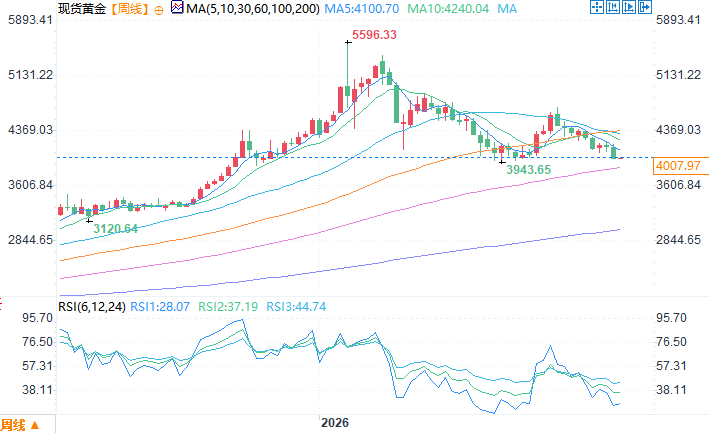
Spot gold weekly chart source: EasyForex
At 11:36 AM Beijing time on October 26, spot gold was trading at $4011.97 per ounce.
- Risk Warning and Disclaimer
- The market involves risk, and trading may not be suitable for all investors. This article is for reference only and does not constitute personal investment advice, nor does it take into account certain users’ specific investment objectives, financial situation, or other needs. Any investment decisions made based on this information are at your own risk.