AI-driven debt alerts and soaring oil prices cause wild fluctuations in US Treasury yields.
2026-10-26 12:08:22
Last week, investors flocked to safe-haven assets, as concerns about AI capital expenditures and rising oil prices both impacted the stock market, pushing the yield on the 10-year US Treasury bond below 5% at one point. The battle between bulls and bears in the US Treasury market intensified, compounded by inflation expectations, manufacturing data, and geopolitical turmoil in the Middle East, with market attention now focused on this week's Federal Reserve interest rate meeting.
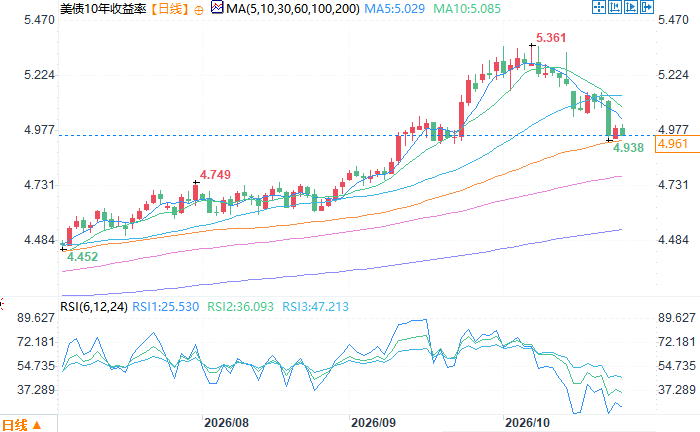 10-year US Treasury yield daily chart. Source: EasyTrade. At 12:05 PM Beijing time on October 26, the 10-year US Treasury yield was 4.961%.
US Treasury yields fell initially before rising, highlighting the debt risks of AI companies.
The 10-year Treasury yield fell below 5% on Thursday for the first time in a month, before rebounding slightly on Friday to close at 4.994%. The 2-year and 30-year yields rose accordingly. Chris Rupkey, chief economist at Fwdbonds, said the sharp drop in the 10-year yield on Thursday left bond investors confused, and the only clear theme on Friday was the continued rise in oil prices. He said, "This basically means that inflationary pressures will return, and bond yields are adjusting upwards to absorb the impact of this round of energy price increases." Market concerns about tech companies borrowing heavily to build AI infrastructure led to weakness in related stocks, higher tech bond yields, and a significant widening of credit default swap spreads. CoreWeave became a representative target of this sell-off, with its 2031 bond yield rising to 15.637%, and the 5-year credit default swap spread exceeding 1000, a level typically considered distressed debt.Whether the bond market rally can continue is a point of contention among institutions.
Byron Anderson, head of fixed income at Laffer Tengler Investments, is cautious about the sustainability of the U.S. Treasury bond rally. He said, "The Fed's policy focus remains on inflation, and it is no longer acting as a buyer in the bond market. Unless the market narrative shifts towards recession, a sustained bond rally is unlikely. We are still far from recession expectations, the market is still pricing in two rate hikes, and the economic fundamentals remain resilient." The market expects the Fed to maintain the current interest rate range of 3.75% to 4.00% at this week's meeting, but the CME FedWatch tool shows a roughly 71% probability of a 25 basis point rate hike in December. Chris Rupkey predicts that Fed Chairman Kevin Warsh will find it difficult to provide clear guidance to the bond market at Wednesday's press conference. He said, "We expect Warsh will not directly approve a December rate hike, which will be different from the communication style during Powell's era."Consumer confidence remains weak, while manufacturing data unexpectedly strengthens.
A University of Michigan survey released last Friday showed that the U.S. consumer confidence index for October was only 48, a slight decrease of 0.1 points from September, better than market consensus, but still at a historically low level, and a significant year-on-year decline of 10.4%. One-year inflation expectations rose to 4.7%, and five-year inflation expectations climbed to 3.5%, both increasing by 0.1 percentage points from September, indicating continued inflationary pressure suppressing consumer expectations. On the same day, the S&P Global Manufacturing Purchasing Managers' Index (PMI) recorded 56, higher than the expected value of 55.3, reaching a 53-month high. This strong manufacturing data further supported inflation and interest rate hike expectations.The situation in the Middle East is pushing up oil prices, and external risks continue to escalate.
Energy prices have once again become a key variable in inflation, with WTI crude oil futures and Brent crude oil futures closing at $103.44/barrel and $116.80/barrel respectively on Friday. This round of oil price increases stems from renewed attacks on Saudi oil facilities by Iranian-backed Houthi rebels, raising market concerns about a contraction in oil supply. Trump stated on Wednesday that the US would not negotiate with Iran, and related actions would be implemented soon. Earlier reports indicated that after the US midterm elections on November 3, the US and Israel might resume strikes against Iran, with geopolitical risks continuing to roil the energy market and inflation expectations.Conclusion
The market is currently caught in a tug-of-war between AI debt risks, energy inflation, economic resilience, and Federal Reserve policy, resulting in significant short-term volatility in US Treasury yields. Next week's Fed policy statement and the evolving situation in the Middle East will directly determine the future direction of the bond, oil, and stock markets. 10-year US Treasury yield daily chart. Source: EasyTrade. At 12:05 PM Beijing time on October 26, the 10-year US Treasury yield was 4.961%.
- Risk Warning and Disclaimer
- The market involves risk, and trading may not be suitable for all investors. This article is for reference only and does not constitute personal investment advice, nor does it take into account certain users’ specific investment objectives, financial situation, or other needs. Any investment decisions made based on this information are at your own risk.