The pound was supported by expectations of a Bank of England interest rate hike, and the pound traded in a narrow range against the dollar.
2026-10-26 15:38:23
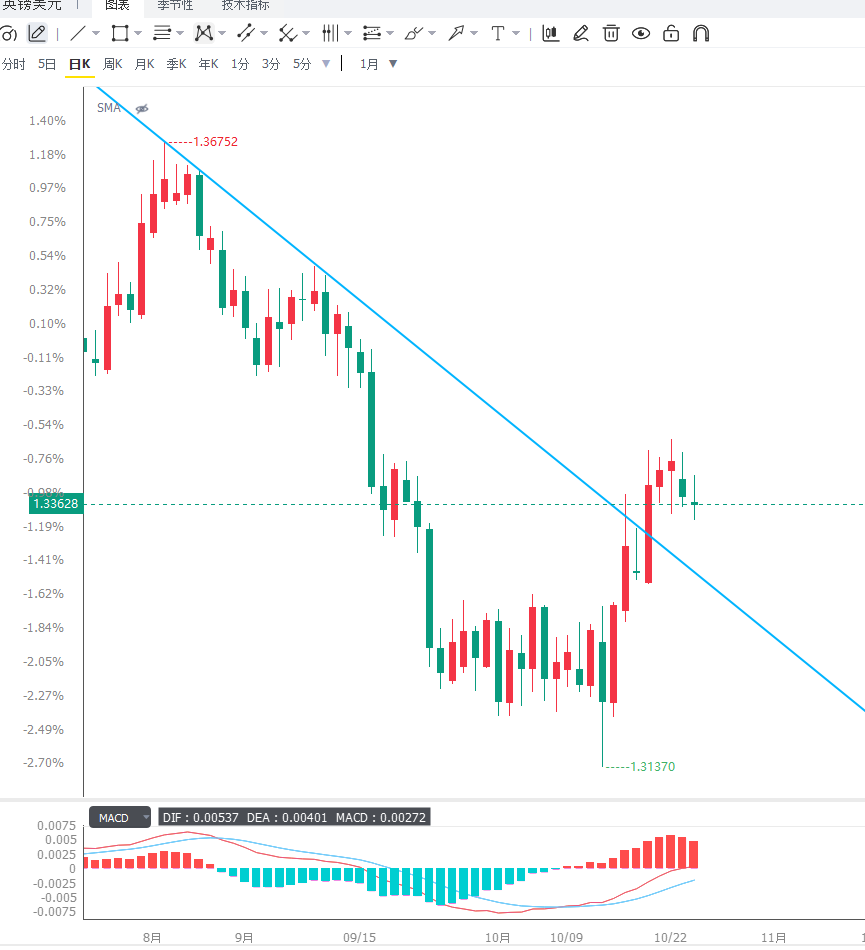
On Friday during the Asian session, the pound traded around 1.3360 against the dollar, continuing its rebound from a nearly four-month low on October 14. The core contradiction in the current exchange rate lies in the fact that expectations of a Bank of England rate hike provide proactive interest rate differential support for the pound, while the dollar's pullback, though aided by falling US Treasury yields, is limited by the undisproven tightening path at the end of the year and geopolitical risk premiums. This combination results in a tug-of-war pattern where declines are met with support and rallies require confirmation, with the key level concentrated around 1.3400.  From the perspective of the pound, the resilience of both inflation and employment data has been the main driver of this round of strength. Stronger-than-expected UK inflation data and a resilient labor market have solidified market bets on further tightening of monetary policy by the Bank of England—traders are currently pricing in a 95% probability of a 25 basis point rate hike on November 5th. The significance of this reading is that it is not merely a game of expectations, but a policy path backed by actual data. For the pound against the dollar, this means that the interest rate differential is tilting towards the pound, making it easier for carry trades to find support at relatively low levels during any pullbacks caused by dollar fluctuations. This is the fundamental reason why the pound has been able to stage a "decent rebound" from its near four-month low: its upward momentum stems from substantial improvements in domestic fundamentals, rather than simply relying on the passive weakening of the dollar. However, it should be noted that high probability pricing itself also implies risk—if subsequent data softens or the Bank of England's rhetoric becomes more cautious, this fully priced-in rate hike expectation could be quickly reversed, leading to an accelerated pullback in the pound. Therefore, a 95% probability is both a tailwind and a potential source of crowded trades. The US dollar provided a counterbalancing force. The recent sharp decline in US Treasury yields from multi-year highs limited the dollar's attempt to rebound from its three-week low last Thursday, indirectly providing upside potential for the pound against the dollar. However, investors still attribute about an 80% probability of a Fed rate hike in December, making the dollar's pullback more of a technical correction than a trend reversal. For the pound against the dollar, this presents an environment of "short-term dollar weakness, medium-term floor": Wednesday's inaction was widely expected, offering little additional negative news; however, the year-end tightening path has not been disproven, making any breakout in the pound likely to encounter selling pressure at relatively high levels. This is also the structural reason why the pound's rebound has consistently failed to smoothly break through 1.3400 – the lack of buying pressure is not due to a lack of buyers, but rather a lack of catalysts to convince the market that the interest rate advantage will continue to widen. This week's event distribution suggests that the short-term rhythm will remain primarily one of "wait and see, then choose a side." Wednesday's Fed decision and Warsh press conference are the first key events. Given that the decision to hold rates steady is largely expected, the real factor triggering a repricing will be the wording of the statement and the Chairman's comments on the December path. Thursday's preliminary Q3 GDP figures and PCE price index will provide direct evidence of the US economic resilience and inflation stickiness. Stronger-than-expected data could weaken the narrative supporting lower US Treasury yields, potentially triggering short-term profit-taking in the pound. This means that before these two major events, a range-bound trading strategy is more prudent than a trend-following strategy, significantly reducing the probability of success for chasing highs and lows. It's worth noting that the fundamental background still provides support, and any corrective pullback could be seen as a buying opportunity—but this is contingent on the exchange rate not breaking key structural levels and the events not disrupting the existing interest rate differential. From a cross-asset perspective, the current fluctuations in the pound against the dollar are essentially a confluence of four factors: first, proactive interest rate hikes supported by UK inflation and employment data; second, a passive pullback in the dollar caused by falling US Treasury yields; third, a valuation ceiling created by the Fed's year-end path not being disproven; and fourth, two-way disturbances caused by high oil prices and geopolitical risk premiums. The same round of oil price increases simultaneously affects multiple transmission chains—it pushes up imported inflation in the UK (supporting the Bank of England's interest rate hikes, which is good for the pound), worsens the terms of trade for net importers (suppressing growth expectations, which is bad for the pound), and strengthens the Fed's rationale for maintaining high interest rates through global inflation (supporting the dollar). The result of these three forces offsetting each other is the fundamental reason why the exchange rate has been repeatedly fluctuating within a narrow range of 1.3340-1.3403. It is not appropriate to view single data points or statements in isolation, but rather to assess them within the transmission chain of "oil price—inflation—interest rate differential—exchange rate": only when a link in this chain shows substantial loosening will the pound's pricing center shift clearly. On the daily chart, GBP/USD is holding below the 100-day simple moving average (around 1.3390) and the 50.0% Fibonacci retracement level (around 1.3403), forming a dense resistance zone. Only a daily close above 1.3403 would confirm a breakout and open the way for a move towards the 61.8% retracement level at 1.3466 and even 1.3556. Support levels to watch are the 38.2% retracement at 1.3341 and the 23.6% retracement at 1.3263. A sustained break below 1.3263 would expose the structural Fibonacci anchor at 1.3137. Currently, the price is trading between key moving averages and a dense Fibonacci zone, a typical "building momentum for a breakout" pattern. A directional move will depend on a catalyst. On the 4-hour chart, the exchange rate rebounded from around 1.3340 and then slowly moved upward along the short-term moving average. The MACD histogram is close to the zero axis, and the fast and slow lines are repeatedly intertwined, indicating weak momentum but a slightly bullish bias. Currently, the price is fluctuating narrowly between 1.3355 and 1.3370. If it retraces to 1.3340-1.3350 and finds support, there is still a chance for another upward attack on 1.3380-1.3400 in the short term. If it breaks below 1.3341 with high volume, it may seek support at 1.3263 or even 1.3137. An upward breakout requires the Fed's statement and PCE data to be released. Until then, it is advisable to treat the price within a range and avoid chasing highs and lows.
 Editor's Summary: The core contradiction in the short-term GBP/USD exchange rate lies in the proactive interest rate differential support provided by the Bank of England's expected rate hike, while the upside potential is limited by the undisproven Fed year-end path and geopolitical risk premiums. This two-way driver makes the exchange rate more likely to consolidate within the 1.3340-1.3403 range, awaiting a breakout. Three key variables need to be monitored: first, the Fed's decision, interest rate statement, and Warsh press conference on Wednesday, which are the primary indicators of the tightness or looseness of the dollar's interest rate floor; second, the preliminary US Q3 GDP and PCE price index on Thursday, directly verifying the resilience of the US economy and inflation stickiness, thus affecting the direction of US Treasury yields; and third, the continuity of inflation and employment data before the Bank of England's November 5th meeting, which is crucial in determining whether the 95% probability of a rate hike will materialize. In addition, the Strait of Hormuz's navigation conditions and oil price trends, as dual sources of imported inflation and terms of trade, also need to be monitored simultaneously.
From the perspective of the pound, the resilience of both inflation and employment data has been the main driver of this round of strength. Stronger-than-expected UK inflation data and a resilient labor market have solidified market bets on further tightening of monetary policy by the Bank of England—traders are currently pricing in a 95% probability of a 25 basis point rate hike on November 5th. The significance of this reading is that it is not merely a game of expectations, but a policy path backed by actual data. For the pound against the dollar, this means that the interest rate differential is tilting towards the pound, making it easier for carry trades to find support at relatively low levels during any pullbacks caused by dollar fluctuations. This is the fundamental reason why the pound has been able to stage a "decent rebound" from its near four-month low: its upward momentum stems from substantial improvements in domestic fundamentals, rather than simply relying on the passive weakening of the dollar. However, it should be noted that high probability pricing itself also implies risk—if subsequent data softens or the Bank of England's rhetoric becomes more cautious, this fully priced-in rate hike expectation could be quickly reversed, leading to an accelerated pullback in the pound. Therefore, a 95% probability is both a tailwind and a potential source of crowded trades. The US dollar provided a counterbalancing force. The recent sharp decline in US Treasury yields from multi-year highs limited the dollar's attempt to rebound from its three-week low last Thursday, indirectly providing upside potential for the pound against the dollar. However, investors still attribute about an 80% probability of a Fed rate hike in December, making the dollar's pullback more of a technical correction than a trend reversal. For the pound against the dollar, this presents an environment of "short-term dollar weakness, medium-term floor": Wednesday's inaction was widely expected, offering little additional negative news; however, the year-end tightening path has not been disproven, making any breakout in the pound likely to encounter selling pressure at relatively high levels. This is also the structural reason why the pound's rebound has consistently failed to smoothly break through 1.3400 – the lack of buying pressure is not due to a lack of buyers, but rather a lack of catalysts to convince the market that the interest rate advantage will continue to widen. This week's event distribution suggests that the short-term rhythm will remain primarily one of "wait and see, then choose a side." Wednesday's Fed decision and Warsh press conference are the first key events. Given that the decision to hold rates steady is largely expected, the real factor triggering a repricing will be the wording of the statement and the Chairman's comments on the December path. Thursday's preliminary Q3 GDP figures and PCE price index will provide direct evidence of the US economic resilience and inflation stickiness. Stronger-than-expected data could weaken the narrative supporting lower US Treasury yields, potentially triggering short-term profit-taking in the pound. This means that before these two major events, a range-bound trading strategy is more prudent than a trend-following strategy, significantly reducing the probability of success for chasing highs and lows. It's worth noting that the fundamental background still provides support, and any corrective pullback could be seen as a buying opportunity—but this is contingent on the exchange rate not breaking key structural levels and the events not disrupting the existing interest rate differential. From a cross-asset perspective, the current fluctuations in the pound against the dollar are essentially a confluence of four factors: first, proactive interest rate hikes supported by UK inflation and employment data; second, a passive pullback in the dollar caused by falling US Treasury yields; third, a valuation ceiling created by the Fed's year-end path not being disproven; and fourth, two-way disturbances caused by high oil prices and geopolitical risk premiums. The same round of oil price increases simultaneously affects multiple transmission chains—it pushes up imported inflation in the UK (supporting the Bank of England's interest rate hikes, which is good for the pound), worsens the terms of trade for net importers (suppressing growth expectations, which is bad for the pound), and strengthens the Fed's rationale for maintaining high interest rates through global inflation (supporting the dollar). The result of these three forces offsetting each other is the fundamental reason why the exchange rate has been repeatedly fluctuating within a narrow range of 1.3340-1.3403. It is not appropriate to view single data points or statements in isolation, but rather to assess them within the transmission chain of "oil price—inflation—interest rate differential—exchange rate": only when a link in this chain shows substantial loosening will the pound's pricing center shift clearly. On the daily chart, GBP/USD is holding below the 100-day simple moving average (around 1.3390) and the 50.0% Fibonacci retracement level (around 1.3403), forming a dense resistance zone. Only a daily close above 1.3403 would confirm a breakout and open the way for a move towards the 61.8% retracement level at 1.3466 and even 1.3556. Support levels to watch are the 38.2% retracement at 1.3341 and the 23.6% retracement at 1.3263. A sustained break below 1.3263 would expose the structural Fibonacci anchor at 1.3137. Currently, the price is trading between key moving averages and a dense Fibonacci zone, a typical "building momentum for a breakout" pattern. A directional move will depend on a catalyst. On the 4-hour chart, the exchange rate rebounded from around 1.3340 and then slowly moved upward along the short-term moving average. The MACD histogram is close to the zero axis, and the fast and slow lines are repeatedly intertwined, indicating weak momentum but a slightly bullish bias. Currently, the price is fluctuating narrowly between 1.3355 and 1.3370. If it retraces to 1.3340-1.3350 and finds support, there is still a chance for another upward attack on 1.3380-1.3400 in the short term. If it breaks below 1.3341 with high volume, it may seek support at 1.3263 or even 1.3137. An upward breakout requires the Fed's statement and PCE data to be released. Until then, it is advisable to treat the price within a range and avoid chasing highs and lows. Editor's Summary: The core contradiction in the short-term GBP/USD exchange rate lies in the proactive interest rate differential support provided by the Bank of England's expected rate hike, while the upside potential is limited by the undisproven Fed year-end path and geopolitical risk premiums. This two-way driver makes the exchange rate more likely to consolidate within the 1.3340-1.3403 range, awaiting a breakout. Three key variables need to be monitored: first, the Fed's decision, interest rate statement, and Warsh press conference on Wednesday, which are the primary indicators of the tightness or looseness of the dollar's interest rate floor; second, the preliminary US Q3 GDP and PCE price index on Thursday, directly verifying the resilience of the US economy and inflation stickiness, thus affecting the direction of US Treasury yields; and third, the continuity of inflation and employment data before the Bank of England's November 5th meeting, which is crucial in determining whether the 95% probability of a rate hike will materialize. In addition, the Strait of Hormuz's navigation conditions and oil price trends, as dual sources of imported inflation and terms of trade, also need to be monitored simultaneously.
- Risk Warning and Disclaimer
- The market involves risk, and trading may not be suitable for all investors. This article is for reference only and does not constitute personal investment advice, nor does it take into account certain users’ specific investment objectives, financial situation, or other needs. Any investment decisions made based on this information are at your own risk.