Credit Market Observation: The Other Side of High Yields
2026-10-27 01:14:22
We have consistently maintained that this round of yield rebalancing has re-established the dual role of bonds in multi-asset portfolios: providing substantial returns while once again possessing significant risk hedging potential. The volatility in the tech market this month is a prime example: when the stock market was under pressure, funds flowed into US Treasuries for safety, causing US Treasury yields to decline, and duration assets once again played a role in diversifying risk. A single market event is insufficient to prove that the stock-bond hedging relationship has been fully restored, but the current allocation starting point is at a level rarely seen in recent years. Investors holding this type of hedging asset can now reap tangible returns.  However, this round of yield increases, which makes bonds more attractive in portfolios, also raises a familiar question for the market and the economy: where will the impact of rising capital costs begin to manifest? So far, the overall macroeconomic resilience remains strong. However, rising borrowing costs are amplifying market divergence. Sectors with high leverage, large refinancing needs, fragile balance sheets, or long asset durations with minimal margin for error are becoming increasingly sensitive to interest rates. We focus on five key areas: 1. Even if the macroeconomic fundamentals do not deteriorate significantly, the pressure on low-quality corporate bonds may continue. Most high-quality companies can withstand rising risk-free rates: their leverage levels are controllable, their interest coverage is robust, and they maintain access to market financing channels. However, CCC-rated borrowers have much weaker financial flexibility, and the market has already reacted—the US high-yield bond market has recently shown significant credit divergence, meaning that the spread between low-rated bonds and US Treasuries has widened more significantly compared to the overall high-yield bond market. The pressure comes from two sides: on the one hand, higher-rated bonds already offer good total yields, and investors are no longer willing to allocate CCC-rated bonds for a small interest rate spread; on the other hand, the financing costs for the weakest borrowers will increase significantly when they refinance. Figure 1 visually illustrates this pressure by comparing the secondary market index yield and the outstanding coupon rate for each rating tier of high-yield bonds. This indicator can roughly estimate the increase in borrowing costs after refinancing, but it is not a precise calculation. Figure 1: CCC-rated capital structures face the largest increase in refinancing costs.
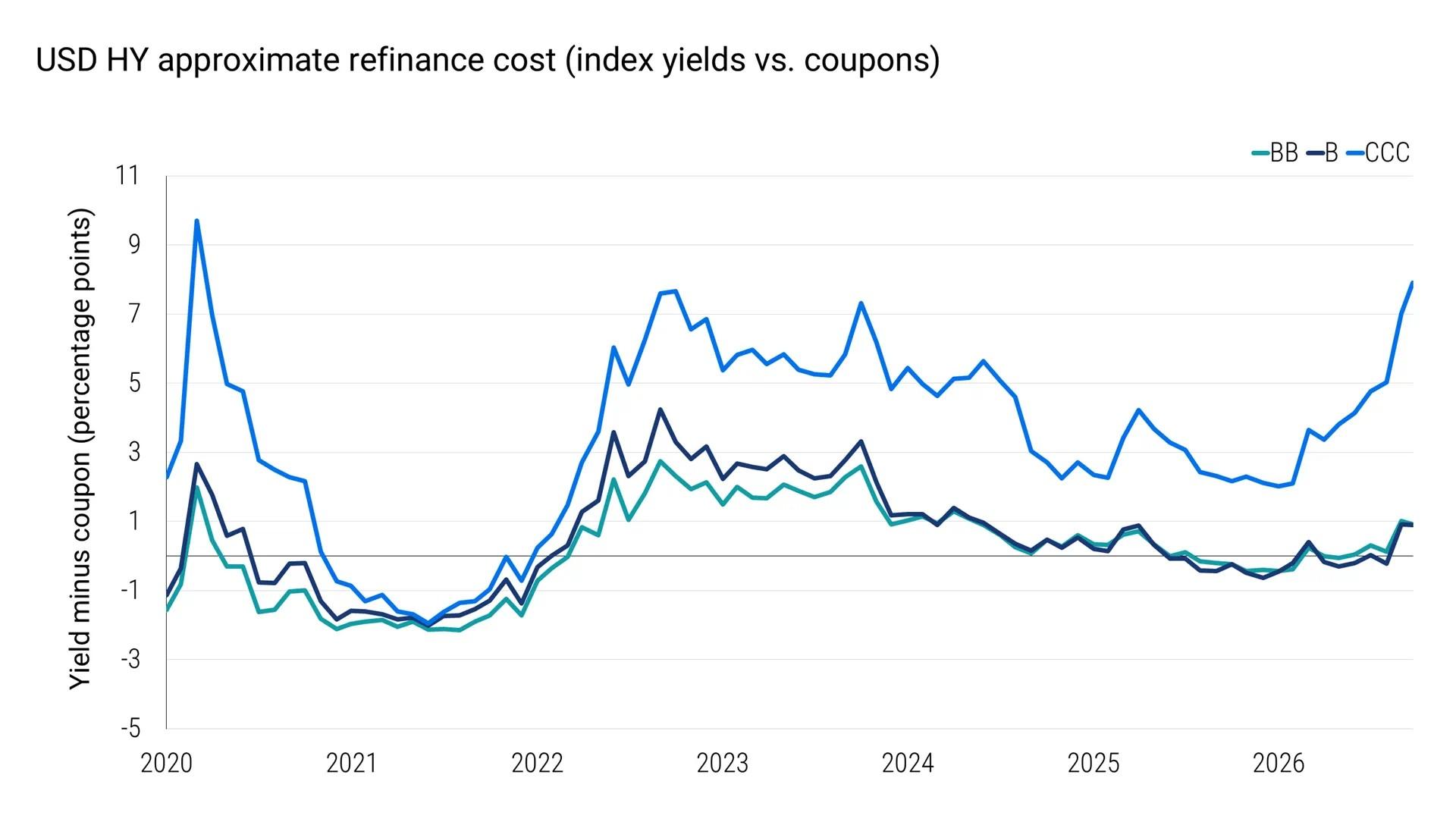 BB-rated credit: Bloomberg Ba US High Yield Total Return Index; B-rated credit: Bloomberg B US High Yield Total Return Index; CCC-rated credit: Bloomberg Caa US High Yield Total Return Index . 2. The risk of fiscal fragility in Europe remains a key concern. We continue to monitor the situation in Europe, especially economies with sluggish economic growth and significant fiscal balance pressures, leaving them with almost no buffer to absorb rising financing costs. Yields on both sides of the Atlantic have rebounded, but the underlying driving logics are quite different. In the US, rising interest rates are almost entirely driven by real yields (see Figure 2); while in Europe, breakeven inflation (inflation expectations) contributes more to the rise in nominal yields (see Figure 3). Simply put: the sell-off of US Treasuries is essentially a repricing of market expectations for growth; this is not the case in Europe. Figure 2: The rise in US interest rates is almost entirely driven by real yields.
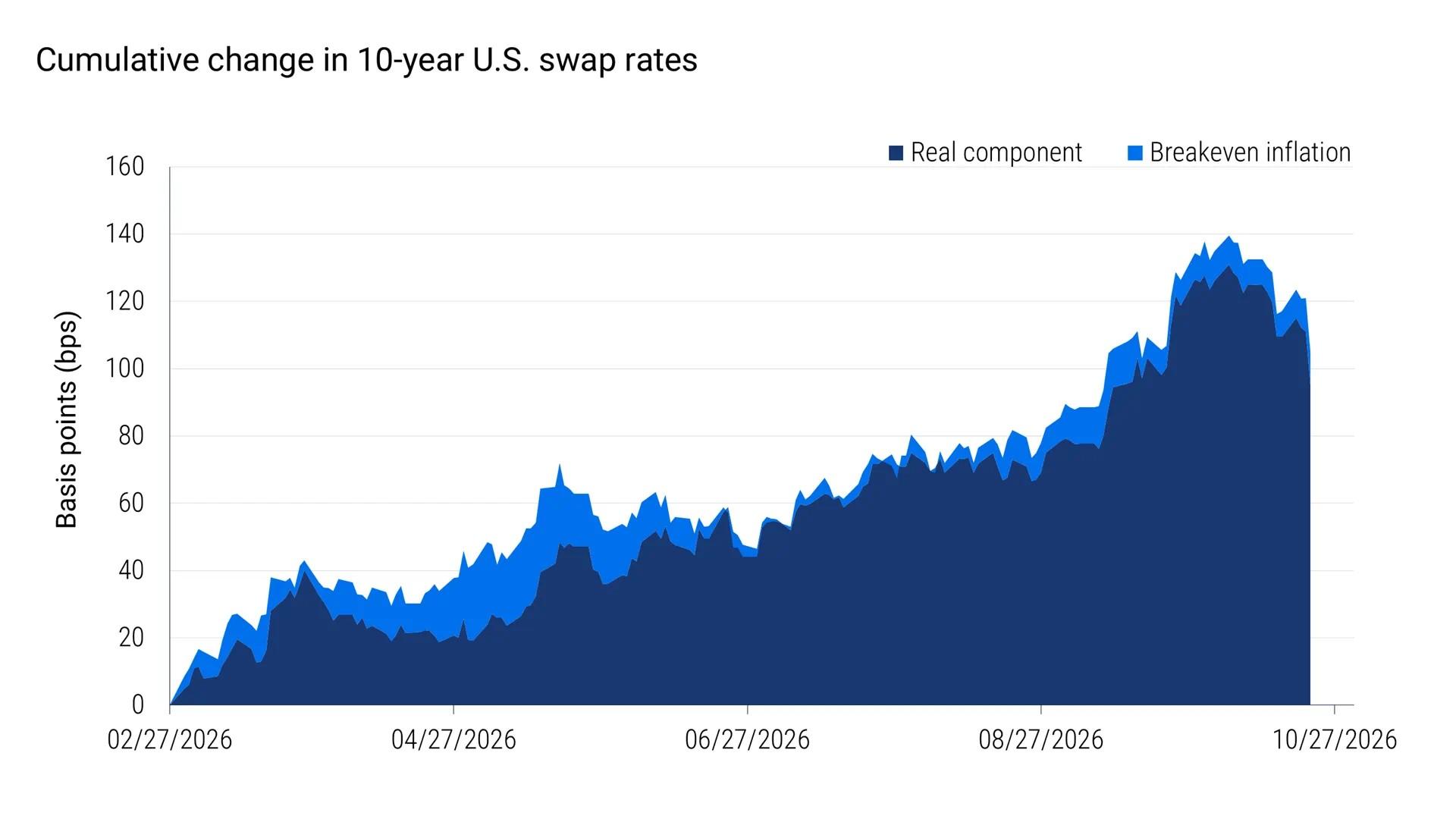 The baseline starting point, February 27, 2026, represents the low point of this round of yields (yields began to rise after the outbreak of the US-Iran conflict on February 28). Figure 3: In Europe, breakeven inflation plays a greater role in driving yields.
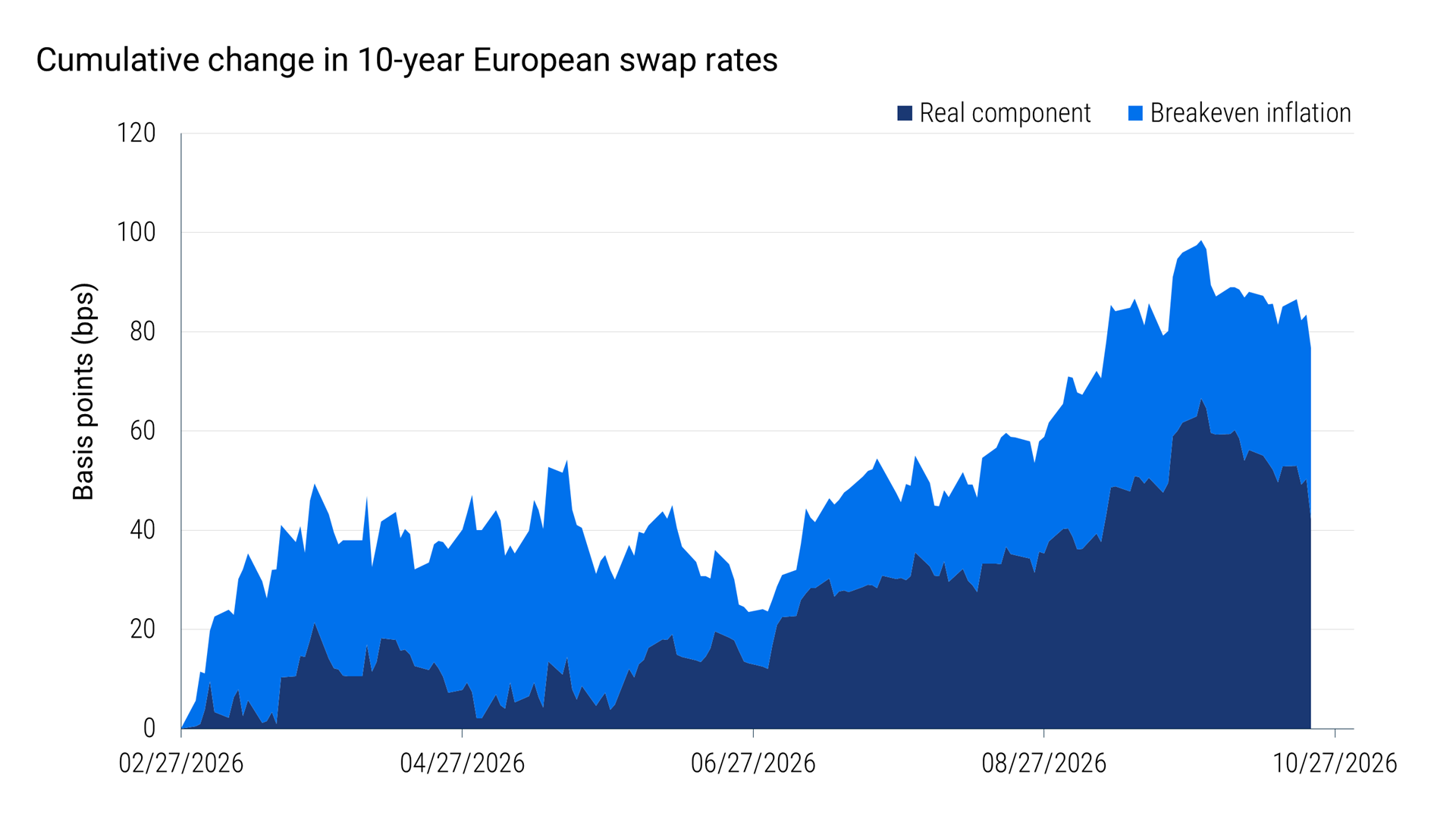 The composition of rising yields determines how easily an economy can absorb this pressure. If rising real yields are accompanied by stronger nominal growth and improved fiscal revenue, economies can more easily absorb it; however, if higher financing costs mainly come from inflation compensation, the pressure is greater for sovereign states already facing weak growth and difficult fiscal situations. France is a typical example: rising global yields have further worsened the already fragile growth and fiscal environment. French government bond (OAT) spreads have widened significantly, making it very difficult to achieve a sustained decline in risk premiums (see Figure 4). A more stable global duration environment can curb further widening of spreads; however, sluggish growth, high financing costs, coupled with a long political cycle, mean that risk premiums are likely to remain high and continue to recover. Figure 4: Widening Eurozone sovereign bond spreads, particularly prominent in France.
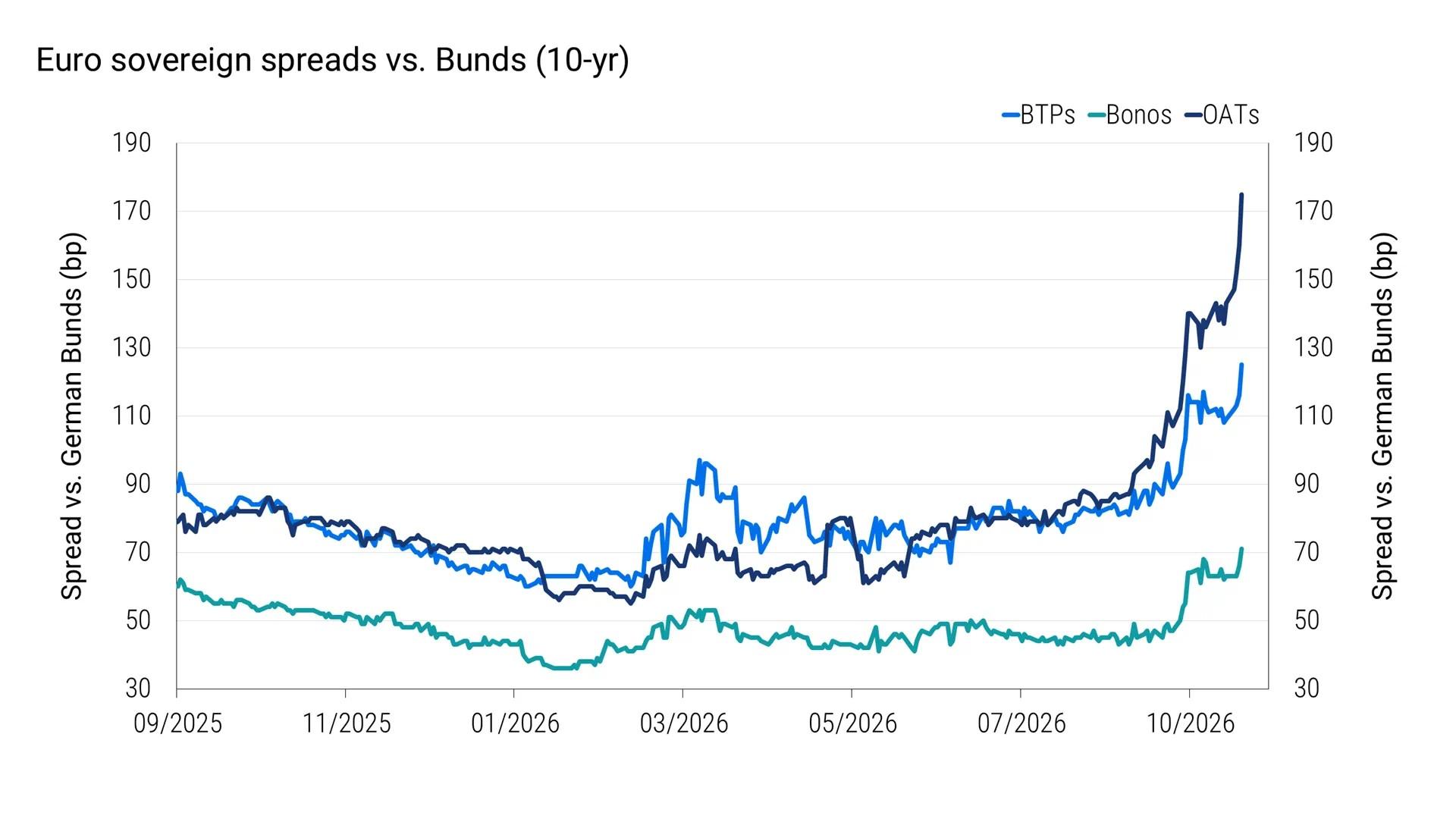 The data represents the spread between 10-year Italian BTP, Spanish Bonos, and French OAT bonds and German Bund bonds of the same maturity. 3. AI Debt: Rising Yields + Increased Supply Will Accelerate Credit Differentiation In our view, the recent sharp decline in bonds issued by low-credit-rating entities in the AI financing chain does not indicate a deterioration in the fundamentals of computing power. Computing power remains scarce, and demand remains strong. The market is repricing the sustainability of leveraged financing models in a high-yield environment, coupled with accelerated bond supply and increased attractiveness of high-rated alternatives. Market discussions on AI financing often focus on whether investors have sufficient capacity to absorb the massive amount of newly issued bonds. However, the more crucial question is: at what price can bonds be cleared out? The next round of financing will be larger in scale and more diversified in structure, requiring low-credit-rating borrowers to compete with cloud giants, data centers held by investment-grade entities, and asset-side projects with higher security levels. With overall yields already high, investors have no incentive to take on additional credit risk for returns. As the capital expenditure cycle matures, new challenges will emerge: market focus will shift from "building computing power capacity" to "monetizing capacity for profit." Returns depend on computing power utilization, pricing, the risk of technological obsolescence, and whether declining token costs can stimulate sufficient new demand. Even if the long-term commercialization of AI validates the current investment logic, the ultimate winners remain highly uncertain. New-generation hardware may capture most of the upward gains, while simultaneously reducing the utilization rate, rental income, and residual value of older equipment. This significant uncertainty leaves very little room for error for highly leveraged financing entities. 4. US Residential Real Estate: High Interest Rates Will Prolong the Downward Cycle, Not Exacerbate the Collapse A new round of mortgage rate increases is unlikely to trigger a new round of housing market crashes, but rather will continue the current weak trend. Housing is one of the most interest-rate-sensitive sectors in the real economy, and its fundamentals are already weak. Since 2022, housing prices, mortgage rates, and insurance costs have risen simultaneously, with housing expenditures growing far faster than household income. Housing affordability has deteriorated significantly, transaction volume is sluggish, the "low-interest rate lock-up effect" persists, and the share of residential investment in GDP is at a cyclical low (see Figure 5). Figure 5: Residential investment as a share of US GDP remains at a cyclical low.
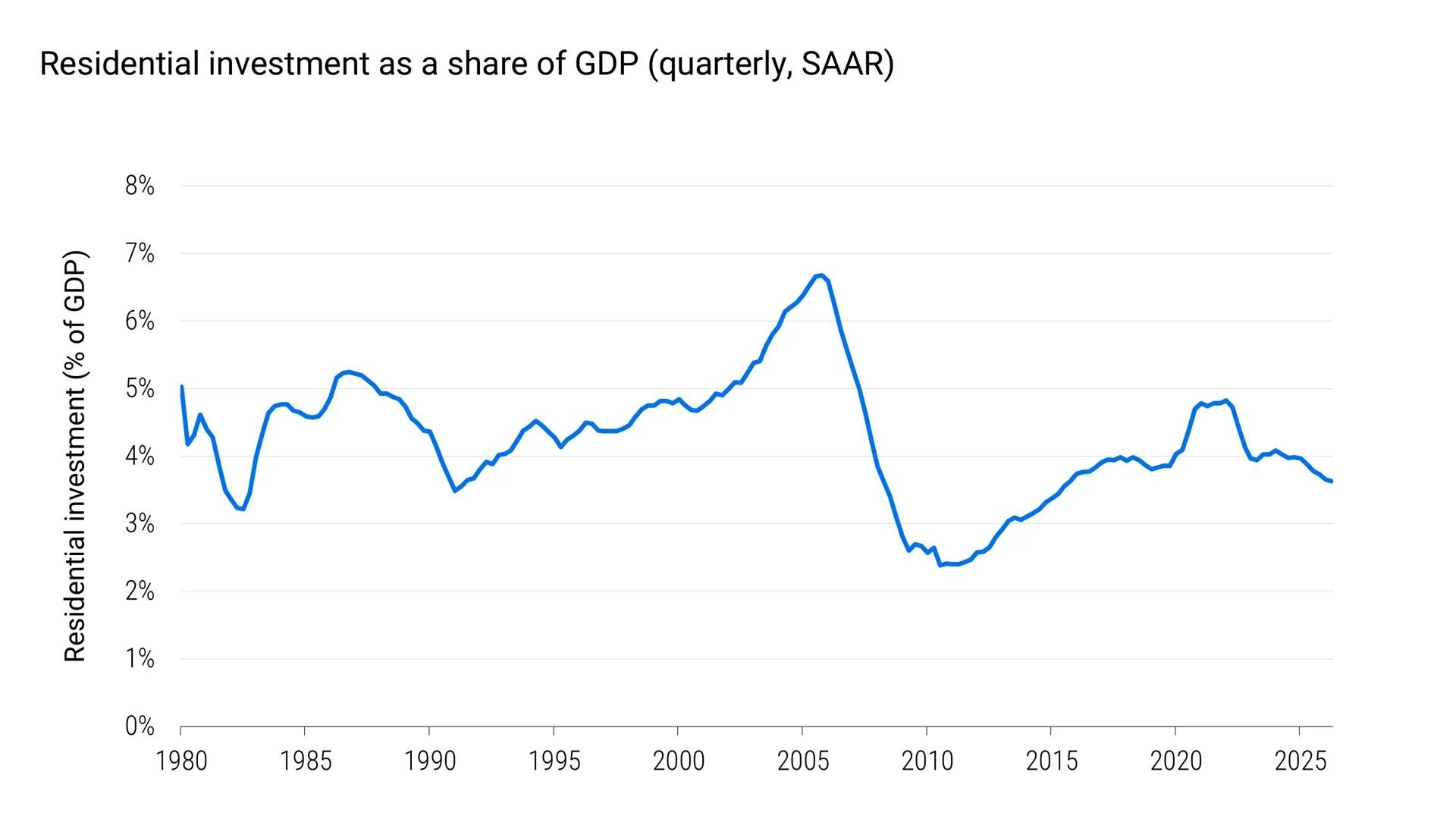 SAAR = Seasonally Adjusted Annualized Value. This means the residential market isn't entering a new downturn, but rather the existing weak cycle has been prolonged. High interest rates continue to suppress potential homebuyers; homeowners with low-interest mortgages also lack the incentive to upgrade, continuously dragging down property turnover, agent commissions, and residential-related investments tied to transactions. 5. Commercial Real Estate: Valuation Under Pressure, But No Global Credit Crisis Yet Rising yields are putting pressure on commercial real estate (CRE) valuations, but we haven't yet seen a widespread credit risk similar to that of 2023. The recent decline in listed real estate investment trusts (REITs) is more of a valuation reassessment than a new round of commercial real estate crisis. Rising real yields will push up capitalization rates (the rate of return investors require for property operating cash flow). Assuming operating cash flow remains unchanged, a higher capitalization rate will directly depress property valuations (other things being equal). According to GreenStreet data, the premium of commercial real estate capitalization rates relative to real yields is already close to historical lows, therefore valuations remain fragile. However, the signals from the credit market are relatively stable: investment-grade REIT bond spreads largely follow the benchmark, and commercial mortgage-backed securities (CMBS) spreads are resilient (see Figure 6); despite a decline in new lending, financing channels remain open. Unlike 2023, this round of yield increases has not led to a significant contraction in credit supply. Figure 6: Unlike 2023, this round of overall yield increases has not triggered a credit contraction in the real estate sector.
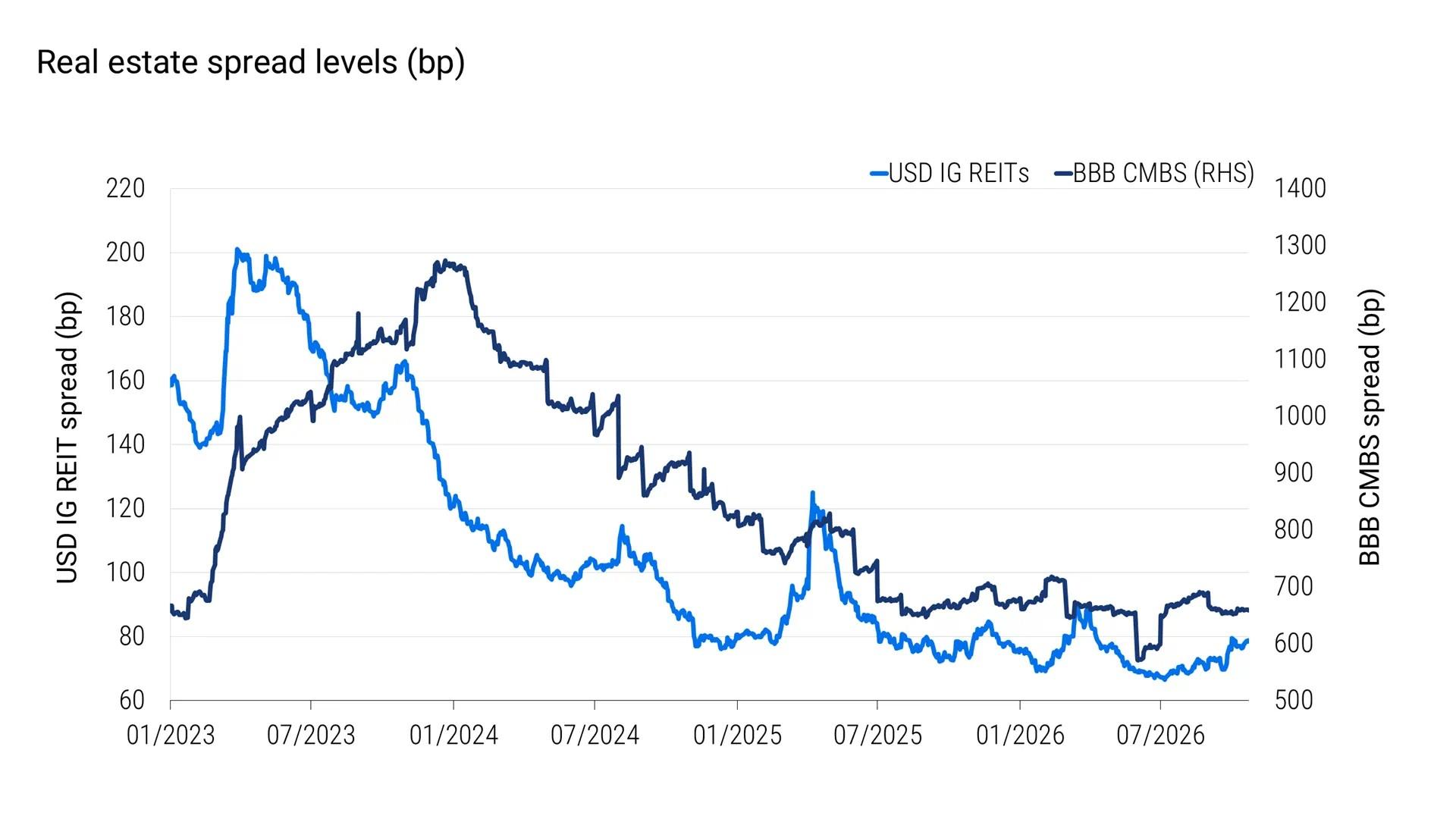 Investment-grade REITs: Bloomberg US Investment-Grade REIT Index; BBB-rated CMBS: The BBB component of the Bloomberg US Investment-Grade CMBS Index. The starting point for this round is also significantly different from previous ones: current borrowing costs are already high, and the impact of further interest rate increases on new debt repayments is limited. Projects completed after 2022 generally have lower leverage and stronger debt repayment coverage. There is a trend towards easing bank lending constraints at the policy level; at the same time, most real estate sub-sectors have not experienced the structural demand collapse seen in office real estate in 2023.
However, this round of yield increases, which makes bonds more attractive in portfolios, also raises a familiar question for the market and the economy: where will the impact of rising capital costs begin to manifest? So far, the overall macroeconomic resilience remains strong. However, rising borrowing costs are amplifying market divergence. Sectors with high leverage, large refinancing needs, fragile balance sheets, or long asset durations with minimal margin for error are becoming increasingly sensitive to interest rates. We focus on five key areas: 1. Even if the macroeconomic fundamentals do not deteriorate significantly, the pressure on low-quality corporate bonds may continue. Most high-quality companies can withstand rising risk-free rates: their leverage levels are controllable, their interest coverage is robust, and they maintain access to market financing channels. However, CCC-rated borrowers have much weaker financial flexibility, and the market has already reacted—the US high-yield bond market has recently shown significant credit divergence, meaning that the spread between low-rated bonds and US Treasuries has widened more significantly compared to the overall high-yield bond market. The pressure comes from two sides: on the one hand, higher-rated bonds already offer good total yields, and investors are no longer willing to allocate CCC-rated bonds for a small interest rate spread; on the other hand, the financing costs for the weakest borrowers will increase significantly when they refinance. Figure 1 visually illustrates this pressure by comparing the secondary market index yield and the outstanding coupon rate for each rating tier of high-yield bonds. This indicator can roughly estimate the increase in borrowing costs after refinancing, but it is not a precise calculation. Figure 1: CCC-rated capital structures face the largest increase in refinancing costs. BB-rated credit: Bloomberg Ba US High Yield Total Return Index; B-rated credit: Bloomberg B US High Yield Total Return Index; CCC-rated credit: Bloomberg Caa US High Yield Total Return Index . 2. The risk of fiscal fragility in Europe remains a key concern. We continue to monitor the situation in Europe, especially economies with sluggish economic growth and significant fiscal balance pressures, leaving them with almost no buffer to absorb rising financing costs. Yields on both sides of the Atlantic have rebounded, but the underlying driving logics are quite different. In the US, rising interest rates are almost entirely driven by real yields (see Figure 2); while in Europe, breakeven inflation (inflation expectations) contributes more to the rise in nominal yields (see Figure 3). Simply put: the sell-off of US Treasuries is essentially a repricing of market expectations for growth; this is not the case in Europe. Figure 2: The rise in US interest rates is almost entirely driven by real yields. The baseline starting point, February 27, 2026, represents the low point of this round of yields (yields began to rise after the outbreak of the US-Iran conflict on February 28). Figure 3: In Europe, breakeven inflation plays a greater role in driving yields. The composition of rising yields determines how easily an economy can absorb this pressure. If rising real yields are accompanied by stronger nominal growth and improved fiscal revenue, economies can more easily absorb it; however, if higher financing costs mainly come from inflation compensation, the pressure is greater for sovereign states already facing weak growth and difficult fiscal situations. France is a typical example: rising global yields have further worsened the already fragile growth and fiscal environment. French government bond (OAT) spreads have widened significantly, making it very difficult to achieve a sustained decline in risk premiums (see Figure 4). A more stable global duration environment can curb further widening of spreads; however, sluggish growth, high financing costs, coupled with a long political cycle, mean that risk premiums are likely to remain high and continue to recover. Figure 4: Widening Eurozone sovereign bond spreads, particularly prominent in France. The data represents the spread between 10-year Italian BTP, Spanish Bonos, and French OAT bonds and German Bund bonds of the same maturity. 3. AI Debt: Rising Yields + Increased Supply Will Accelerate Credit Differentiation In our view, the recent sharp decline in bonds issued by low-credit-rating entities in the AI financing chain does not indicate a deterioration in the fundamentals of computing power. Computing power remains scarce, and demand remains strong. The market is repricing the sustainability of leveraged financing models in a high-yield environment, coupled with accelerated bond supply and increased attractiveness of high-rated alternatives. Market discussions on AI financing often focus on whether investors have sufficient capacity to absorb the massive amount of newly issued bonds. However, the more crucial question is: at what price can bonds be cleared out? The next round of financing will be larger in scale and more diversified in structure, requiring low-credit-rating borrowers to compete with cloud giants, data centers held by investment-grade entities, and asset-side projects with higher security levels. With overall yields already high, investors have no incentive to take on additional credit risk for returns. As the capital expenditure cycle matures, new challenges will emerge: market focus will shift from "building computing power capacity" to "monetizing capacity for profit." Returns depend on computing power utilization, pricing, the risk of technological obsolescence, and whether declining token costs can stimulate sufficient new demand. Even if the long-term commercialization of AI validates the current investment logic, the ultimate winners remain highly uncertain. New-generation hardware may capture most of the upward gains, while simultaneously reducing the utilization rate, rental income, and residual value of older equipment. This significant uncertainty leaves very little room for error for highly leveraged financing entities. 4. US Residential Real Estate: High Interest Rates Will Prolong the Downward Cycle, Not Exacerbate the Collapse A new round of mortgage rate increases is unlikely to trigger a new round of housing market crashes, but rather will continue the current weak trend. Housing is one of the most interest-rate-sensitive sectors in the real economy, and its fundamentals are already weak. Since 2022, housing prices, mortgage rates, and insurance costs have risen simultaneously, with housing expenditures growing far faster than household income. Housing affordability has deteriorated significantly, transaction volume is sluggish, the "low-interest rate lock-up effect" persists, and the share of residential investment in GDP is at a cyclical low (see Figure 5). Figure 5: Residential investment as a share of US GDP remains at a cyclical low. SAAR = Seasonally Adjusted Annualized Value. This means the residential market isn't entering a new downturn, but rather the existing weak cycle has been prolonged. High interest rates continue to suppress potential homebuyers; homeowners with low-interest mortgages also lack the incentive to upgrade, continuously dragging down property turnover, agent commissions, and residential-related investments tied to transactions. 5. Commercial Real Estate: Valuation Under Pressure, But No Global Credit Crisis Yet Rising yields are putting pressure on commercial real estate (CRE) valuations, but we haven't yet seen a widespread credit risk similar to that of 2023. The recent decline in listed real estate investment trusts (REITs) is more of a valuation reassessment than a new round of commercial real estate crisis. Rising real yields will push up capitalization rates (the rate of return investors require for property operating cash flow). Assuming operating cash flow remains unchanged, a higher capitalization rate will directly depress property valuations (other things being equal). According to GreenStreet data, the premium of commercial real estate capitalization rates relative to real yields is already close to historical lows, therefore valuations remain fragile. However, the signals from the credit market are relatively stable: investment-grade REIT bond spreads largely follow the benchmark, and commercial mortgage-backed securities (CMBS) spreads are resilient (see Figure 6); despite a decline in new lending, financing channels remain open. Unlike 2023, this round of yield increases has not led to a significant contraction in credit supply. Figure 6: Unlike 2023, this round of overall yield increases has not triggered a credit contraction in the real estate sector. Investment-grade REITs: Bloomberg US Investment-Grade REIT Index; BBB-rated CMBS: The BBB component of the Bloomberg US Investment-Grade CMBS Index. The starting point for this round is also significantly different from previous ones: current borrowing costs are already high, and the impact of further interest rate increases on new debt repayments is limited. Projects completed after 2022 generally have lower leverage and stronger debt repayment coverage. There is a trend towards easing bank lending constraints at the policy level; at the same time, most real estate sub-sectors have not experienced the structural demand collapse seen in office real estate in 2023.
- Risk Warning and Disclaimer
- The market involves risk, and trading may not be suitable for all investors. This article is for reference only and does not constitute personal investment advice, nor does it take into account certain users’ specific investment objectives, financial situation, or other needs. Any investment decisions made based on this information are at your own risk.