Gold Trading Alert: Oil Prices Pull Back, But Fed Hawkish Sentiment Looms Large; Battle for $4,000 Gold Intensifies
2026-10-27 07:56:24
Spot gold rebounded 0.48% on Monday (October 26) to close at $4,016.97 per ounce after falling to its lowest level since July 20 at $3,975 on Friday. December U.S. gold futures rose 0.8% to settle at $4,038.40. On the surface, this appears to be a technical correction after an oversold condition; at a deeper level, gold prices have temporarily stabilized due to a confluence of factors, including falling oil prices easing inflation concerns, bargain hunting, cautious trading ahead of the Fed decision, and lingering geopolitical risks in the Middle East. The core contradiction for gold is clear: on the upside, there is pressure from Fed rate hike expectations, a resilient dollar, and near-5% U.S. Treasury yields; on the downside, there is support from geopolitical safe-haven demand, inflation hedging, and buying interest near the $4,000 level. Gold prices are likely to fluctuate around $4,000 in the short term, with the true direction depending on the Fed decision and PCE data for further clues. On Tuesday (October 27) in early Asian trading, spot gold fluctuated slightly lower, currently trading around $4005.04 per ounce, down about 0.3%. 
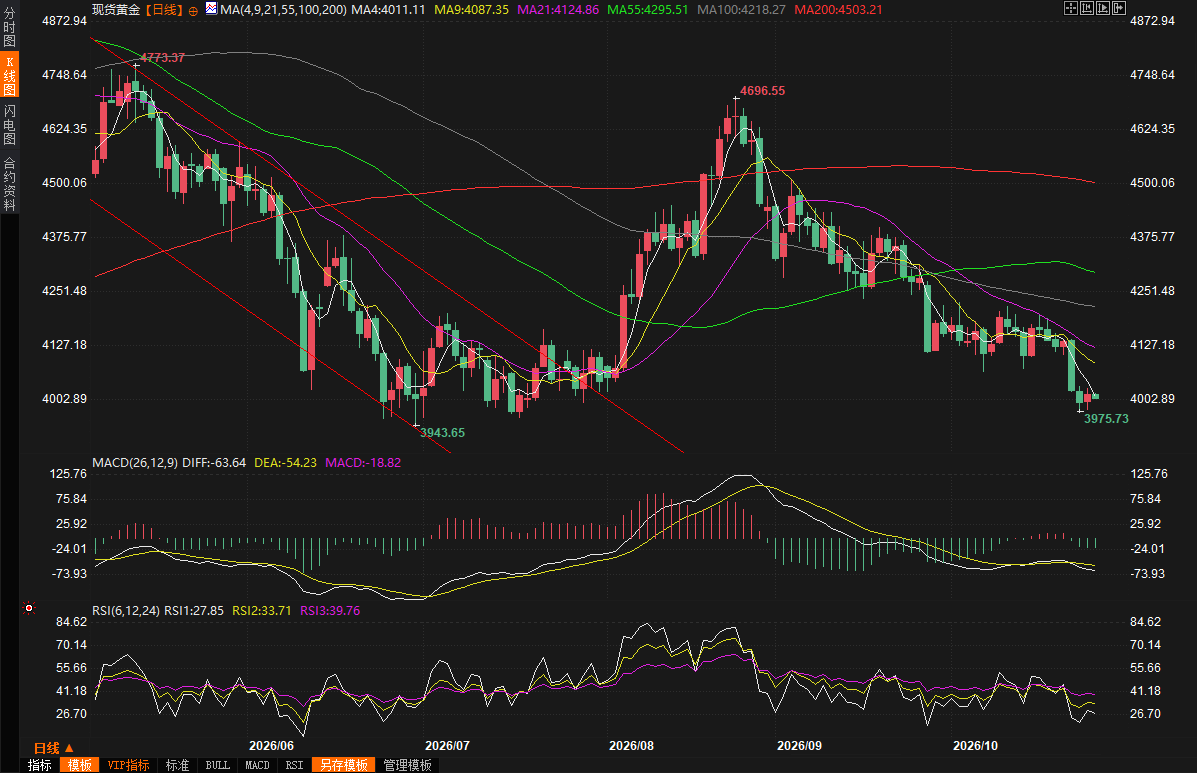 (Spot gold daily chart, source: FX678) At 07:52 Beijing time, spot gold is currently trading at $4006.19 per ounce.
I. A Night of Terror at the $4,000 Mark: Bargain Buying and Falling Oil Prices Join Forces to Support the Market
From a technical perspective, after gold prices touched $3,975 last Friday, the market did not continue with panic selling; instead, bargain hunting emerged on Monday. Bob Haberkorn, senior market strategist at StoneX, offered a straightforward assessment: the pullback in crude oil prices provided support for gold, while some bargain hunting also entered the market; gold prices are likely to remain around $4,000 before the Fed's decision. This suggests two key drivers behind the short-term rebound in gold. Firstly, oil prices retreated from near six-month highs, with Brent crude closing down 0.8% at $115.81 per barrel and U.S. crude down 1.46% at $101.76 per barrel. The cooling oil prices eased market concerns about runaway inflation, thus reducing pressure on gold holders facing expectations of interest rate hikes. Secondly, after gold prices fell to a more than three-month low, some funds believed there was short-term value around $3,975 and were willing to make tentative purchases before the Fed meeting. However, this rebound is more like a "defensive rebound" because trading is thin and investors are unwilling to make big bets ahead of the Fed's decision on Wednesday, with gold prices temporarily locked in a narrow range above $4,000.II. Oil prices are a double-edged sword for gold: Inflation concerns have eased, but the specter of high oil prices lingers.
The decline in oil prices is not a simple boon for gold, but a double-edged sword. In the short term, lower oil prices alleviate inflation concerns and reduce market fears of more aggressive interest rate hikes by the Federal Reserve, providing support for gold. However, in the medium term, oil prices remain near six-month highs, and the Middle East conflict continues to disrupt commercial shipping in the Strait of Hormuz and the Bab el-Mandeb Strait. International Energy Agency Executive Director Fatih Birol even reiterated that the global energy market is not expected to recover to pre-war levels by 2027. This means that inflationary pressures have not truly disappeared, but have only temporarily shifted from an acute issue to a chronic one. If Saudi oil pipeline pumping stations, Riyadh airport, or other energy and transportation facilities are attacked again, or if hostilities between the US and Iran escalate again, oil prices could surge again, inflation concerns would quickly return, and expectations of a Fed rate hike in December would be reinforced. For gold, the safe-haven buying and inflation hedging demand brought about by rising oil prices may be suppressed by the opportunity cost of rising interest rates; while the decline in oil prices may alleviate inflation, it may also weaken gold's appeal as an inflation hedge. Therefore, the short-term decline in oil prices is a "rescue force" for the rebound in gold prices, but it is by no means a reason for gold bulls to be complacent.III. On the eve of the Fed's decision: Pausing rate hikes is not a lifeline; December expectations are the sword of Damocles hanging overhead.
The Federal Reserve will announce its interest rate decision this Wednesday. The market widely expects a pause in rate hikes after the September increase, with interest rate futures indicating a roughly 90% probability of rates remaining unchanged this week. However, gold investors should not simply interpret this "pause in rate hikes" as a positive sign, as it appears more like an observation period than a policy shift. The CME Group's FedWatch tool shows traders expect an 80% probability of a December rate hike; Gennadiy Goldberg, head of US interest rate strategy at TD Securities, also predicts the Fed will resume rate hikes in December. In other words, the market has already fully priced in the Fed holding rates steady this week; what truly affects gold prices is the wording of the statement and hints at the future path. If Fed Chairman Warsh emphasizes inflation concerns and confirms continued gradual rate hikes at the press conference, real interest rate expectations and the dollar may strengthen again, putting new downward pressure on gold prices. If the Fed expresses more concern about the economic outlook, the AI bubble, or financial market volatility, US Treasury yields may fall, giving gold some breathing room. For gold, the most dangerous scenario is not a no-hike this week, but rather the market's firm belief that a December rate hike is imminent.IV. US PCE, Midterm Elections, and US Treasury Bonds/Dollar: Gold Awaits Three Signals
The US personal consumption expenditure (PCE) data released on Thursday is a preferred inflation indicator by the Federal Reserve and a key variable for gold's short-term price movement. If the PCE data is strong, the market will further strengthen expectations of a December rate hike, potentially pushing up the dollar and US Treasury yields, and gold prices could retest $3975 or even below $4000. Conversely, if the PCE data is weak, rate hike expectations will cool, and gold prices are expected to stabilize above $4000 and recover upwards. Meanwhile, the US midterm elections on November 3rd are also coming into focus, with investors assessing how the election results might affect fiscal policy and overall market sentiment. Expectations of fiscal expansion could strengthen gold's inflation hedge and safe-haven attributes, but if market sentiment stabilizes and risk appetite recovers, gold's safe-haven premium will be weakened. More direct pressure comes from US Treasury bonds and the US dollar: the 10-year US Treasury yield remains near 5% at 4.988%, the 30-year yield is at 5.3%, and the 2-year yield has risen to 4.714%, narrowing the spread between the 2-year and 10-year yields to its lowest level in about a month; the US dollar index rose 0.26% to 102.02. High real interest rates and a strong dollar are the "gravitational pull" on gold. As long as these two indicators do not show a significant decline, it will be very difficult for gold prices to break through upwards. However, last week's sell-off in tech stocks caused the 10-year yield to record its largest single-day drop in nearly four years. If earnings reports from AI companies such as Microsoft, Alphabet, and Amazon this week trigger market volatility and yields continue to decline, gold may receive some support in the short term.V. Middle East turmoil and the negotiating table coexist: Safe-haven premiums fluctuate wildly.
Geopolitics is currently the most unpredictable variable for gold. On one hand, senior officials from Saudi Arabia, Turkey, and Pakistan traveled to Tehran to meet with Iranian officials, and a Qatari mediation delegation also went to Tehran. The market initially hoped for a de-escalation of tensions in the Middle East, causing oil prices to fall intraday and cooling the safe-haven premium for gold. On the other hand, the Houthi rebels in Yemen claimed to have attacked pumping stations on Saudi Arabia's east-west oil pipeline and Riyadh airport. The Saudi-led coalition claimed to have destroyed three drones targeting Riyadh and southern Saudi Arabia. The Egyptian parliament authorized the military to assist in the defense of Saudi Arabia. The US may launch another attack on Iran, and Iranian security officials stated that if the US and Israel launch another attack, they will target submarine cables in the Gulf region. These developments indicate that the Middle East conflict is far from over, and safe-haven demand could rise again at any time. For gold, the expectation of peace talks would indirectly reduce the pressure for interest rate hikes by lowering oil prices and alleviating inflation, but an escalation of conflict would directly stimulate safe-haven buying. The fluctuating safe-haven premium has caused gold prices to oscillate around $4,000, making short-term traders hesitant to aggressively short or long.VI. Market Outlook: $4,000 is not the end, but the starting point of the decisive battle between bulls and bears.
In summary, gold is currently caught in a dilemma, with short-term support and upward resistance. The $4,000 level is not only a psychological barrier but also a sentiment barometer for the market's observation of the Federal Reserve's policy signals. The $3,975 level is the low of last Friday and the lowest since July 20th. If the Fed adopts a hawkish stance, the PCE is strong, and the dollar and US Treasury yields rise again, gold prices may retest this area, or even further test the support near the June low of $3,943. On the upside, the futures settlement price area around $4,038 is the first target for recovery. If the Fed's rhetoric is cautious, the PCE cools, geopolitical risks escalate, or US Treasury yields fall, gold prices are expected to stabilize above $4,000 and launch a larger rebound. In the medium term, the key to gold's success remains the race between inflation and interest rate hikes: oil prices, though retreating, are still near six-month highs, the IEA's concerns about the supply outlook persist, and inflationary pressures are unlikely to recede completely; the Fed raised rates for the first time in three years in September, and the probability of a December rate hike is as high as 80%, keeping real interest rates high; the dollar index remains resilient around 102, and the Eurozone is plagued by energy prices and fiscal pressures. These factors determine that gold is unlikely to experience a unilateral surge, but the Middle East unrest, shipping disruptions, the US midterm elections, and market volatility triggered by AI earnings reports provide opportunities for bargain hunters and a safe-haven premium. Before the Fed's decision and PCE data are released, gold prices are more likely to consolidate in a range, awaiting the next decisive catalyst. (Spot gold daily chart, source: FX678) At 07:52 Beijing time, spot gold is currently trading at $4006.19 per ounce.
- Risk Warning and Disclaimer
- The market involves risk, and trading may not be suitable for all investors. This article is for reference only and does not constitute personal investment advice, nor does it take into account certain users’ specific investment objectives, financial situation, or other needs. Any investment decisions made based on this information are at your own risk.