Crude oil trading alert: Geopolitical risk premiums have slightly declined, and US crude oil has adjusted for two consecutive days, maintaining a high level of fluctuation.
2026-10-27 09:44:22
On Tuesday during Asian trading hours, WTI crude oil traded around $100.10, falling again from the previous trading day and approaching the $100 mark. The core contradiction in current oil prices lies in the fact that diplomatic contacts have removed the impulsive premium of "immediate escalation," causing oil prices to retreat from sentiment-driven highs; however, military options have not been abandoned. Trump has repeatedly hinted at a possible resumption of strikes against Iran after the midterm elections, while the two fronts in Yemen and Lebanon continue to strain prices. This intermediate state of "negotiations remaining open, military options in hand" is precisely the most difficult scenario to price in the oil market—it is neither sufficient to disprove the risk of supply disruptions nor to provide a clear path to easing tensions, ultimately leading to a tug-of-war in oil prices, characterized by "not falling too deeply and not rising too much."  From the perspective of suppressive factors, the significance of the Tehran talks lies more in the emotional realm than in the substantive realm. The four countries agreed to maintain dialogue and consultation, which is a procedural progress and did not involve a ceasefire arrangement, guarantees of passage through the Strait of Hormuz, or a mechanism to restrain the Houthis. For oil prices, the typical effect of this kind of news is to trigger short-term profit-taking rather than to reconstruct the supply and demand narrative. This is also one of the reasons why this round of pullback is more persistent than previous rounds: funds are betting not on the current conflict, but on the asymmetric increase in the probability of conflict within the election window; however, at the same time, due to the lack of immediate catalysts, the rebound in oil prices also lacks smoothness. It is worth noting that these discussions took place about a week before the US midterm elections—meaning that any diplomatic progress could be interpreted by the market as a "pre-election de-escalation gesture," naturally reducing its credibility and making it difficult to form a sustained downward push. Geopolitical factors, on the other hand, provided support from another side. The Saudi-led coalition is still fighting with the Houthis, while Hezbollah is reportedly preparing for a new round of conflict in Lebanon after receiving support from Iran. Although crude oil flows have recovered to pre-war levels, these ongoing tensions continue to threaten Middle Eastern supplies. The pricing logic here has shifted: market focus has moved from "individual facility damage" to "the sustainability of core hubs." As attacks spread from ports and oil fields to capital airports and energy infrastructure, the pricing of disruption risk is no longer limited to the toll fees of a single shipping route, but extends to a reassessment of logistics and insurance costs across the entire region. In the past two weeks, there have been at least several attacks on merchant ships in the Strait of Hormuz, with Brent crude oil prices remaining high. High oil prices have pushed up global inflation readings through the cost channel, reinforcing the rationale for central banks to maintain high interest rates, thereby raising the central level of real interest rates—creating a self-reinforcing cycle for crude oil: conflict drives up oil prices, oil prices drive up inflation, inflation forces central banks to maintain tightening, tightening suppresses demand expectations, and demand concerns, in turn, limit the upside potential of oil prices. Institutional positioning provides the most easily overlooked variable in this round. TD Securities points out that trend-following accounts remain positively aligned with WTI, with their CTA positions showing "constructive holdings." Net long positions are concentrated near recent price levels, and an "uptrend trigger" is imminent, indicating that systematic traders are adding to their positions as the current trend continues. The bank also emphasizes that scenario analysis surrounding WTI shows CTAs are prepared to "increase or decrease their exposure as volatility and trend signals evolve over the next few months." This assessment offers investors a dual warning: First, there is structural support from algorithmic buying below current oil prices—as long as prices don't break below key trend signal levels, CTAs have no reason to systematically reduce their positions, explaining why they quickly find support whenever prices fall back to around $100. Second, this support is rule-driven rather than belief-driven; once prices effectively break below the trigger threshold, the reduction in positions will also be mechanical and concentrated, easily amplifying downward volatility. In other words, the CTAs' "constructive holdings" act as both a buffer and a potential accelerator. Policy and inventory dimensions constitute potential downside variables. With the midterm elections approaching, the White House has employed a series of executive measures to address the persistent diesel price problem: providing subsidies to farmers, easing regulations on truck drivers, relaxing sanctions on Russian fuel, and pressuring European allies to release emergency oil reserves. The essence of these measures is to artificially lower end-user fuel costs through administrative means, rather than resolving structural supply-side tensions. In the short term, these measures may indeed alleviate upward pressure on diesel prices, thereby indirectly weakening the demand-side narrative for crude oil; however, in the long term, easing sanctions on Russian fuel and pressuring allies to release reserves actually increase available supply in the market—opposite to the supply contraction caused by geopolitical conflicts. If these measures are implemented around the time of the election, they could create an additional "policy pressure window" beyond the escalating premium, subjecting oil prices to an extra layer of selling pressure. Furthermore, the upcoming EIA and API inventory data will be direct evidence of this logic; an unexpected accumulation of inventories could resonate with news of de-escalating diplomacy, accelerating oil prices' test of below $100. From a cross-asset perspective, the current volatility in crude oil is essentially a confluence of four factors: first, the fading of the sentiment premium from the Tehran talks; second, the bottom support provided by the asymmetric distribution of the probability of escalation within the election window; third, the reassessment of logistics and insurance costs triggered by the Houthi and Hezbollah front; and fourth, the two-way disturbance caused by US administrative price-cutting measures and CTA position structures. The high-level fluctuations in oil prices are also indirectly shaping the rhythm of precious metals and foreign exchange: rising energy costs reinforce the central bank's rationale for maintaining high interest rates through inflation. This explains why gold fell below $4,000 to a new low since July and silver approached its year-to-date low, and also explains the logic behind the yen's interest rate hikes supported by imported inflation. It is inappropriate to view the unilateral trend of crude oil in isolation, but rather to evaluate it within the transmission chain of "oil price—inflation—interest rate—exchange rate"—only when a link in this chain breaks will the pricing center of oil prices undergo a substantial shift. On the daily chart, WTI crude oil fell for the second consecutive trading day, with prices hovering near a key moving average cluster and testing the $100 mark. The short-term bias is neutral to bearish, but momentum has not yet strengthened. The RSI (14) has fallen from the previous day's high to around 55, remaining in the neutral zone and far from overbought and oversold levels, indicating a moderate weakening of upward momentum. However, there is still room for fluctuation before the indicator overextends, representing a typical "strong consolidation, awaiting confirmation" pattern. The next resistance levels to watch are $101.50 (the previous day's low), $102.50, and the psychological levels of $103.80 and $105.00. Only a decisive break above $102.50 on the daily chart can confirm the end of the consolidation and open up space for further upward movement. The first support level to watch is the psychological level of $100.00, followed by the previous support level of $99.80 and $98.50. $100.00 is a key psychological support level; a break below it could open up further downside potential towards $98.50 and even $97.20. On the 4-hour chart, oil prices have been slowly declining along the short-term moving average after falling from around $101.80. The MACD histogram is close to the zero line, with the fast and slow lines intertwined, indicating a neutral to weak momentum. Currently, the price is fluctuating narrowly between $100.00 and $100.40. If it finds support at $99.90-$100.10, there is still a chance for a short-term upward move towards $100.60-$101.20. However, a significant break below $99.80 could lead to further downside potential towards $98.50 and even $97.20.
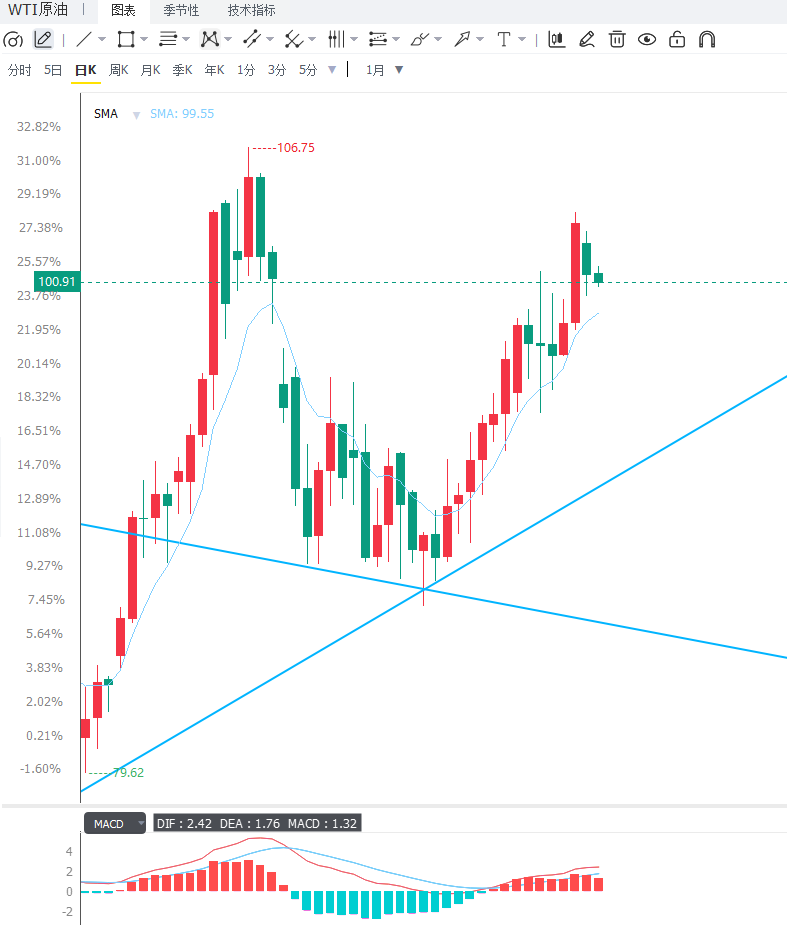 The editor summarizes that the core contradiction for WTI crude oil in the short term lies in the diplomatic maneuvering that is removing the impulsive premium, while the escalation risk within the election window and the Houthi-Hezbollah front maintaining bottom support, driving oil prices to likely consolidate within the $99.80-$101.50 range, awaiting a resolution to the events. Three variables need to be closely monitored going forward: first, the progress of the US-Israel plan against Iran and Iranian retaliatory actions, approximately one week before the midterm elections; any substantial escalation or de-escalation could potentially inject or remove the premium through supply disruptions; second, the operational status of King Khalid Airport and traffic data across the Strait of Hormuz, directly determining the extent of the revaluation of logistics and insurance costs; and third, the pace of implementation of EIA and API inventory data and US administrative price-cutting measures, with policy-driven supply releases potentially becoming the most easily underestimated downside variable in this round.
From the perspective of suppressive factors, the significance of the Tehran talks lies more in the emotional realm than in the substantive realm. The four countries agreed to maintain dialogue and consultation, which is a procedural progress and did not involve a ceasefire arrangement, guarantees of passage through the Strait of Hormuz, or a mechanism to restrain the Houthis. For oil prices, the typical effect of this kind of news is to trigger short-term profit-taking rather than to reconstruct the supply and demand narrative. This is also one of the reasons why this round of pullback is more persistent than previous rounds: funds are betting not on the current conflict, but on the asymmetric increase in the probability of conflict within the election window; however, at the same time, due to the lack of immediate catalysts, the rebound in oil prices also lacks smoothness. It is worth noting that these discussions took place about a week before the US midterm elections—meaning that any diplomatic progress could be interpreted by the market as a "pre-election de-escalation gesture," naturally reducing its credibility and making it difficult to form a sustained downward push. Geopolitical factors, on the other hand, provided support from another side. The Saudi-led coalition is still fighting with the Houthis, while Hezbollah is reportedly preparing for a new round of conflict in Lebanon after receiving support from Iran. Although crude oil flows have recovered to pre-war levels, these ongoing tensions continue to threaten Middle Eastern supplies. The pricing logic here has shifted: market focus has moved from "individual facility damage" to "the sustainability of core hubs." As attacks spread from ports and oil fields to capital airports and energy infrastructure, the pricing of disruption risk is no longer limited to the toll fees of a single shipping route, but extends to a reassessment of logistics and insurance costs across the entire region. In the past two weeks, there have been at least several attacks on merchant ships in the Strait of Hormuz, with Brent crude oil prices remaining high. High oil prices have pushed up global inflation readings through the cost channel, reinforcing the rationale for central banks to maintain high interest rates, thereby raising the central level of real interest rates—creating a self-reinforcing cycle for crude oil: conflict drives up oil prices, oil prices drive up inflation, inflation forces central banks to maintain tightening, tightening suppresses demand expectations, and demand concerns, in turn, limit the upside potential of oil prices. Institutional positioning provides the most easily overlooked variable in this round. TD Securities points out that trend-following accounts remain positively aligned with WTI, with their CTA positions showing "constructive holdings." Net long positions are concentrated near recent price levels, and an "uptrend trigger" is imminent, indicating that systematic traders are adding to their positions as the current trend continues. The bank also emphasizes that scenario analysis surrounding WTI shows CTAs are prepared to "increase or decrease their exposure as volatility and trend signals evolve over the next few months." This assessment offers investors a dual warning: First, there is structural support from algorithmic buying below current oil prices—as long as prices don't break below key trend signal levels, CTAs have no reason to systematically reduce their positions, explaining why they quickly find support whenever prices fall back to around $100. Second, this support is rule-driven rather than belief-driven; once prices effectively break below the trigger threshold, the reduction in positions will also be mechanical and concentrated, easily amplifying downward volatility. In other words, the CTAs' "constructive holdings" act as both a buffer and a potential accelerator. Policy and inventory dimensions constitute potential downside variables. With the midterm elections approaching, the White House has employed a series of executive measures to address the persistent diesel price problem: providing subsidies to farmers, easing regulations on truck drivers, relaxing sanctions on Russian fuel, and pressuring European allies to release emergency oil reserves. The essence of these measures is to artificially lower end-user fuel costs through administrative means, rather than resolving structural supply-side tensions. In the short term, these measures may indeed alleviate upward pressure on diesel prices, thereby indirectly weakening the demand-side narrative for crude oil; however, in the long term, easing sanctions on Russian fuel and pressuring allies to release reserves actually increase available supply in the market—opposite to the supply contraction caused by geopolitical conflicts. If these measures are implemented around the time of the election, they could create an additional "policy pressure window" beyond the escalating premium, subjecting oil prices to an extra layer of selling pressure. Furthermore, the upcoming EIA and API inventory data will be direct evidence of this logic; an unexpected accumulation of inventories could resonate with news of de-escalating diplomacy, accelerating oil prices' test of below $100. From a cross-asset perspective, the current volatility in crude oil is essentially a confluence of four factors: first, the fading of the sentiment premium from the Tehran talks; second, the bottom support provided by the asymmetric distribution of the probability of escalation within the election window; third, the reassessment of logistics and insurance costs triggered by the Houthi and Hezbollah front; and fourth, the two-way disturbance caused by US administrative price-cutting measures and CTA position structures. The high-level fluctuations in oil prices are also indirectly shaping the rhythm of precious metals and foreign exchange: rising energy costs reinforce the central bank's rationale for maintaining high interest rates through inflation. This explains why gold fell below $4,000 to a new low since July and silver approached its year-to-date low, and also explains the logic behind the yen's interest rate hikes supported by imported inflation. It is inappropriate to view the unilateral trend of crude oil in isolation, but rather to evaluate it within the transmission chain of "oil price—inflation—interest rate—exchange rate"—only when a link in this chain breaks will the pricing center of oil prices undergo a substantial shift. On the daily chart, WTI crude oil fell for the second consecutive trading day, with prices hovering near a key moving average cluster and testing the $100 mark. The short-term bias is neutral to bearish, but momentum has not yet strengthened. The RSI (14) has fallen from the previous day's high to around 55, remaining in the neutral zone and far from overbought and oversold levels, indicating a moderate weakening of upward momentum. However, there is still room for fluctuation before the indicator overextends, representing a typical "strong consolidation, awaiting confirmation" pattern. The next resistance levels to watch are $101.50 (the previous day's low), $102.50, and the psychological levels of $103.80 and $105.00. Only a decisive break above $102.50 on the daily chart can confirm the end of the consolidation and open up space for further upward movement. The first support level to watch is the psychological level of $100.00, followed by the previous support level of $99.80 and $98.50. $100.00 is a key psychological support level; a break below it could open up further downside potential towards $98.50 and even $97.20. On the 4-hour chart, oil prices have been slowly declining along the short-term moving average after falling from around $101.80. The MACD histogram is close to the zero line, with the fast and slow lines intertwined, indicating a neutral to weak momentum. Currently, the price is fluctuating narrowly between $100.00 and $100.40. If it finds support at $99.90-$100.10, there is still a chance for a short-term upward move towards $100.60-$101.20. However, a significant break below $99.80 could lead to further downside potential towards $98.50 and even $97.20. The editor summarizes that the core contradiction for WTI crude oil in the short term lies in the diplomatic maneuvering that is removing the impulsive premium, while the escalation risk within the election window and the Houthi-Hezbollah front maintaining bottom support, driving oil prices to likely consolidate within the $99.80-$101.50 range, awaiting a resolution to the events. Three variables need to be closely monitored going forward: first, the progress of the US-Israel plan against Iran and Iranian retaliatory actions, approximately one week before the midterm elections; any substantial escalation or de-escalation could potentially inject or remove the premium through supply disruptions; second, the operational status of King Khalid Airport and traffic data across the Strait of Hormuz, directly determining the extent of the revaluation of logistics and insurance costs; and third, the pace of implementation of EIA and API inventory data and US administrative price-cutting measures, with policy-driven supply releases potentially becoming the most easily underestimated downside variable in this round.
- Risk Warning and Disclaimer
- The market involves risk, and trading may not be suitable for all investors. This article is for reference only and does not constitute personal investment advice, nor does it take into account certain users’ specific investment objectives, financial situation, or other needs. Any investment decisions made based on this information are at your own risk.