The dollar index held above 102, while Moody's warned the Federal Reserve against further tightening: the bond market has already done the work for the central bank.
2026-10-27 10:24:27
On Tuesday (October 27) during Asian trading hours, the US dollar index continued its upward trend, currently trading above 102. The recent strength of the dollar reflects market bets on continued tightening by the Federal Reserve. However, Moody's Analytics chief economist Mark Zandi believes that a rate hike by the Fed this week would be a mistake. He points out that the 10-year Treasury yield is approaching 5%, mortgage rates are above 7%, and credit spreads are widening, indicating that rising market interest rates are already tightening policy; furthermore, a rate hike cannot solve the Iranian-driven oil supply shock and will instead erode real wages and consumption. This view contradicts market pricing and is more of a dovish marker than a market-driven factor, but it highlights the inherent tension surrounding this week's decision. 
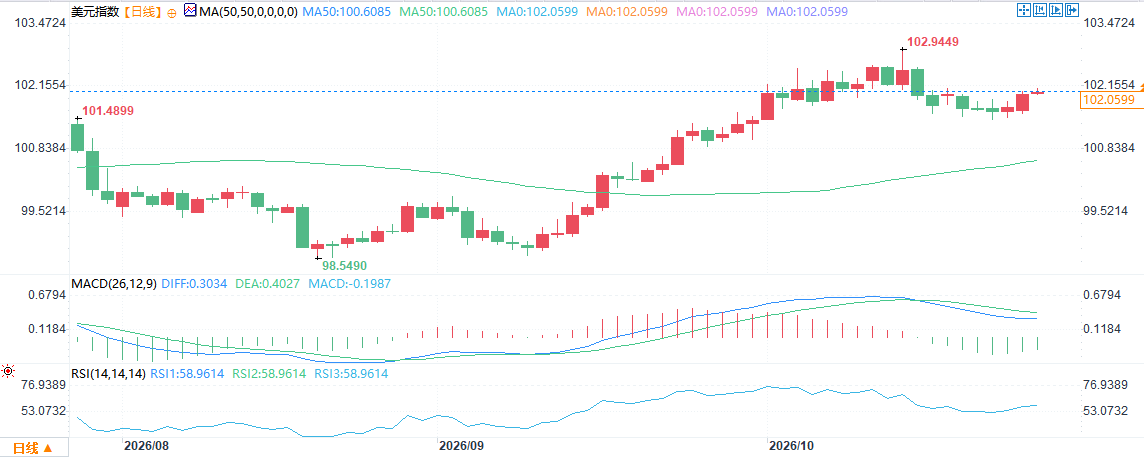 (US Dollar Index Daily Chart, Source: FX678) At 10:23 Beijing time, the US Dollar Index was at 102.03.
Key takeaway: The bond market has already tightened for the Fed; raising interest rates now would be a policy mistake.
Moody's Analytics chief economist Mark Zandi warned that raising interest rates at this week's Federal Reserve meeting would be a mistake. He believes the bond market has already done the tightening work for the central bank, and this policy misstep is becoming one of the growing risks facing the US economy. Zandi posted on social media on Monday, pointing out that borrowing costs have risen sharply since the Fed's September rate hike. The 10-year US Treasury yield is hovering around 5%, fixed mortgage rates are above 7%, and corporate bond spreads have widened. In his view, rising market interest rates are already dampening the economy, and the Fed has no need to increase its lending. The Federal Open Market Committee will meet on October 27-28. After the 25 basis point rate hike in September, the federal funds rate is in the range of 3.75% to 4.00%, and the market is pricing in at least one more rate hike this year.The debate over oil prices: Raising interest rates won't cure supply shocks, but will instead squeeze real income.
Oil price trends are a core element of Zandi's argument. With escalating tensions in the Middle East, particularly regarding Iran, international oil prices have rebounded to near wartime peak levels. Zandi acknowledges that higher energy costs will push up overall inflation in the short term, but he emphasizes that interest rate hikes cannot fundamentally address the supply-side shock. Instead, rising oil prices will directly erode workers' real wages and suppress consumer spending. Given this context of real income already squeezed by energy prices, further tightening monetary policy by central banks would be tantamount to adding insult to injury, potentially pushing an already strained economy into deeper trouble. He points out that monetary policy has limited effectiveness against supply shocks, and over-reliance on interest rate hikes will only cause unnecessary damage to the demand side, potentially sacrificing growth and employment without fundamentally alleviating geopolitically driven energy price volatility.Risk matrix: AI stock sell-off, Fed missteps, escalating conflict, trade frictions and financial repression
Zandi also specifically mentioned Moody's internal risk matrix. This matrix ranks the main threats facing the U.S. economy over the next 12 to 18 months according to the probability of events occurring and the potential damage. He stated bluntly that the current matrix has "many reds," indicating a significant increase in risk signals. Specific risks include: a potential concentrated sell-off in AI-related stocks, policy mistakes by the Federal Reserve itself, further escalation of geopolitical conflicts, escalation of trade frictions, and excessively restrictive financial conditions on economic activity. These risks are not isolated but interconnected and may resonate. In particular, the feedback loop between policy mistakes and market volatility, once triggered, could rapidly amplify the impact on the real economy. Through the risk matrix, Zandi reminded the market and policymakers that the current environment is no longer a single inflation problem, but a complex situation with multiple uncertainties overlapping, requiring more prudent policy operations.The Fed's stance remains unchanged: a September rate hike would have been a "serious mistake," and the continued high core inflation provides justification for the Fed's position.
Zandi's warning was not a sudden shift, but rather consistent with his previous stance. He had explicitly described the September rate hike as a "serious mistake" and continued to warn at the end of September that higher interest rates had begun to harm the economy. Meanwhile, the Fed's core rationale for maintaining its tightening policy remains based on inflation well above the 2% target: the overall PCE price index for August was estimated at 3.8%, and the core PCE at 3.4%. Furthermore, rising oil prices, tariff-related rhetoric, and large-scale investment in artificial intelligence have all contributed to additional price pressures to varying degrees. Zandi acknowledges that these factors do indeed provide reasons for the central bank to continue focusing on inflation, but he maintains that the sharp tightening of financial conditions has already accomplished most of the tightening task ahead of schedule, and further rate hikes will only cause the lagged effects of policy to manifest in the future, thereby increasing unnecessary economic costs.Market Divergence: Goldman Sachs Expects Rate Hike to Skip This Week and Happen in December
Wall Street's expectations for the Federal Reserve's actions this week are not unified. Some institutions have turned cautious; Goldman Sachs, for example, predicts the Fed will hold rates steady at its October meeting, postponing the next rate hike until December. This prediction makes Zandi's view a double test of both this week's meeting and the subsequent December meeting. If the Fed does skip a rate hike this week, it will, to some extent, validate the market's assessment that interest rates are already sufficiently tight; if it ultimately chooses to raise rates, Zandi may see it as a signal that policy is further deviating from economic fundamentals. The market divergence itself reflects the complexity of current data and expectations: on the one hand, core inflation remains high, and on the other hand, financial conditions and real incomes are clearly under pressure. Therefore, this week's decision is not only about the interest rate level, but will also be a key observation window to see whether the Fed acknowledges the reality that "the bond market has already done the work."Summarize
Moody's Analytics chief economist Mark Zandi believes that a Fed rate hike this week would be a mistake, arguing that the 10-year Treasury yield is approaching 5%, mortgage rates are above 7%, and credit spreads are widening, indicating that rising market interest rates are already tightening policy for the Fed. He further argues that a rate hike would not solve the Iranian-driven oil supply shock but would instead push the economy into trouble by eroding real wages and consumption. He calls the September rate hike a "serious mistake" and cites Moody's risk matrix warnings of risks such as a sell-off in AI stocks, Fed missteps, escalating conflicts, trade frictions, and financial repression. This view contradicts market pricing in at least one more rate hike this year and is more of a dovish sign; Goldman Sachs expects a skip this week and a December rate hike, making Zandi's argument both a test of this meeting and a test of the December meeting. (US Dollar Index Daily Chart, Source: FX678) At 10:23 Beijing time, the US Dollar Index was at 102.03.
- Risk Warning and Disclaimer
- The market involves risk, and trading may not be suitable for all investors. This article is for reference only and does not constitute personal investment advice, nor does it take into account certain users’ specific investment objectives, financial situation, or other needs. Any investment decisions made based on this information are at your own risk.