With service inflation holding steady at a more than two-year high, the Bank of Japan's 2% inflation target provides further evidence.
2026-10-27 08:28:24
On Tuesday (October 27) during Asian trading hours, the USD/JPY pair traded in a narrow range, currently hovering around 157.50. Japan's September services producer price index rose 3.7% year-on-year, in line with expectations and unchanged from August, maintaining its highest level in over two years. Robust services inflation provides a basis for the Bank of Japan's announcement this week that underlying inflation has reached 2%, with the market expecting interest rates to remain at 1.25% and a rate hike in December. While the data itself is unlikely to drive the yen alone, it eliminated a possible dovish surprise ahead of Friday's decision, supporting pricing in a December rate hike. 
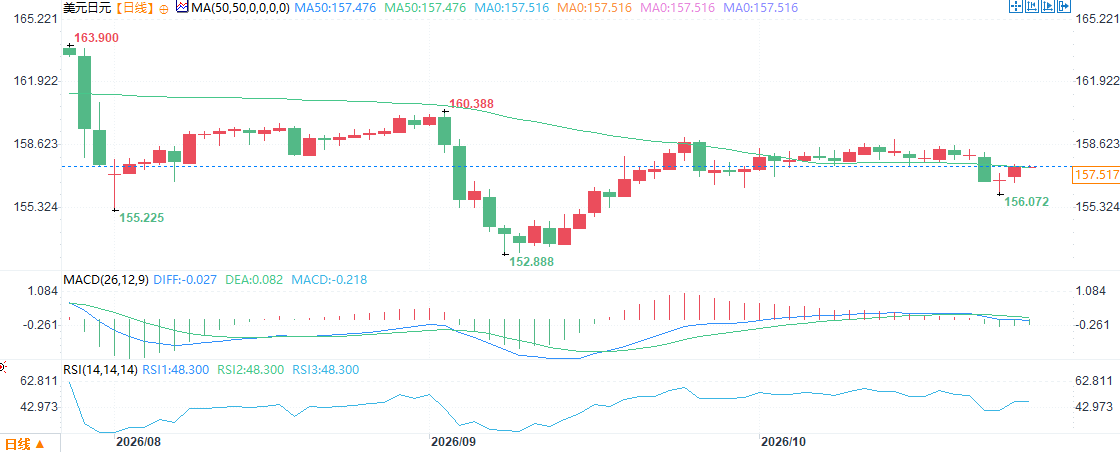 (USD/JPY daily chart, source: EasyForex) At 8:12 Beijing time, USD/JPY was trading at 157.45/46.
Key data: Service PPI rose 3.7% year-on-year, unchanged from August, maintaining a level not seen for more than two years.
Data released by the Bank of Japan on Tuesday showed that the services producer price index (PPI) rose 3.7% year-on-year in September, fully in line with market expectations and unchanged from August. This growth rate has remained at its highest level in over two years for several consecutive months, indicating that price pressures in Japan's service sector have not shown any significant signs of easing. The continued high level of the services PPI coincides with the Bank of Japan's upcoming policy meeting in a few days. The market generally believes that the central bank's latest assessment of inflation will have a greater impact on the market than the decision to adjust interest rates itself. Current data suggests that domestic service sector inflation remains sticky, providing an important reference for the central bank's subsequent policy discussions. Market focus is shifting from short-term data fluctuations to the sustainability of inflation trends, and the robust performance of the September services PPI further strengthens the urgency of this discussion. Overall, the data continues the strong momentum of the previous months, providing the latest empirical support for the Bank of Japan's assessment of whether inflation has truly stabilized.Indicator Meaning: Prices of labor-intensive services; a key window for observing wage transmission.
The Producer Price Index for Services (PPI), also known as the Enterprise Services Price Index, primarily tracks price changes between businesses in sectors such as transportation, communications, finance, real estate, advertising, and equipment leasing. These services are mostly labor-intensive, with labor costs accounting for a significant portion of total costs. Therefore, this index is considered a key indicator of whether wage increases can be effectively transmitted to end-user prices. The Bank of Japan has long emphasized that inflation can only be sustainable when wage increases truly translate into price increases, forming a self-reinforcing virtuous cycle. The continued high level of the September service PPI is an important indicator of whether this transmission mechanism is functioning smoothly. If service prices remain firm, it will further support the Bank of Japan's assessment that "Japanese inflation is gradually becoming self-sustaining." This data therefore not only reflects the current price level but also serves as a core reference for assessing whether the Japanese economy has truly escaped the shadow of long-term deflation.Structural Comparison: Service prices remained firm, while commodity PPI slowed to 6.8% due to fuel subsidies.
In stark contrast to the robust performance of service prices, producer prices for goods have slowed. The year-on-year increase in the producer price index for goods fell to 6.8% in September from 7.6% in August, mainly due to government-implemented fuel subsidies, which effectively alleviated some of the upward pressure on raw material and energy costs. With the early stages of import cost-driven inflation gradually fading, the continued strength of service prices indicates that current price pressures stem more from the domestic service sector itself than from external factors. This structural divergence suggests that the price stickiness of Japan's domestic service sector is significantly higher than that of goods, and the driving force of inflation is shifting from external shocks to internal demand and cost-push inflation. The continued strength of service prices further highlights the importance of domestic supply and demand and wage transmission mechanisms, and provides clear data support for the central bank to distinguish between "temporary inflation" and "persistent inflation."Policy Background: The Bank of Japan is expected to maintain its interest rate at 1.25%, with the focus on whether the Outlook Report will announce a 2% rate.
This data release comes on the eve of the Bank of Japan's policy meeting on October 29-30. The market widely expects the central bank to keep the policy rate unchanged at 1.25% after its September rate hike, with most economists predicting the next rate hike may be postponed until December. What is truly attracting significant attention is the central bank's upcoming updated "Economic and Price Outlook Report." The market is focused on whether the report substantially declares that underlying inflation has reached the 2% policy target—a crucial step the Bank of Japan has taken since formally adopting this target in 2013. Governor Kazuo Ueda stated after last week's G20 meeting that underlying inflation is broadly close to 2%, and the central bank cannot tolerate a further significant increase. If the outlook report formally confirms this assessment, it will signify a significant increase in the central bank's confidence in the inflation outlook, providing a more solid theoretical basis for subsequent policy normalization.Voting Risks: Two opponents may advocate for another interest rate cut; today's data is unlikely to support their stance.
Besides the interest rate decision and outlook report, the market will closely watch the voting results of this policy meeting. The two members who opposed a rate hike at the September meeting are likely to vote against it again, advocating for a rate cut or maintaining a more accommodative stance. Such opposition would soften the Bank of Japan's overall hawkish tone and could put short-term pressure on the yen. However, the September services PPI continued to rise at a more than two-year high of 3.7%, offering little support to the two opponents. On the contrary, the data further highlighted the persistence of price pressures in the services sector, making the arguments for further easing appear weaker. Therefore, the market expects that even with dissenting votes, it will be difficult to change the central bank's overall assessment of inflation trends; the services price data released today actually strengthens the rationale for maintaining the current policy stance.Summarize
Japan's September services producer price index rose 3.7% year-on-year, in line with expectations and unchanged from August, maintaining its highest level in more than two years. The firm service prices contrast with the goods PPI, which slowed to 6.8% due to fuel subsidies, indicating that domestic service price pressures are more persistent than import cost pressures, providing justification for the Bank of Japan's Outlook Report this week, which essentially declares underlying inflation at 2%. The market widely expects the Bank of Japan to keep interest rates at 1.25% at its October 29-30 meeting, with a December rate hike as the consensus. While the data itself is unlikely to drive the yen alone, it eliminated a possible dovish surprise before Friday's decision, supporting pricing in a December rate hike. The focus now shifts to voting disagreements, Ueda's press conference, and the Federal Reserve's decision on Wednesday. (USD/JPY daily chart, source: EasyForex) At 8:12 Beijing time, USD/JPY was trading at 157.45/46.
- Risk Warning and Disclaimer
- The market involves risk, and trading may not be suitable for all investors. This article is for reference only and does not constitute personal investment advice, nor does it take into account certain users’ specific investment objectives, financial situation, or other needs. Any investment decisions made based on this information are at your own risk.