Australian CPI Outlook: Core Inflation Expected to Continue Exceeding Expectations; Interest Rate Hike Pricing Halfway Through
2026-10-27 08:28:26
The Australian dollar traded slightly higher against the US dollar during Asian trading hours on Tuesday (October 27), currently hovering around 0.7020. The market is cautiously awaiting the upcoming release of the third-quarter CPI data, which could be crucial in determining whether the Reserve Bank of Australia (RBA) will raise interest rates in November. Australia's third-quarter CPI will be released on Wednesday Beijing time. The four major banks expect the trimmed average to rise by about 1.0% quarter-on-quarter, higher than the RBA's forecast of 0.8%, with fuel prices pushing up overall inflation. 
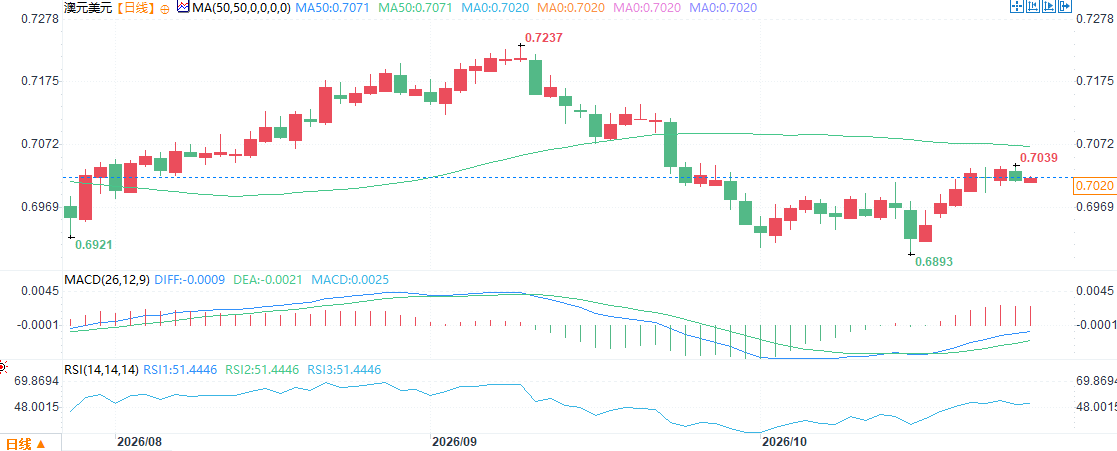 (Australian dollar to US dollar daily chart, source: EasyForex) At 8:16 Beijing time, the Australian dollar to US dollar exchange rate was 0.7019/20.
Key expectations: Core inflation in the third quarter is expected to exceed the Reserve Bank of Australia's forecast again, with the four major banks' forecasts all around 1.0%.
Australia's third-quarter inflation data will be released on Wednesday Beijing time, and is expected to show underlying price pressures far higher than the Reserve Bank of Australia's (RBA) own forecasts, intensifying market debate over whether the central bank will raise interest rates again on November 3. The four major banks generally expect the cut-off mean (a core indicator favored by the RBA) to rise by about 1.0% quarter-on-quarter, higher than the RBA's August forecast of 0.8%. Westpac is the only bank with a quarterly cut-off mean below 1.0%, while National Australia Bank's overall inflation is slightly lower than its peers.Fuel-driven: Oil prices are expected to rise by about 10% in September, with annual fuel inflation reaching 24%.
Fuel prices are the core driver of overall inflation data in this round. The Commonwealth Bank expects fuel prices to rise by about 10% month-on-month in September, following a sharp increase of nearly 15% in August, pushing annual fuel inflation to around 24%. The shocks in the global energy market are continuing to be transmitted through the supply chain to Australian petrol stations, directly pushing up perceived inflationary pressures for consumers. On a monthly basis, the Commonwealth Bank expects overall annual inflation to rise further to 4.2% in September from 4.0% in August, while the annual cut-off mean, which better reflects the underlying inflation trend, is expected to remain stable at 3.6%. For monetary policymakers, a more noteworthy signal comes from the services sector: the Commonwealth Bank expects annual market services inflation to rise slightly to 4.3% from 4.1%. This indicates that current price pressures are not solely concentrated in the energy sector; sticky inflation in the services sector remains, suggesting that domestic demand and cost-push factors are still at play. The persistently high fuel prices and the synchronized rise in services inflation together constitute evidence of strong inflation resilience, increasing the complexity for the Reserve Bank of Australia in assessing its policy path.Policy Background: Interest rates have already been raised four times this year to 4.60%, and the Vice Chairman's remarks have boosted expectations for further rate hikes.
The Reserve Bank of Australia (RBA) has raised the cash rate four times this year, most recently by 25 basis points in September, pushing the rate to 4.60%. This continuous tightening path reflects the central bank's concern that inflation is falling slower than expected. Deputy Governor Andrew Hauser recently stated publicly that the current inflation outlook has deteriorated significantly compared to the RBA's August forecast, a statement that quickly changed market expectations. Previously, the market implied a rate hike in November at only about a quarter, but after Hauser's remarks, that probability jumped sharply to over half. Market interpretations suggest that the RBA's internal assessment of inflation stickiness is becoming more cautious, even hawkish, significantly increasing the likelihood of further rate hikes. This shift in policy communication, coupled with the potential upward movement in the latest inflation data, has greatly increased the suspense surrounding the November meeting. Policymakers must address both the short-term impact of energy prices and assess whether inflation in the services sector is solidifying into more persistent pressure, directly impacting whether the cash rate needs to be raised again to consolidate the anti-inflation gains.Institutional divergence: ANZ and Westpac expect rate hikes in November, while the Federal Reserve and National Australia Bank expect to hold rates steady.
Major banks are showing significant divergence in their assessments of the Reserve Bank of Australia's (RBA) next move. ANZ and Westpac are using a November rate hike as their baseline scenario, with ANZ explicitly stating that if the cutoff mean remains high around 1.0%, it will further reinforce the necessity of a rate hike. In contrast, Commonwealth Bank and National Australia Bank expect the RBA to hold rates steady in November. However, Commonwealth Bank emphasizes that this decision is in a "delicate balance" and warns that the risk of another rate hike is rising given the weak economic activity, signs of a weakening labor market, and persistently low consumer spending. This divergence reflects the complexity of current economic data: on the one hand, inflation, particularly fuel and service prices, remains resilient; on the other hand, growth and demand are showing signs of cooling. The market is therefore closely watching the upcoming inflation details and further statements from RBA officials to determine which forecast more accurately captures the policy committee's final decision.Summarize
Australia's Q3 CPI will be released on Wednesday. The four major banks expect the cut-off mean to rise by about 1.0% quarter-on-quarter, higher than the Reserve Bank of Australia's (RBA) forecast of 0.8%. Fuel prices rising by about 10%, with annual fuel inflation reaching 24%, are the main drivers of overall inflation. Market services inflation rose slightly to 4.3%, indicating that pressure is not limited to energy. The RBA has already raised interest rates four times this year to 4.60%, and after Deputy Governor Hauser's remarks, the implied probability of a rate hike in November has risen to over 50%. ANZ and Westpac expect a rate hike in November, while Commonwealth Bank and National Australia Bank expect to hold rates steady. A cut-off mean of 1.0% or higher would strengthen the case for back-to-back rate hikes and support the Australian dollar, while 0.9% or lower could lead to a rapid reversal in rate hike pricing. The data release coincides with RBA officials testifying before the Senate, adding to the event's risks. (Australian dollar to US dollar daily chart, source: EasyForex) At 8:16 Beijing time, the Australian dollar to US dollar exchange rate was 0.7019/20.
- Risk Warning and Disclaimer
- The market involves risk, and trading may not be suitable for all investors. This article is for reference only and does not constitute personal investment advice, nor does it take into account certain users’ specific investment objectives, financial situation, or other needs. Any investment decisions made based on this information are at your own risk.