The rebound in the US dollar index led the USD/JPY pair to test the upper limit of its trading range, awaiting the release of the Federal Reserve's interest rate decision.
2026-10-27 15:12:29
On Tuesday, the USD/JPY pair traded around 157.70, continuing its recovery from a more than one-month low. The core contradiction in the current exchange rate lies in the fact that the dollar benefits from both the undisproven hawkish stance and the Middle East geopolitical risk premium, while the yen is continuously suppressed by active carry trades. This combination results in a tug-of-war pattern, with resistance on the upside and support on the downside, and the key level is around 157.81, the 200-period EMA.  From the perspective of the yen, the persistence of carry trades has been the main driver of this round of weakness. The market widely expects the Bank of Japan to pause its aggressive interest rate hikes, which has allowed the interest rate differential advantage to continue tilting towards the dollar, enabling carry trades to maintain their positions in a relatively safe environment. The key to this logic is that the yen's weakness does not stem from an absolute deterioration in the Japanese economy, but rather from the relative lag in policy pace. As long as the Bank of Japan does not release a clear tightening signal, carry trades lack a reason to be unwound, and any rebound in the yen is likely to encounter selling pressure at relatively low levels. This is also the structural reason why the exchange rate has failed to smoothly break through 157.81 since its rebound from 156.00 – there is not a lack of selling pressure below, but a lack of catalysts that can convince the market that a policy shift is imminent. For investors, this means that Friday's Bank of Japan meeting is more likely to determine the medium-term direction of the exchange rate than the Fed's decision: the former concerns the trend, while the latter affects the pace more. However, this pricing structure reliant on carry trades also implies vulnerability. If the Bank of Japan releases a more hawkish signal than expected at its meeting on Friday, or if global risk sentiment deteriorates rapidly due to sudden geopolitical shifts, the deleveraging process of carry trades often unfolds faster than the accumulation, leading to a rapid appreciation of the yen. Historically, this scenario typically presents as a "sharp drop followed by consolidation": the exchange rate initially reacts sharply to policy surprises, and then is repriced by interest rate differentials. This suggests that investors should not make unilateral bets before the meeting, but rather wait for the market to complete the first round of sentiment release before assessing the trend. Furthermore, the yen's safe-haven status has not been effectively activated in the current Middle East tensions—funds tend to flow towards the Swiss franc and US Treasuries rather than the yen. This "failure of safe-haven attributes" further confirms that the current pricing focus of the yen is entirely on interest rates, rather than risk sentiment. The dollar, on the other hand, provided proactive support. As the market increasingly accepts the expectation that the Federal Reserve will maintain a hawkish stance, the dollar attracted follow-up buying for the third consecutive trading day, driven by inflation concerns stemming from high energy prices. While Federal Reserve Chairman Warsh's recent remarks have been slightly dovish, they remain cautious. He acknowledged that he was "too traumatized by the global financial crisis," emphasized structural growth and a surge in policy-driven investment, viewed artificial intelligence as a short-term demand-side force, and declined to predict the decisions for October and December. The FXS Fed Sentiment Index remained unchanged at a high of 127.51, indicating that the overall policy narrative remains firmly in the hawkish range. For USD/JPY, this is an environment of "no short-term catalysts, but tailwinds in the medium term": Wednesday's inaction was widely expected and unlikely to provide additional positive factors; however, the statement that inflationary pressures remain high has not been disproven, making any rebound in the yen likely to be met with resistance at relatively low levels. In addition, Thursday's preliminary US Q3 GDP and PCE price index will be direct evidence of the resilience of the US economy and the stickiness of inflation. If the data is stronger than expected, it may weaken the narrative of declining US Treasury yields, thus providing further upward momentum for the dollar. Geopolitical factors, on the other hand, provide complex disturbances from another angle. The ongoing geopolitical risk premium from Middle East tensions has provided additional support for the safe-haven dollar and reinforced the rationale for further appreciation of the USD/JPY. However, the transmission mechanism here needs clarification: the impact of geopolitical conflict on USD/JPY is bidirectional. On the one hand, it pushes up oil prices and inflation expectations, thereby strengthening the Federal Reserve's rationale for maintaining high interest rates; on the other hand, if the conflict escalates and triggers a global sell-off of risk assets, the yen should theoretically attract buying due to its safe-haven properties. Current market performance shows that the first transmission chain is dominant—funds are more focused on the upward shift in the interest rate center than on safe-haven outflows. This also explains why USD/JPY has significantly outperformed EUR/USD and GBP/USD in this round of tensions: the latter are simultaneously suffering from the double blow of imported energy inflation and growth discounts, while USD/JPY mainly benefits from interest rate differentials and the diversion effect of safe-haven demand. From a cross-asset perspective, the current fluctuations in the USD/JPY exchange rate are essentially a confluence of four factors: first, the proactive carry trade pressure resulting from the Bank of Japan's pause in aggressive interest rate hikes; second, the dollar's bottom formed by the undisproven hawkish stance of the Federal Reserve; third, the interest rate narrative reinforced by high energy prices through inflation; and fourth, the two-way disturbance caused by geopolitical risk premiums. It is noteworthy that the same round of oil price increases has had inconsistent effects on different currency pairs—it exerts a stagflationary drag on the euro, provides commodity-like support for the Canadian dollar, and reinforces interest rate hike expectations for the pound through inflation. This divergence is the structural reason for the divergent performance of G10 currencies this month: the net direction is not determined by a single event, but by the relative strength of forces along each transmission chain. Investors should not view the unilateral movement of the USD/JPY exchange rate in isolation, but rather assess it within the transmission chain of "oil prices—inflation—interest rate differentials—exchange rates." On the daily chart, USD/JPY is trading at 157.70, rising for the third consecutive trading day. However, the price remains capped by the 200-period exponential moving average, indicating an overall neutral-to-bullish bias but with momentum yet to strengthen. The 23.6% Fibonacci retracement level at 157.63 provides initial support and defines the upper boundary of the corrective retracement zone, suggesting the pair is in a critical state of "building momentum for a breakout." Key resistance levels to watch are the 200-period EMA around 157.81 and the cycle high near 159.07—only a break above these levels would substantially alleviate the bearish bias and open up space for further upward movement. The first support level to watch is the 23.6% Fibonacci retracement at 157.63, followed by a dense cluster of Fibonacci levels: the 38.2% retracement at 156.74 and the 50.0% retracement at 156.02. Further support levels to watch are 155.30 and 154.28. On the 4-hour chart, the price is slowly moving upwards along the short-term moving averages. The MACD histogram is close to the zero line, with the fast and slow lines repeatedly intertwined, indicating weak but slightly bullish momentum. Currently, the price is oscillating narrowly between 157.60 and 157.85. If it retraces to 157.60-157.70 and finds support, there is still a chance for a short-term upward move towards 157.90-158.20. If it breaks below 157.63 with significant volume, it may seek support at 156.74 or even 156.02. An upward breakout requires confirmation from the Fed's decision and signals from the Bank of Japan. Until then, a range-bound trading strategy is advisable, avoiding chasing highs and lows.
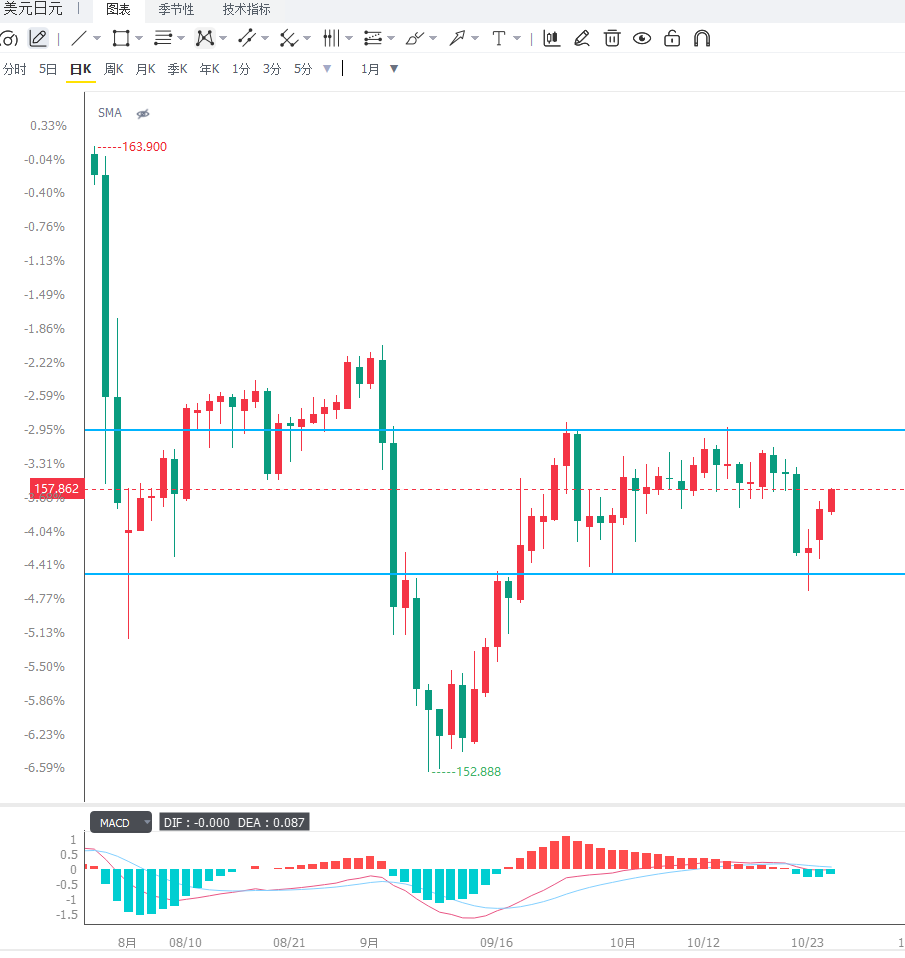 Editor's Summary: The core contradiction in the USD/JPY exchange rate in the short term lies in the Bank of Japan's pause in interest rate hikes, which has led to active carry trades and suppressed the yen. Meanwhile, the undisproven hawkish stance of the Federal Reserve and geopolitical risk premiums support the dollar. This two-way dynamic makes the exchange rate more likely to consolidate within a narrow range of 157.63-157.81, awaiting a breakthrough from the central bank meeting. Three key variables need to be monitored: first, the Fed's decision, policy statement, and Warsh press conference on Wednesday, whose statements on inflationary pressures will directly determine the tightness of the dollar's interest rate floor; second, the preliminary US Q3 GDP and PCE price index on Thursday, which will directly verify the resilience of the US economy and the stickiness of inflation, thus affecting the direction of US Treasury yields; and third, the Bank of Japan's policy update and forward guidance on Friday, which is the primary criterion for judging whether carry trades will continue and whether the yen will see a policy shift. In addition, the trends of Brent and WTI crude oil, the passage of the Strait of Hormuz, and developments in the Middle East also need to be monitored, as they simultaneously affect both inflation expectations and safe-haven demand.
From the perspective of the yen, the persistence of carry trades has been the main driver of this round of weakness. The market widely expects the Bank of Japan to pause its aggressive interest rate hikes, which has allowed the interest rate differential advantage to continue tilting towards the dollar, enabling carry trades to maintain their positions in a relatively safe environment. The key to this logic is that the yen's weakness does not stem from an absolute deterioration in the Japanese economy, but rather from the relative lag in policy pace. As long as the Bank of Japan does not release a clear tightening signal, carry trades lack a reason to be unwound, and any rebound in the yen is likely to encounter selling pressure at relatively low levels. This is also the structural reason why the exchange rate has failed to smoothly break through 157.81 since its rebound from 156.00 – there is not a lack of selling pressure below, but a lack of catalysts that can convince the market that a policy shift is imminent. For investors, this means that Friday's Bank of Japan meeting is more likely to determine the medium-term direction of the exchange rate than the Fed's decision: the former concerns the trend, while the latter affects the pace more. However, this pricing structure reliant on carry trades also implies vulnerability. If the Bank of Japan releases a more hawkish signal than expected at its meeting on Friday, or if global risk sentiment deteriorates rapidly due to sudden geopolitical shifts, the deleveraging process of carry trades often unfolds faster than the accumulation, leading to a rapid appreciation of the yen. Historically, this scenario typically presents as a "sharp drop followed by consolidation": the exchange rate initially reacts sharply to policy surprises, and then is repriced by interest rate differentials. This suggests that investors should not make unilateral bets before the meeting, but rather wait for the market to complete the first round of sentiment release before assessing the trend. Furthermore, the yen's safe-haven status has not been effectively activated in the current Middle East tensions—funds tend to flow towards the Swiss franc and US Treasuries rather than the yen. This "failure of safe-haven attributes" further confirms that the current pricing focus of the yen is entirely on interest rates, rather than risk sentiment. The dollar, on the other hand, provided proactive support. As the market increasingly accepts the expectation that the Federal Reserve will maintain a hawkish stance, the dollar attracted follow-up buying for the third consecutive trading day, driven by inflation concerns stemming from high energy prices. While Federal Reserve Chairman Warsh's recent remarks have been slightly dovish, they remain cautious. He acknowledged that he was "too traumatized by the global financial crisis," emphasized structural growth and a surge in policy-driven investment, viewed artificial intelligence as a short-term demand-side force, and declined to predict the decisions for October and December. The FXS Fed Sentiment Index remained unchanged at a high of 127.51, indicating that the overall policy narrative remains firmly in the hawkish range. For USD/JPY, this is an environment of "no short-term catalysts, but tailwinds in the medium term": Wednesday's inaction was widely expected and unlikely to provide additional positive factors; however, the statement that inflationary pressures remain high has not been disproven, making any rebound in the yen likely to be met with resistance at relatively low levels. In addition, Thursday's preliminary US Q3 GDP and PCE price index will be direct evidence of the resilience of the US economy and the stickiness of inflation. If the data is stronger than expected, it may weaken the narrative of declining US Treasury yields, thus providing further upward momentum for the dollar. Geopolitical factors, on the other hand, provide complex disturbances from another angle. The ongoing geopolitical risk premium from Middle East tensions has provided additional support for the safe-haven dollar and reinforced the rationale for further appreciation of the USD/JPY. However, the transmission mechanism here needs clarification: the impact of geopolitical conflict on USD/JPY is bidirectional. On the one hand, it pushes up oil prices and inflation expectations, thereby strengthening the Federal Reserve's rationale for maintaining high interest rates; on the other hand, if the conflict escalates and triggers a global sell-off of risk assets, the yen should theoretically attract buying due to its safe-haven properties. Current market performance shows that the first transmission chain is dominant—funds are more focused on the upward shift in the interest rate center than on safe-haven outflows. This also explains why USD/JPY has significantly outperformed EUR/USD and GBP/USD in this round of tensions: the latter are simultaneously suffering from the double blow of imported energy inflation and growth discounts, while USD/JPY mainly benefits from interest rate differentials and the diversion effect of safe-haven demand. From a cross-asset perspective, the current fluctuations in the USD/JPY exchange rate are essentially a confluence of four factors: first, the proactive carry trade pressure resulting from the Bank of Japan's pause in aggressive interest rate hikes; second, the dollar's bottom formed by the undisproven hawkish stance of the Federal Reserve; third, the interest rate narrative reinforced by high energy prices through inflation; and fourth, the two-way disturbance caused by geopolitical risk premiums. It is noteworthy that the same round of oil price increases has had inconsistent effects on different currency pairs—it exerts a stagflationary drag on the euro, provides commodity-like support for the Canadian dollar, and reinforces interest rate hike expectations for the pound through inflation. This divergence is the structural reason for the divergent performance of G10 currencies this month: the net direction is not determined by a single event, but by the relative strength of forces along each transmission chain. Investors should not view the unilateral movement of the USD/JPY exchange rate in isolation, but rather assess it within the transmission chain of "oil prices—inflation—interest rate differentials—exchange rates." On the daily chart, USD/JPY is trading at 157.70, rising for the third consecutive trading day. However, the price remains capped by the 200-period exponential moving average, indicating an overall neutral-to-bullish bias but with momentum yet to strengthen. The 23.6% Fibonacci retracement level at 157.63 provides initial support and defines the upper boundary of the corrective retracement zone, suggesting the pair is in a critical state of "building momentum for a breakout." Key resistance levels to watch are the 200-period EMA around 157.81 and the cycle high near 159.07—only a break above these levels would substantially alleviate the bearish bias and open up space for further upward movement. The first support level to watch is the 23.6% Fibonacci retracement at 157.63, followed by a dense cluster of Fibonacci levels: the 38.2% retracement at 156.74 and the 50.0% retracement at 156.02. Further support levels to watch are 155.30 and 154.28. On the 4-hour chart, the price is slowly moving upwards along the short-term moving averages. The MACD histogram is close to the zero line, with the fast and slow lines repeatedly intertwined, indicating weak but slightly bullish momentum. Currently, the price is oscillating narrowly between 157.60 and 157.85. If it retraces to 157.60-157.70 and finds support, there is still a chance for a short-term upward move towards 157.90-158.20. If it breaks below 157.63 with significant volume, it may seek support at 156.74 or even 156.02. An upward breakout requires confirmation from the Fed's decision and signals from the Bank of Japan. Until then, a range-bound trading strategy is advisable, avoiding chasing highs and lows. Editor's Summary: The core contradiction in the USD/JPY exchange rate in the short term lies in the Bank of Japan's pause in interest rate hikes, which has led to active carry trades and suppressed the yen. Meanwhile, the undisproven hawkish stance of the Federal Reserve and geopolitical risk premiums support the dollar. This two-way dynamic makes the exchange rate more likely to consolidate within a narrow range of 157.63-157.81, awaiting a breakthrough from the central bank meeting. Three key variables need to be monitored: first, the Fed's decision, policy statement, and Warsh press conference on Wednesday, whose statements on inflationary pressures will directly determine the tightness of the dollar's interest rate floor; second, the preliminary US Q3 GDP and PCE price index on Thursday, which will directly verify the resilience of the US economy and the stickiness of inflation, thus affecting the direction of US Treasury yields; and third, the Bank of Japan's policy update and forward guidance on Friday, which is the primary criterion for judging whether carry trades will continue and whether the yen will see a policy shift. In addition, the trends of Brent and WTI crude oil, the passage of the Strait of Hormuz, and developments in the Middle East also need to be monitored, as they simultaneously affect both inflation expectations and safe-haven demand.
- Risk Warning and Disclaimer
- The market involves risk, and trading may not be suitable for all investors. This article is for reference only and does not constitute personal investment advice, nor does it take into account certain users’ specific investment objectives, financial situation, or other needs. Any investment decisions made based on this information are at your own risk.