Ahead of the Federal Reserve and Bank of Canada's policy decisions, the US dollar rose for two consecutive days, reaching 1.4000 against the Canadian dollar.
2026-10-27 15:16:22
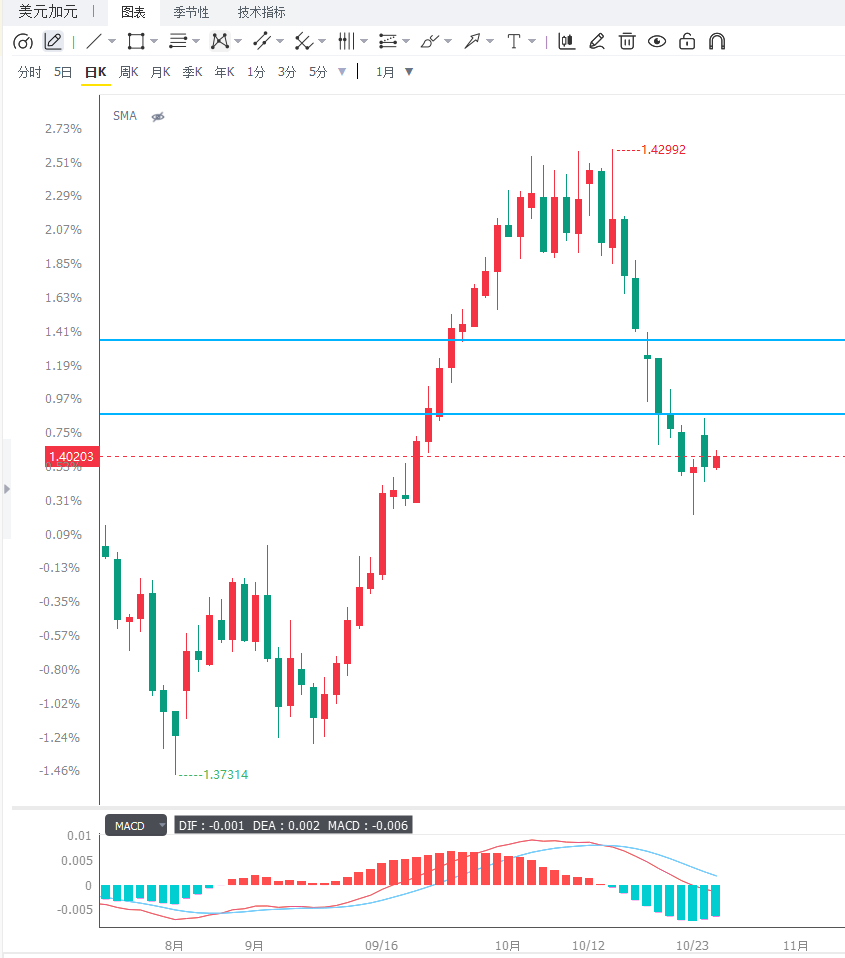
On Tuesday during Asian trading hours, the USD/CAD pair traded around 1.4020, continuing its recovery from lower levels. The core contradiction in the current exchange rate lies in the fact that falling oil prices have weakened the Canadian dollar's commodity-related support, while the market's aggressively priced-in expectations of a Bank of Canada interest rate hike are providing a counter-cyclical support. This combination results in a tug-of-war pattern, with resistance on the upside and support on the downside, and the key dividing line concentrated between the 1.4000 psychological level and the dense area of moving averages around 1.4073. 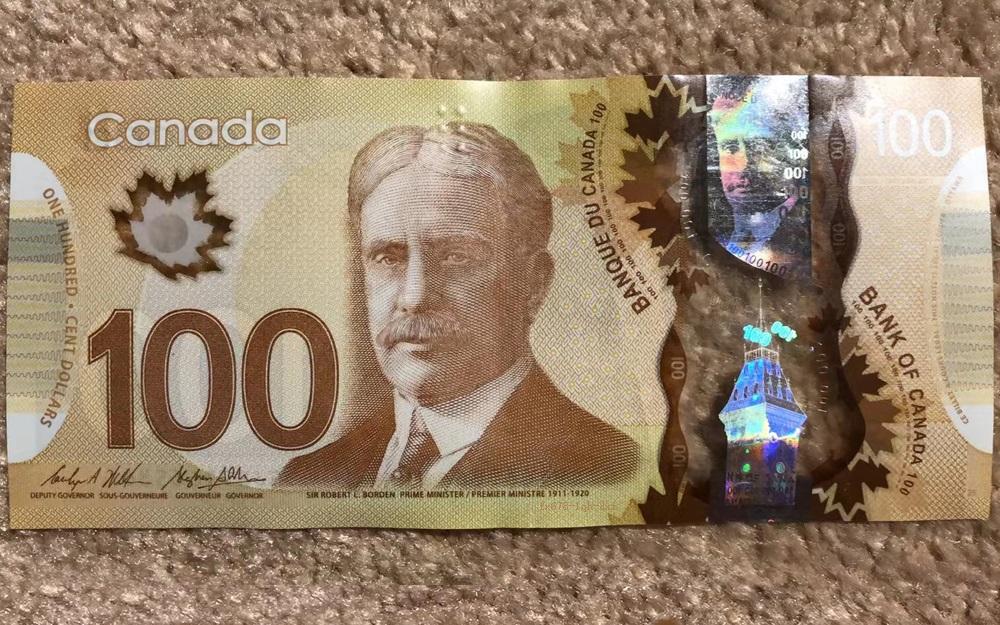 From the Canadian dollar's perspective, this week presents two opposing transmission chains: commodity prices and interest rate expectations. On the oil price front, Iran, Saudi Arabia, Pakistan, and Turkey agreed to continue security dialogue and strengthen regional cooperation after high-level talks in Tehran on Monday. A joint statement following the meeting emphasized that the four countries would maintain consultations on regional peace, security, and stability. This development boosted market hopes to avoid further escalation of the US-Iran conflict, causing crude oil to relinquish some geopolitical premiums, thus removing a traditional support source for the Canadian dollar. However, the significance of the Tehran talks lies more in the emotional than the substantive level—the agreement to maintain dialogue is a procedural step and did not involve a ceasefire arrangement, guarantees of passage through the Strait of Hormuz, or a binding mechanism for the Houthis. For the Canadian dollar, the typical effect of such news is to trigger short-term profit-taking rather than reconstruct the supply and demand narrative. Interest rates, on the other hand, provide a reverse constraint. Commerzbank points out that McClellan's recent communications "significantly increased the risk of a near-term rate hike," and therefore expects the first action before the end of this year. Market participants have already priced in an 85% probability of a rate hike this week, and the bank also anticipates a rate hike, but warns that "given subdued core inflation, we still believe it is premature." More noteworthy is the forward-looking dimension: "By September 2027, the market has priced in a total of four rate hikes." The duality of this reading is noteworthy: on the one hand, it explains why the decline in oil prices has not driven a smooth rise in the USD/CAD exchange rate—the expected upward shift in the interest rate differential is offsetting the drag from commodity attributes; on the other hand, the 85% probability itself also implies the risk of crowded trades—if the Bank of Canada holds its position or adopts a more cautious tone, this fully priced-in expectation could be quickly reversed, triggering an accelerated sell-off of the Canadian dollar. Commerzbank's assessment that the move was "premature" precisely points to the most vulnerable link in the current pricing: if core inflation data fails to correlate, the legitimacy of the rate hike will be questioned, and the exchange rate reaction may lean towards the negative rather than the positive. The political sphere provides another layer of complex disturbance. Canadian Prime Minister Carney stated on Monday that the country has not changed its position in trade negotiations with the United States, adding that any progress is due to Washington moving closer to Canada's position. The significance of this statement lies in its attempt to shift the initiative in the trade narrative from "passive concessions" to "the other side moving closer," thereby providing some emotional support for the Canadian dollar. However, the actual effectiveness of such statements highly depends on the subsequent implementation of specific terms—in the absence of substantial agreement details, their impact on the exchange rate is more impulsive than trend-driven. This means that a single political statement should not be viewed in isolation, but rather evaluated within the transmission chain of "trade terms—growth—interest rate differential—exchange rate." The US dollar side sets the overall tempo framework. As the market increasingly accepts the expectation that the Federal Reserve will hold rates steady this week, the focus has shifted to the policy statement and Chairman Warsh's post-meeting remarks. Heather Long, chief economist at the Navy Federal Credit Union, corroborated this environment: "Inflation remains the primary concern for the U.S. economy, and there are many signs that it is becoming more widespread," and "For consumers, this means very high borrowing costs for the foreseeable future." However, she also noted, "Given that this is right before the election, they are unlikely to raise rates in October." This combination of a "pause before the election, with an option reserved for the end of the year" creates a "no catalyst in the short term, but a floor in the medium term" environment for the USD/CAD pair: the meeting itself is unlikely to provide additional negative news, but the approximately 82.3% probability of a rate hike at the end of the year makes any breakout of the Canadian dollar likely to encounter selling pressure at relatively high levels. This is also the structural reason why the exchange rate has failed to smoothly break through 1.4073 since its rebound from the lows—it's not that there's a lack of buying pressure above, but rather a lack of catalysts that can convince the market that the interest rate advantage will continue to widen. From a cross-asset perspective, the current volatility of the USD/CAD exchange rate is essentially a confluence of four factors: first, the fading oil price premium resulting from Middle East diplomatic maneuvering; second, proactive support from the Bank of Canada's aggressive interest rate hike pricing; third, the dollar's bottom formed by the Fed's year-end path not being disproven; and fourth, emotional disturbances caused by trade negotiation statements. It's worth noting that the same round of oil price declines simultaneously affected three transmission chains—weakening the Canadian dollar's commodity attributes, lowering global inflation readings, and easing cost pressures in the US. The offsetting effect of these three forces is the fundamental reason why the exchange rate has repeatedly fluctuated within a narrow range of 1.4000-1.4073. This also explains why, during this period of easing tensions, the USD/CAD exchange rate's volatility has consistently remained within its range. The divergence of opinions among institutions further confirms the complexity of the current environment. Commerzbank, on the one hand, acknowledges the increased risk of interest rate hikes and anticipates action, but on the other hand, explicitly questions whether the timing is premature—forming a combination of "bullish direction, questionable timing." This means that the probability of success for going long on the Canadian dollar solely based on interest rate hike expectations is declining: only when core inflation data provides substantial support, or when the Fed's year-end path is completely disproven, will the rise in USD/CAD have a trend basis. Until then, any upward movement is more appropriate to view as a technical correction within a range, rather than the start of a one-sided trend. On the daily chart, USD/CAD is trading at 1.4020, rising for the second consecutive trading day, but the price remains below the 9-period and 50-period exponential moving averages, with the short-term EMA cluster forming dense resistance. The 14-day Relative Strength Index (RSI) is at 37, leaning towards the oversold side, indicating that the rebound from the lows is more of an oversold correction than a trend reversal, a typical "bearish consolidation, momentum awaiting confirmation" pattern. The next resistance levels to watch are the 50-period EMA around 1.4067, the 9-period EMA around 1.4073, and the strong horizontal resistance level around 1.4300; only a decisive break above 1.4073 on the daily chart can alleviate the current bearish bias and open up space for further upward movement. The first support level to watch is the psychological level of 1.4000, followed by 1.3732 and the further structural bottom at 1.3482. Since there is a lack of near-term technical support between 1.4000 and 1.3732, if the price breaks below 1.4000, it may enter a downward phase without clear technical references, and we need to wait for a new demand zone to emerge. On the 4-hour chart, the exchange rate is slowly moving upwards along the short-term moving average. The MACD histogram is close to the zero axis, with the fast and slow lines repeatedly intertwined, indicating weak momentum but a slightly bullish bias. Currently, the price is fluctuating narrowly between 1.4010 and 1.4030. If it retraces to 1.4000-1.4015 and finds support, there is still a chance for a short-term upward attack on 1.4050-1.4073. If it breaks below 1.4000 with significant volume, it may seek support at 1.3732 or even 1.3482. An upward breakout requires the cooperation of the decisions of both the Federal Reserve and the Bank of Canada. Until then, it is advisable to treat the market within a range and avoid chasing highs and lows.
 Editor's Summary: The core contradiction in the short-term USD/CAD exchange rate lies in the weakening of the Canadian dollar's commodity attributes due to falling oil prices. Meanwhile, the Bank of Canada's aggressive interest rate hike pricing and the Federal Reserve's year-end path provide a counterbalancing force, making the exchange rate more likely to consolidate within the 1.4000-1.4073 range, awaiting a breakthrough in the decisions of both central banks. Three key variables need to be monitored: First, the Bank of Canada's policy decision and McClellan's press conference on Wednesday—whether the 85% probability of a rate hike will materialize and whether the pricing of "four rate hikes until September 2027" will be revised—this is the primary criterion for determining whether the Canadian dollar can escape the drag of oil prices. Second, the Federal Reserve's decision, policy statement, and Warsh's press conference on the same day; their statements on inflation and the year-end path will directly affect the tightness of the US dollar's interest rate floor. Fourth, the trends of Brent and WTI crude oil and the progress of Middle East diplomatic negotiations directly determine the continuation of the Canadian dollar's commodity premium. In addition, the progress of US-Canada trade negotiations and Canadian core inflation data also need to be monitored simultaneously.
From the Canadian dollar's perspective, this week presents two opposing transmission chains: commodity prices and interest rate expectations. On the oil price front, Iran, Saudi Arabia, Pakistan, and Turkey agreed to continue security dialogue and strengthen regional cooperation after high-level talks in Tehran on Monday. A joint statement following the meeting emphasized that the four countries would maintain consultations on regional peace, security, and stability. This development boosted market hopes to avoid further escalation of the US-Iran conflict, causing crude oil to relinquish some geopolitical premiums, thus removing a traditional support source for the Canadian dollar. However, the significance of the Tehran talks lies more in the emotional than the substantive level—the agreement to maintain dialogue is a procedural step and did not involve a ceasefire arrangement, guarantees of passage through the Strait of Hormuz, or a binding mechanism for the Houthis. For the Canadian dollar, the typical effect of such news is to trigger short-term profit-taking rather than reconstruct the supply and demand narrative. Interest rates, on the other hand, provide a reverse constraint. Commerzbank points out that McClellan's recent communications "significantly increased the risk of a near-term rate hike," and therefore expects the first action before the end of this year. Market participants have already priced in an 85% probability of a rate hike this week, and the bank also anticipates a rate hike, but warns that "given subdued core inflation, we still believe it is premature." More noteworthy is the forward-looking dimension: "By September 2027, the market has priced in a total of four rate hikes." The duality of this reading is noteworthy: on the one hand, it explains why the decline in oil prices has not driven a smooth rise in the USD/CAD exchange rate—the expected upward shift in the interest rate differential is offsetting the drag from commodity attributes; on the other hand, the 85% probability itself also implies the risk of crowded trades—if the Bank of Canada holds its position or adopts a more cautious tone, this fully priced-in expectation could be quickly reversed, triggering an accelerated sell-off of the Canadian dollar. Commerzbank's assessment that the move was "premature" precisely points to the most vulnerable link in the current pricing: if core inflation data fails to correlate, the legitimacy of the rate hike will be questioned, and the exchange rate reaction may lean towards the negative rather than the positive. The political sphere provides another layer of complex disturbance. Canadian Prime Minister Carney stated on Monday that the country has not changed its position in trade negotiations with the United States, adding that any progress is due to Washington moving closer to Canada's position. The significance of this statement lies in its attempt to shift the initiative in the trade narrative from "passive concessions" to "the other side moving closer," thereby providing some emotional support for the Canadian dollar. However, the actual effectiveness of such statements highly depends on the subsequent implementation of specific terms—in the absence of substantial agreement details, their impact on the exchange rate is more impulsive than trend-driven. This means that a single political statement should not be viewed in isolation, but rather evaluated within the transmission chain of "trade terms—growth—interest rate differential—exchange rate." The US dollar side sets the overall tempo framework. As the market increasingly accepts the expectation that the Federal Reserve will hold rates steady this week, the focus has shifted to the policy statement and Chairman Warsh's post-meeting remarks. Heather Long, chief economist at the Navy Federal Credit Union, corroborated this environment: "Inflation remains the primary concern for the U.S. economy, and there are many signs that it is becoming more widespread," and "For consumers, this means very high borrowing costs for the foreseeable future." However, she also noted, "Given that this is right before the election, they are unlikely to raise rates in October." This combination of a "pause before the election, with an option reserved for the end of the year" creates a "no catalyst in the short term, but a floor in the medium term" environment for the USD/CAD pair: the meeting itself is unlikely to provide additional negative news, but the approximately 82.3% probability of a rate hike at the end of the year makes any breakout of the Canadian dollar likely to encounter selling pressure at relatively high levels. This is also the structural reason why the exchange rate has failed to smoothly break through 1.4073 since its rebound from the lows—it's not that there's a lack of buying pressure above, but rather a lack of catalysts that can convince the market that the interest rate advantage will continue to widen. From a cross-asset perspective, the current volatility of the USD/CAD exchange rate is essentially a confluence of four factors: first, the fading oil price premium resulting from Middle East diplomatic maneuvering; second, proactive support from the Bank of Canada's aggressive interest rate hike pricing; third, the dollar's bottom formed by the Fed's year-end path not being disproven; and fourth, emotional disturbances caused by trade negotiation statements. It's worth noting that the same round of oil price declines simultaneously affected three transmission chains—weakening the Canadian dollar's commodity attributes, lowering global inflation readings, and easing cost pressures in the US. The offsetting effect of these three forces is the fundamental reason why the exchange rate has repeatedly fluctuated within a narrow range of 1.4000-1.4073. This also explains why, during this period of easing tensions, the USD/CAD exchange rate's volatility has consistently remained within its range. The divergence of opinions among institutions further confirms the complexity of the current environment. Commerzbank, on the one hand, acknowledges the increased risk of interest rate hikes and anticipates action, but on the other hand, explicitly questions whether the timing is premature—forming a combination of "bullish direction, questionable timing." This means that the probability of success for going long on the Canadian dollar solely based on interest rate hike expectations is declining: only when core inflation data provides substantial support, or when the Fed's year-end path is completely disproven, will the rise in USD/CAD have a trend basis. Until then, any upward movement is more appropriate to view as a technical correction within a range, rather than the start of a one-sided trend. On the daily chart, USD/CAD is trading at 1.4020, rising for the second consecutive trading day, but the price remains below the 9-period and 50-period exponential moving averages, with the short-term EMA cluster forming dense resistance. The 14-day Relative Strength Index (RSI) is at 37, leaning towards the oversold side, indicating that the rebound from the lows is more of an oversold correction than a trend reversal, a typical "bearish consolidation, momentum awaiting confirmation" pattern. The next resistance levels to watch are the 50-period EMA around 1.4067, the 9-period EMA around 1.4073, and the strong horizontal resistance level around 1.4300; only a decisive break above 1.4073 on the daily chart can alleviate the current bearish bias and open up space for further upward movement. The first support level to watch is the psychological level of 1.4000, followed by 1.3732 and the further structural bottom at 1.3482. Since there is a lack of near-term technical support between 1.4000 and 1.3732, if the price breaks below 1.4000, it may enter a downward phase without clear technical references, and we need to wait for a new demand zone to emerge. On the 4-hour chart, the exchange rate is slowly moving upwards along the short-term moving average. The MACD histogram is close to the zero axis, with the fast and slow lines repeatedly intertwined, indicating weak momentum but a slightly bullish bias. Currently, the price is fluctuating narrowly between 1.4010 and 1.4030. If it retraces to 1.4000-1.4015 and finds support, there is still a chance for a short-term upward attack on 1.4050-1.4073. If it breaks below 1.4000 with significant volume, it may seek support at 1.3732 or even 1.3482. An upward breakout requires the cooperation of the decisions of both the Federal Reserve and the Bank of Canada. Until then, it is advisable to treat the market within a range and avoid chasing highs and lows. Editor's Summary: The core contradiction in the short-term USD/CAD exchange rate lies in the weakening of the Canadian dollar's commodity attributes due to falling oil prices. Meanwhile, the Bank of Canada's aggressive interest rate hike pricing and the Federal Reserve's year-end path provide a counterbalancing force, making the exchange rate more likely to consolidate within the 1.4000-1.4073 range, awaiting a breakthrough in the decisions of both central banks. Three key variables need to be monitored: First, the Bank of Canada's policy decision and McClellan's press conference on Wednesday—whether the 85% probability of a rate hike will materialize and whether the pricing of "four rate hikes until September 2027" will be revised—this is the primary criterion for determining whether the Canadian dollar can escape the drag of oil prices. Second, the Federal Reserve's decision, policy statement, and Warsh's press conference on the same day; their statements on inflation and the year-end path will directly affect the tightness of the US dollar's interest rate floor. Fourth, the trends of Brent and WTI crude oil and the progress of Middle East diplomatic negotiations directly determine the continuation of the Canadian dollar's commodity premium. In addition, the progress of US-Canada trade negotiations and Canadian core inflation data also need to be monitored simultaneously.
- Risk Warning and Disclaimer
- The market involves risk, and trading may not be suitable for all investors. This article is for reference only and does not constitute personal investment advice, nor does it take into account certain users’ specific investment objectives, financial situation, or other needs. Any investment decisions made based on this information are at your own risk.