The pound fell against the dollar amid a double test from the UK's autumn budget and the Federal Reserve's decision.
2026-10-27 15:20:25
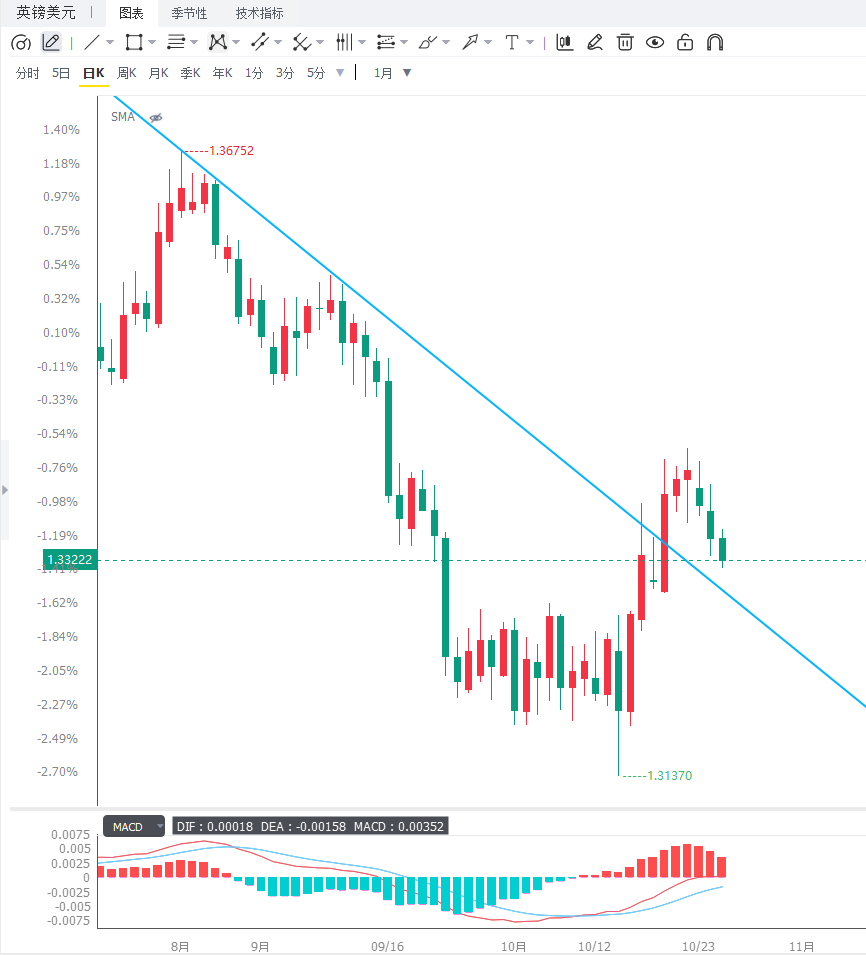
On Tuesday during Asian trading hours, the British pound traded around 1.3330 against the US dollar, continuing its consolidation pattern after retreating from its highs. The core contradiction in the current exchange rate lies in the upcoming high-volatility event of the autumn budget for the pound, while the US dollar is supported by the Fed's decision and expectations of a year-end rate hike. This combination has led to a wait-and-see approach in the market before the data release, resulting in a tug-of-war pattern where there is support on dips but no upward momentum. The key dividing line is around 1.3300.  From the perspective of the pound, the political risks of Wednesday constitute the biggest source of uncertainty. Healy's first autumn budget needs to find a balance between "delivering on Burnham's massive spending commitments" and "avoiding a repeat of the gilt market turmoil." Market participants will closely scrutinize the proposed public spending and new financing plans, observing how they can raise funds without excessively increasing bond issuance. The key to this logic is that the strength of the pound will no longer solely depend on the Bank of England's interest rate hike expectations, but will be more constrained by the repricing of fiscal credibility. If the financing plan is interpreted by the market as disciplined and with a manageable impact on bond supply, the pound may receive a temporary boost, strengthening the case for further tightening by the Bank of England; conversely, if the plan is seen as a disguised expansion of the deficit, the jump in gilt yields could quickly translate into selling pressure on the pound. This is also the structural reason why the pound's recent rebound has consistently failed to smoothly break through 1.3389—it's not that there's a lack of buying pressure above, but rather a lack of catalysts that can convince the market that the fiscal path is sustainable. For investors, this means that before the budget details are finalized, a range-bound approach is more prudent than a trend-following approach, and the success rate of chasing highs and lows has significantly decreased. However, expectations surrounding the Bank of England's policy continue to provide a floor for the pound. Market bets on further tightening of monetary policy by the Bank of England, coupled with stronger-than-expected inflation data and a resilient labor market, have limited the downside for the pound against the dollar. The nature of this support is noteworthy: it stems from a relative advantage in the interest rate floor, rather than improvements in fiscal fundamentals. Therefore, if the autumn budget triggers a disorderly rise in GILT yields, these two forces could clash—rate hike expectations would benefit the pound, but damage to fiscal credibility would harm it, ultimately determining the net direction based on which transmission chain the market prioritizes. Historically, such scenarios have often ended with a "fall followed by stabilization": the exchange rate reacts first to fiscal risks, followed by a repricing of interest rate differentials. This suggests that investors should not make unilateral bets immediately after the budget announcement, but rather wait for the market to complete its first round of sentiment release before assessing the trend. The dollar side provides a reverse restraint. As the market increasingly accepts the expectation that the Fed will hold rates steady this week, the focus has shifted to the policy statement and Warsh's post-meeting remarks—in the absence of updated economic forecasts, these will be the main basis for judging the future policy path. Meanwhile, bets on another Fed rate hike in December, coupled with geopolitical uncertainty, continue to provide a tailwind for the dollar. For the pound against the dollar, this is an environment of "no short-term catalysts, but a medium-term floor": Wednesday's inaction was widely expected, making it difficult to provide additional negative news; however, the year-end tightening path has not been disproven, making any breakout in the pound likely to encounter selling pressure at relatively high levels. Furthermore, Thursday's preliminary US Q3 GDP and PCE price index will be direct evidence of the resilience of the US economy and the stickiness of inflation. If the data is stronger than expected, it may weaken the narrative of declining US Treasury yields, thus triggering short-term profit-taking in the pound. From a cross-asset perspective, the current fluctuations in the pound against the dollar are essentially a confluence of four factors: first, a reassessment of fiscal credibility triggered by the UK's autumn budget; second, passive interest rate differential support provided by expectations of a Bank of England rate hike; third, a dollar floor formed by the Fed's year-end path not being disproven; and fourth, two-way disturbances caused by geopolitical risk premiums. It's worth noting that two major events in the UK and US take place simultaneously this Wednesday, easily creating a volatility resonance: if the budget leans hawkish (fiscal tightening) while the Fed leans dovish, the pound could receive a double boost; if the budget leans loose (deficit expansion) while the Fed retains the December option, the interest rate differential and fiscal policy could both push the exchange rate down rapidly to 1.3267. This asymmetrical risk distribution dictates that the current position is more suitable for a strategy of phased entry at both ends of the range, rather than betting on a single trend. On the daily chart, the pound/dollar pair is constrained by the 100-day simple moving average and the dense Fibonacci resistance zone above. Currently trading slightly below the 38.2% Fibonacci retracement level of 1.3344, the rebound is relatively fragile. The wide-range correction that began from the 1.3141 cycle low has not yet effectively broken through the medium-term resistance, representing a typical "resisted consolidation, awaiting confirmation" pattern. The upside resistance levels to watch are the 38.2% Fibonacci retracement at 1.3344, the 100-day moving average at 1.3389, the 50.0% Fibonacci retracement at 1.3407, and then 1.3470 and 1.3559, with the swing high at 1.3673 further away. On the downside, the first support level to watch is the 23.6% Fibonacci retracement at 1.3267, followed by the deeper structural bottom at the 1.3141 cycle low. A more significant pullback in this area could attract stronger buying interest. On the 4-hour chart, the exchange rate is slowly moving downwards along the short-term moving average. The MACD histogram is close to the zero line, with the fast and slow lines repeatedly intertwined, indicating weak momentum. If it retraces to 1.3330-1.3345 and finds support, there is still a chance for a short-term upward attack on 1.3360-1.3389. If it breaks below 1.3300 with high volume, it may seek support at 1.3267 or even 1.3141. An upward breakout requires the coordination of the autumn budget and signals from the Federal Reserve. Until then, it is advisable to treat it as a range-bound market and avoid chasing highs and lows.
 Editor's Summary: The core contradiction in the short-term GBP/USD exchange rate lies in the dual tension between the credibility test of the UK autumn budget and the unproven year-end path of the Federal Reserve. Meanwhile, the Bank of England's interest rate hike expectations and the support provided by previous lows offer a buffer. This dual-driven force makes the exchange rate more likely to consolidate within the 1.3330-1.3389 range, awaiting a breakthrough in either of these two events. Three key variables need to be monitored: first, the details of the UK autumn budget on Wednesday, especially the impact of public spending and financing plans on the gilt market, which is the primary criterion for whether the pound can escape its fiscal discount; second, the Fed's decision, policy statement, and Warsh press conference on the same day, whose statements on inflation and the year-end path will directly affect the tightness of the dollar's interest rate floor; and third, the preliminary US Q3 GDP and PCE price index on Thursday, directly verifying the resilience of the US economy and the stickiness of inflation. In addition, the continuity of inflation and employment data before the Bank of England's November meeting and developments in geopolitical situations also need to be monitored.
From the perspective of the pound, the political risks of Wednesday constitute the biggest source of uncertainty. Healy's first autumn budget needs to find a balance between "delivering on Burnham's massive spending commitments" and "avoiding a repeat of the gilt market turmoil." Market participants will closely scrutinize the proposed public spending and new financing plans, observing how they can raise funds without excessively increasing bond issuance. The key to this logic is that the strength of the pound will no longer solely depend on the Bank of England's interest rate hike expectations, but will be more constrained by the repricing of fiscal credibility. If the financing plan is interpreted by the market as disciplined and with a manageable impact on bond supply, the pound may receive a temporary boost, strengthening the case for further tightening by the Bank of England; conversely, if the plan is seen as a disguised expansion of the deficit, the jump in gilt yields could quickly translate into selling pressure on the pound. This is also the structural reason why the pound's recent rebound has consistently failed to smoothly break through 1.3389—it's not that there's a lack of buying pressure above, but rather a lack of catalysts that can convince the market that the fiscal path is sustainable. For investors, this means that before the budget details are finalized, a range-bound approach is more prudent than a trend-following approach, and the success rate of chasing highs and lows has significantly decreased. However, expectations surrounding the Bank of England's policy continue to provide a floor for the pound. Market bets on further tightening of monetary policy by the Bank of England, coupled with stronger-than-expected inflation data and a resilient labor market, have limited the downside for the pound against the dollar. The nature of this support is noteworthy: it stems from a relative advantage in the interest rate floor, rather than improvements in fiscal fundamentals. Therefore, if the autumn budget triggers a disorderly rise in GILT yields, these two forces could clash—rate hike expectations would benefit the pound, but damage to fiscal credibility would harm it, ultimately determining the net direction based on which transmission chain the market prioritizes. Historically, such scenarios have often ended with a "fall followed by stabilization": the exchange rate reacts first to fiscal risks, followed by a repricing of interest rate differentials. This suggests that investors should not make unilateral bets immediately after the budget announcement, but rather wait for the market to complete its first round of sentiment release before assessing the trend. The dollar side provides a reverse restraint. As the market increasingly accepts the expectation that the Fed will hold rates steady this week, the focus has shifted to the policy statement and Warsh's post-meeting remarks—in the absence of updated economic forecasts, these will be the main basis for judging the future policy path. Meanwhile, bets on another Fed rate hike in December, coupled with geopolitical uncertainty, continue to provide a tailwind for the dollar. For the pound against the dollar, this is an environment of "no short-term catalysts, but a medium-term floor": Wednesday's inaction was widely expected, making it difficult to provide additional negative news; however, the year-end tightening path has not been disproven, making any breakout in the pound likely to encounter selling pressure at relatively high levels. Furthermore, Thursday's preliminary US Q3 GDP and PCE price index will be direct evidence of the resilience of the US economy and the stickiness of inflation. If the data is stronger than expected, it may weaken the narrative of declining US Treasury yields, thus triggering short-term profit-taking in the pound. From a cross-asset perspective, the current fluctuations in the pound against the dollar are essentially a confluence of four factors: first, a reassessment of fiscal credibility triggered by the UK's autumn budget; second, passive interest rate differential support provided by expectations of a Bank of England rate hike; third, a dollar floor formed by the Fed's year-end path not being disproven; and fourth, two-way disturbances caused by geopolitical risk premiums. It's worth noting that two major events in the UK and US take place simultaneously this Wednesday, easily creating a volatility resonance: if the budget leans hawkish (fiscal tightening) while the Fed leans dovish, the pound could receive a double boost; if the budget leans loose (deficit expansion) while the Fed retains the December option, the interest rate differential and fiscal policy could both push the exchange rate down rapidly to 1.3267. This asymmetrical risk distribution dictates that the current position is more suitable for a strategy of phased entry at both ends of the range, rather than betting on a single trend. On the daily chart, the pound/dollar pair is constrained by the 100-day simple moving average and the dense Fibonacci resistance zone above. Currently trading slightly below the 38.2% Fibonacci retracement level of 1.3344, the rebound is relatively fragile. The wide-range correction that began from the 1.3141 cycle low has not yet effectively broken through the medium-term resistance, representing a typical "resisted consolidation, awaiting confirmation" pattern. The upside resistance levels to watch are the 38.2% Fibonacci retracement at 1.3344, the 100-day moving average at 1.3389, the 50.0% Fibonacci retracement at 1.3407, and then 1.3470 and 1.3559, with the swing high at 1.3673 further away. On the downside, the first support level to watch is the 23.6% Fibonacci retracement at 1.3267, followed by the deeper structural bottom at the 1.3141 cycle low. A more significant pullback in this area could attract stronger buying interest. On the 4-hour chart, the exchange rate is slowly moving downwards along the short-term moving average. The MACD histogram is close to the zero line, with the fast and slow lines repeatedly intertwined, indicating weak momentum. If it retraces to 1.3330-1.3345 and finds support, there is still a chance for a short-term upward attack on 1.3360-1.3389. If it breaks below 1.3300 with high volume, it may seek support at 1.3267 or even 1.3141. An upward breakout requires the coordination of the autumn budget and signals from the Federal Reserve. Until then, it is advisable to treat it as a range-bound market and avoid chasing highs and lows. Editor's Summary: The core contradiction in the short-term GBP/USD exchange rate lies in the dual tension between the credibility test of the UK autumn budget and the unproven year-end path of the Federal Reserve. Meanwhile, the Bank of England's interest rate hike expectations and the support provided by previous lows offer a buffer. This dual-driven force makes the exchange rate more likely to consolidate within the 1.3330-1.3389 range, awaiting a breakthrough in either of these two events. Three key variables need to be monitored: first, the details of the UK autumn budget on Wednesday, especially the impact of public spending and financing plans on the gilt market, which is the primary criterion for whether the pound can escape its fiscal discount; second, the Fed's decision, policy statement, and Warsh press conference on the same day, whose statements on inflation and the year-end path will directly affect the tightness of the dollar's interest rate floor; and third, the preliminary US Q3 GDP and PCE price index on Thursday, directly verifying the resilience of the US economy and the stickiness of inflation. In addition, the continuity of inflation and employment data before the Bank of England's November meeting and developments in geopolitical situations also need to be monitored.
- Risk Warning and Disclaimer
- The market involves risk, and trading may not be suitable for all investors. This article is for reference only and does not constitute personal investment advice, nor does it take into account certain users’ specific investment objectives, financial situation, or other needs. Any investment decisions made based on this information are at your own risk.