Gold Trading Alert: Oil Price Pullback Becomes a "Lifeline," Gold Prices Stage a "Surprising Rebound," and the Fed's Decision is Coming Soon!
2026-10-28 07:50:23
On Tuesday (October 27), international gold prices rebounded after fluctuating, with spot gold ultimately rising about 1% to $4,060.13 per ounce, after briefly dipping to a low of $3,989.06 before a strong rebound. December gold futures also closed up 0.9% at $4,074.60. The core driver of this movement was the significant decline in oil prices. Weaker oil prices alleviated market concerns about inflation to some extent and allowed some investors to reassess the hawkishness of the Federal Reserve's subsequent policies, thus providing temporary support for gold. The market is currently at a critical juncture where multiple factors are intertwined. Falling oil prices ease inflation concerns and may soften the Fed's hawkish stance, thus supporting gold prices; however, oil prices remain near multi-month highs, and Middle East shipping risks and the Houthi attack on Saudi Arabia keep supply risks lingering. Meanwhile, the Fed is likely to hold rates steady this week, but expectations for a December rate hike remain high, and the rebounding dollar and high US Treasury yields are putting downward pressure on non-yielding gold. On Wednesday (October 28) in early Asian trading, spot gold traded in a narrow range, currently hovering around $4,060 per ounce. 
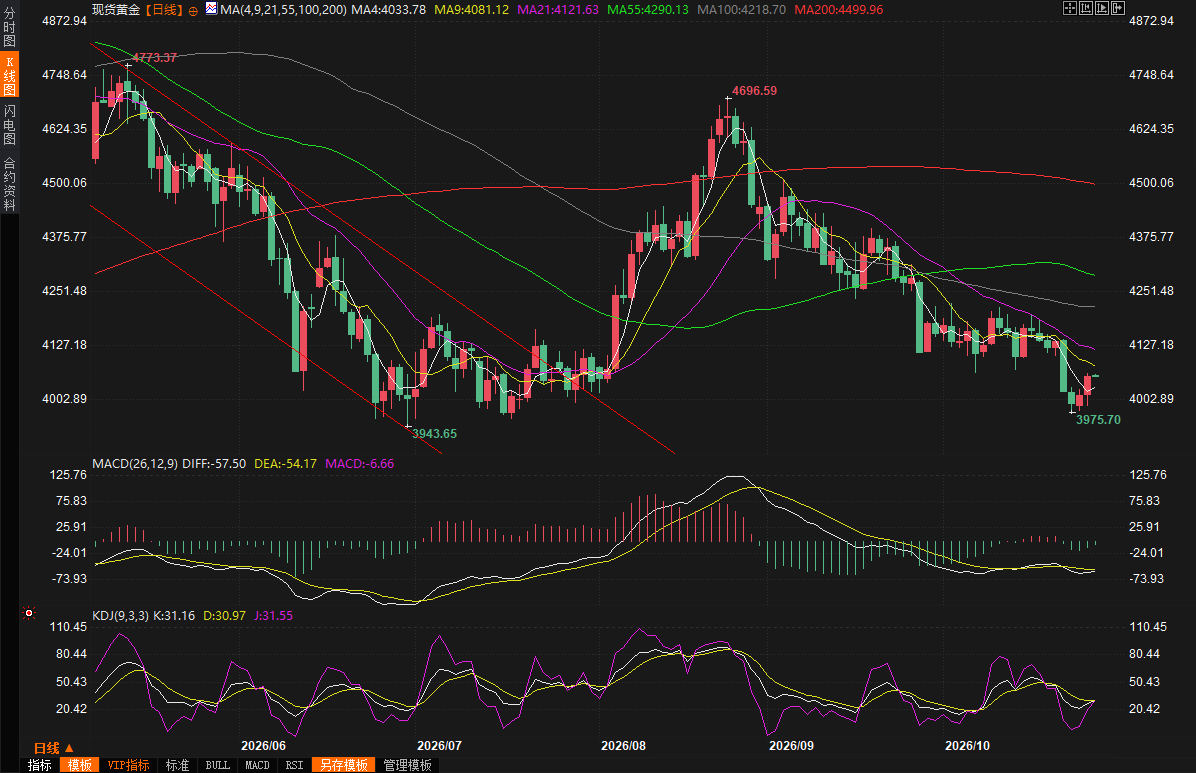 (Spot gold daily chart, source: FX678) At 07:47 Beijing time, spot gold is currently trading at $4060.39 per ounce.
The decline in oil prices became a direct catalyst for the rebound in gold prices.
On Tuesday, the crude oil market saw a significant pullback, with Brent crude futures closing down $1.93 at $113.88 per barrel, a drop of 1.67%; U.S. crude futures also fell $1.86 to $99.90. This decline in oil prices directly alleviated short-term market concerns about imported inflation. Peter Grant, Vice President and Senior Precious Metals Strategist at Zaner Metals, pointed out that weaker oil prices may provide some support for gold, as this eases inflation concerns and may, to some extent, soften the Federal Reserve's hawkish stance. From a trading perspective, there is a complex correlation between gold and crude oil. When oil prices continue to rise, they often push up inflation expectations, forcing central banks to maintain or accelerate the pace of tightening, thereby increasing the opportunity cost of holding non-interest-bearing assets like gold; conversely, when oil prices fall, this pressure temporarily eases, making gold more attractive to investors. Tuesday's price action reflects this logic. However, the market is also keenly aware that current oil prices are still hovering near multi-month highs, and the risk premium has not truly subsided.The situation in the Middle East remains unpredictable, and risk premiums remain a key variable.
The reason oil prices have struggled to fall significantly lies in the persistent geopolitical risks in the Middle East. While some positive diplomatic signals have emerged recently, substantive progress has been limited. In Iran, National Security Council Chairman Mohsen Rezaei met with Supreme Leader Mojtaba Khamenei, who emphasized the need to safeguard Iranian interests and uphold Iran's conditions for ending the war. Simultaneously, Iran and Jordan's foreign ministers spoke, both stressing the importance of maintaining regional peace and stability through diplomacy. Qatar also called on Iran to demonstrate goodwill, cease its threats against the Gulf states, and open the Strait of Hormuz. These statements brought a brief period of easing, driving oil prices down, gold prices up, and US Treasury yields down. However, the renewed attacks on Saudi Arabia by pro-Iranian Houthi rebels in Yemen have left the peace prospects uncertain. Data from Washington think tanks shows that October was the month with the most attacks on merchant ships in the Strait of Hormuz and surrounding waters. UBS points out that although ship traffic in the strait has increased, attacks have risen simultaneously, and the risks could escalate further if US naval support weakens. The market generally believes that current crude oil prices already include a considerable risk premium, reflecting the potential for a US and Israeli attack on Iran in the coming weeks. Analysts at Gelber & Associates also caution that while positive diplomatic news has pushed some of the risk premium down, continued Houthi attacks and the expanding military presence in the Gulf region still pose ongoing supply risks. This "neither war nor peace" situation means that demand for gold as a safe-haven asset has not diminished; it has simply been temporarily masked by the positive impact of falling oil prices.The Federal Reserve meeting is the focus, and the interest rate path will determine the medium-term fate of gold.
The market's real attention is focused on this week's Federal Reserve policy meeting. Policymakers have hinted that they will not raise US short-term borrowing costs again this week, but given persistent inflation concerns, investors believe the pause in rate hikes will not last long. According to the CME FedWatch tool, traders currently expect an 83% probability of a US rate hike in December. Rising interest rates directly increase the opportunity cost of holding gold. Currently, US Treasury yields are generally high, with the 10-year yield fluctuating narrowly below 5%, while the two-year yield has risen slightly. After last week's safe-haven buying driven by the AI sector sell-off, trading has become thin, and investors are cautiously awaiting signals from the Fed's rhetoric. If the meeting releases a hawkish signal, emphasizing sticky inflation and the possibility of further rate hikes, gold may face renewed pressure; conversely, if the rhetoric is dovish or emphasizes data dependence, it will help consolidate the recent rebound. Meanwhile, the US Personal Consumption Expenditures (PCE) data to be released on Thursday is seen by the market as the Fed's most closely watched inflation indicator. This data will directly examine the actual impact of falling oil prices on inflation expectations and may also become an important catalyst for the next direction of gold prices.The resilience of the US economy and the strength of the dollar act as a counterbalance.
At the macro level, US economic data showed some resilience. Core durable goods orders rose 0.5% month-over-month in September, while shipments jumped 1.2%, indicating that business equipment spending remained strong, driven by the AI investment boom. Economists predict that business equipment spending is likely to achieve double-digit growth for the third consecutive quarter in the third quarter, with GDP growth at an annualized rate of around 3.2%. Consumer confidence also rebounded in October, but public dissatisfaction with rising prices remained evident, with the cost of living being a key concern for voters ahead of the midterm elections. The US dollar index rose to a near one-and-a-half-week high on Tuesday, strengthening slightly against major currencies. Against the backdrop of several central banks announcing policy decisions this week, the relative strength of the dollar put some pressure on dollar-denominated gold. Analysts pointed out that if the Federal Reserve maintains its interest rates, a dovish tone could put downside risks on the dollar, thus benefiting gold; a hawkish tone could further strengthen the dollar, increasing upward resistance for gold. It's worth noting that analysts have lowered their 2026 gold price forecasts for the second consecutive quarter, primarily due to persistently high US Treasury yields, a stronger dollar, and market expectations that interest rates will remain high for an extended period. However, most institutions still anticipate a gold price rebound in 2027, indicating that the medium- to long-term bullish logic has not been completely negated.Short-term equilibrium and medium-term observation points amidst the interplay of bullish and bearish factors
In summary, Tuesday's gold price rebound was more of a technical correction and a short-term sentiment boost from the decline in oil prices, rather than a confirmation of a trend reversal. Supporting factors included the temporary weakness in oil prices easing inflation concerns, continued safe-haven demand due to the Middle East situation, and the high probability that the Federal Reserve would hold rates steady this week. Suppressing factors included the continued drag on the opportunity cost of gold from the high-interest-rate environment, the relative strength of the US dollar, and the possibility that a renewed rise in oil prices could reignite inflation expectations. In the short term, whether gold prices can hold above the $4,000 mark and expand upwards depends crucially on the wording of the Federal Reserve meeting and the performance of Thursday's PCE data. If the data confirms that inflationary pressures have eased, and the Federal Reserve releases more cautious signals, gold is expected to continue its rebound; conversely, if inflation stickiness exceeds expectations or the policy stance is hawkish, gold prices may retest lower support levels. From a longer-term perspective, the core logic for gold still revolves around its "safe-haven value in a high-interest-rate environment" and "geopolitical risk premium." With the situation in the Middle East yet to show substantial easing, and the US economy facing both inflationary and cost-of-living pressures despite its resilience, gold's strategic position as a hedging tool in asset allocation remains unshaken. Investors need to strike a balance between short-term volatility and medium-term logic, closely monitoring dynamic changes in oil prices, US Treasury yields, and the Federal Reserve's communications. (Spot gold daily chart, source: FX678) At 07:47 Beijing time, spot gold is currently trading at $4060.39 per ounce.
- Risk Warning and Disclaimer
- The market involves risk, and trading may not be suitable for all investors. This article is for reference only and does not constitute personal investment advice, nor does it take into account certain users’ specific investment objectives, financial situation, or other needs. Any investment decisions made based on this information are at your own risk.