Crude oil trading alert: Geopolitical risk premiums remain active, US crude oil stabilizes and rebounds, continuing its high-level fluctuations.
2026-10-28 09:54:24
WTI crude oil traded at $101.08, continuing its upward trend from $100.30 in the Asian session of the previous trading day, indicating that the market is still pricing in geopolitical headlines. However, the nature of this round of increases remains unchanged: the driver is still a pulse-like return of risk premiums, rather than a substantial improvement in supply and demand fundamentals. The actual production losses, downtime, and recovery progress of the Rastanura attack are still to be confirmed; Israel's vote counting and government formation have not yet been finalized; and the Tehran-based four-nation dialogue framework has not been overturned. None of these three variables are closed loops, meaning that current prices are paying more for "possibility" than for "disruption." This is the fundamental reason why oil prices have consistently failed to break out of the $100-$103 range—the market is pricing in tail risks, but not in substantial supply gaps.  From a supportive perspective, the convergence of three factors on the same day shifted the narrative from "cooling down" back to "heating up." The time window highlighted by Commerzbank is particularly crucial: the midterm elections act as a pre-emptive constraint on administrative decisions; pre-election price suppression and post-election option retention make oil prices more likely to fluctuate within a range rather than experience a unilateral surge before next week. If Netanyahu returns to the premiership and shifts towards a "regime change" approach, the risk premium already embedded in oil prices will be further solidified; conversely, if there is a deadlock in forming a government or the new government tends to be restrained, this premium will be quickly eroded. For investors, this means the current odds structure is asymmetrical: an upward breakout requires confirmed impact from an attack or the midterm elections as an incremental catalyst, while a downward trigger only requires news of "smooth recovery" or "restart of talks." Demand and policy continue to set ceilings from another side. The probability of a Fed rate hike in December remains high at approximately 84.4%, and the high-interest-rate environment indirectly weakens the demand narrative for crude oil by suppressing growth expectations; the high-level fluctuations in the US dollar index also put pressure on dollar-denominated commodities. In a horizontal comparison, copper is tentatively continuing its recovery from the lower end of its range, while gold appears increasingly vulnerable around $4065. Global stock indices are showing divergent performance—crude oil has neither received a boost from a broad-based recovery in risk appetite nor been dragged down by a systemic sell-off, finding itself in a neutral environment lacking directional catalysts. Meanwhile, oil prices are already relatively high (Brent crude is holding above $115), and this high premium will suppress demand expectations and trigger administrative interventions such as the release of strategic reserves, creating a self-correcting force. What can truly change this situation is whether inventory data and OPEC+ policy signals can provide fundamental confirmation. Regarding cross-asset linkages, the same round of geopolitical developments has different effects on different assets: it provides safe-haven support for the dollar, boosts gold by alleviating inflation concerns, disrupts yen carry trades, and is purely an upward driver for crude oil. This divergence indicates that the net direction is not determined by the event itself, but by the relative strength of the forces in each transmission chain. Investors should not view the single-day rebound in oil prices in isolation, but rather assess it within the transmission chain of "geopolitics—supply—inflation—interest rates": only when there is a verifiable disruption on the supply side will this round of premium have the basis to transform into a trend. On the daily chart, WTI is trading at $101.08, continuing its upward trend after ending two consecutive days of declines. The price has risen above the $100 mark and is gradually approaching the short-term moving average cluster, with an overall neutral to bullish bias but the momentum has not yet strengthened. $100 has turned from resistance to near-term support, indicating that there is a willingness to buy above this psychological level, which is a typical "building momentum for a breakout" pattern. The resistance levels to watch are $101.50, $102.50, and $103.80. The support levels to watch are first $100.80, then the psychological level of $100.00 and $99.80; if $99.80 is breached with significant volume, it may seek support at $98.50. On the 4-hour chart, oil prices rebounded from around $99.80 and moved along the short-term moving average. The MACD histogram is close to the zero line, and the fast and slow lines are approaching a golden cross, indicating a shift in momentum from bearish to bullish, but this has not yet been confirmed. Currently, the price is fluctuating narrowly between $100.90 and $101.30. If it retraces to $100.70-$100.90 and finds support, there is still a chance for a short-term upward move towards $101.50-$102.00.
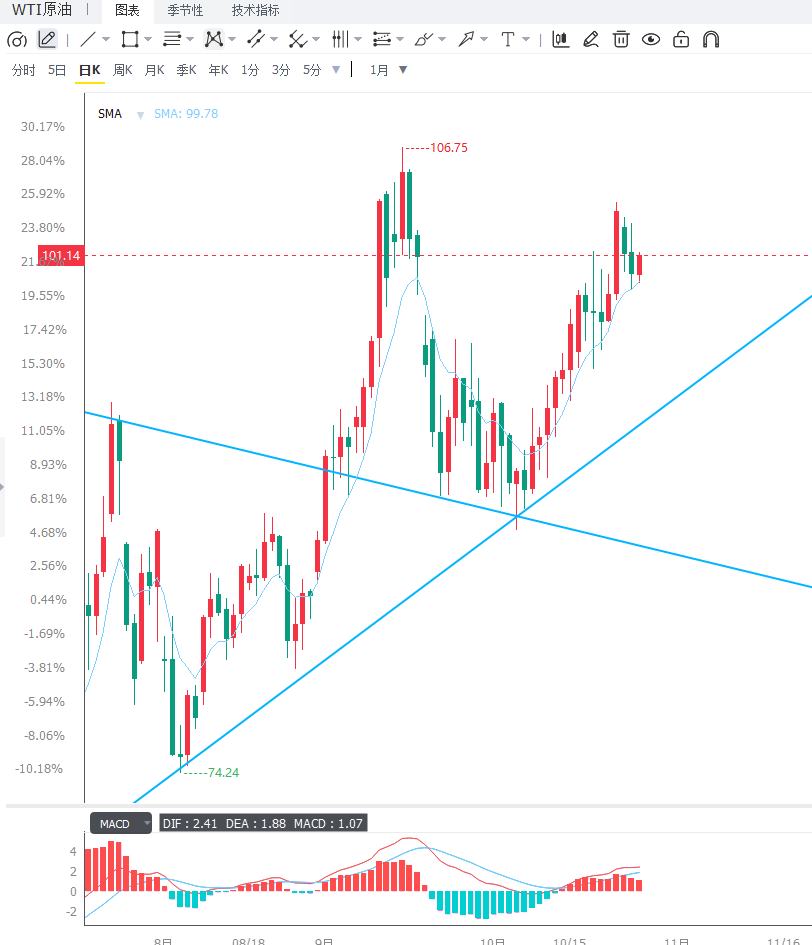 Editor's Summary: The core contradiction in the short term for crude oil lies in the deadlock in the Israeli election, Khamenei's statements, and the Houthi attacks on Rastanura, which continue to push up risk premiums. Meanwhile, the unbroken framework of the Tehran talks and the high-interest-rate environment suppressing demand expectations create a counterbalancing effect. This dual-driven factor makes oil prices more likely to consolidate within the $100.00-$101.50 range, awaiting a breakthrough in the midterm elections and supply impact assessments. Three key variables need to be monitored: first, the final vote count and government formation in the Israeli election, which is the primary criterion for judging whether the conflict might escalate into a "regime change" narrative; second, the actual impact on the Rastanura refinery's capacity and Saudi Arabia's recovery progress, directly determining whether supply disruption concerns can transform from sentiment into fundamentals; and third, the time window of Commerzbank's warning of a possible new attack on Iran next week after the midterm elections, and the navigation status of the Strait of Hormuz. In addition, the EIA crude oil inventory data, OPEC+ policy signals, the US dollar index, and US Treasury yields, which will be released later, also need to be monitored.
From a supportive perspective, the convergence of three factors on the same day shifted the narrative from "cooling down" back to "heating up." The time window highlighted by Commerzbank is particularly crucial: the midterm elections act as a pre-emptive constraint on administrative decisions; pre-election price suppression and post-election option retention make oil prices more likely to fluctuate within a range rather than experience a unilateral surge before next week. If Netanyahu returns to the premiership and shifts towards a "regime change" approach, the risk premium already embedded in oil prices will be further solidified; conversely, if there is a deadlock in forming a government or the new government tends to be restrained, this premium will be quickly eroded. For investors, this means the current odds structure is asymmetrical: an upward breakout requires confirmed impact from an attack or the midterm elections as an incremental catalyst, while a downward trigger only requires news of "smooth recovery" or "restart of talks." Demand and policy continue to set ceilings from another side. The probability of a Fed rate hike in December remains high at approximately 84.4%, and the high-interest-rate environment indirectly weakens the demand narrative for crude oil by suppressing growth expectations; the high-level fluctuations in the US dollar index also put pressure on dollar-denominated commodities. In a horizontal comparison, copper is tentatively continuing its recovery from the lower end of its range, while gold appears increasingly vulnerable around $4065. Global stock indices are showing divergent performance—crude oil has neither received a boost from a broad-based recovery in risk appetite nor been dragged down by a systemic sell-off, finding itself in a neutral environment lacking directional catalysts. Meanwhile, oil prices are already relatively high (Brent crude is holding above $115), and this high premium will suppress demand expectations and trigger administrative interventions such as the release of strategic reserves, creating a self-correcting force. What can truly change this situation is whether inventory data and OPEC+ policy signals can provide fundamental confirmation. Regarding cross-asset linkages, the same round of geopolitical developments has different effects on different assets: it provides safe-haven support for the dollar, boosts gold by alleviating inflation concerns, disrupts yen carry trades, and is purely an upward driver for crude oil. This divergence indicates that the net direction is not determined by the event itself, but by the relative strength of the forces in each transmission chain. Investors should not view the single-day rebound in oil prices in isolation, but rather assess it within the transmission chain of "geopolitics—supply—inflation—interest rates": only when there is a verifiable disruption on the supply side will this round of premium have the basis to transform into a trend. On the daily chart, WTI is trading at $101.08, continuing its upward trend after ending two consecutive days of declines. The price has risen above the $100 mark and is gradually approaching the short-term moving average cluster, with an overall neutral to bullish bias but the momentum has not yet strengthened. $100 has turned from resistance to near-term support, indicating that there is a willingness to buy above this psychological level, which is a typical "building momentum for a breakout" pattern. The resistance levels to watch are $101.50, $102.50, and $103.80. The support levels to watch are first $100.80, then the psychological level of $100.00 and $99.80; if $99.80 is breached with significant volume, it may seek support at $98.50. On the 4-hour chart, oil prices rebounded from around $99.80 and moved along the short-term moving average. The MACD histogram is close to the zero line, and the fast and slow lines are approaching a golden cross, indicating a shift in momentum from bearish to bullish, but this has not yet been confirmed. Currently, the price is fluctuating narrowly between $100.90 and $101.30. If it retraces to $100.70-$100.90 and finds support, there is still a chance for a short-term upward move towards $101.50-$102.00. Editor's Summary: The core contradiction in the short term for crude oil lies in the deadlock in the Israeli election, Khamenei's statements, and the Houthi attacks on Rastanura, which continue to push up risk premiums. Meanwhile, the unbroken framework of the Tehran talks and the high-interest-rate environment suppressing demand expectations create a counterbalancing effect. This dual-driven factor makes oil prices more likely to consolidate within the $100.00-$101.50 range, awaiting a breakthrough in the midterm elections and supply impact assessments. Three key variables need to be monitored: first, the final vote count and government formation in the Israeli election, which is the primary criterion for judging whether the conflict might escalate into a "regime change" narrative; second, the actual impact on the Rastanura refinery's capacity and Saudi Arabia's recovery progress, directly determining whether supply disruption concerns can transform from sentiment into fundamentals; and third, the time window of Commerzbank's warning of a possible new attack on Iran next week after the midterm elections, and the navigation status of the Strait of Hormuz. In addition, the EIA crude oil inventory data, OPEC+ policy signals, the US dollar index, and US Treasury yields, which will be released later, also need to be monitored.
- Risk Warning and Disclaimer
- The market involves risk, and trading may not be suitable for all investors. This article is for reference only and does not constitute personal investment advice, nor does it take into account certain users’ specific investment objectives, financial situation, or other needs. Any investment decisions made based on this information are at your own risk.