The Reserve Bank of New Zealand unexpectedly kept interest rates at 2.75%, causing the New Zealand dollar to fall 1.5% to a two-week low.
2026-10-28 09:30:28
The Reserve Bank of New Zealand's Monetary Policy Committee unexpectedly voted 4-3 on Wednesday (October 28) to maintain the official cash rate at 2.75%. Third-quarter annual CPI inflation fell to 3.7%, lower than expected, but core inflation has risen to the upper end of the 1%-3% target range, widening price pressures. Fourth-quarter inflation is projected to rise to 4.4% due to global energy market turmoil and the depreciation of the New Zealand dollar. The committee unanimously agreed that further tightening may be necessary, but the timing depends on the economic outlook. Four members advocated for a wait-and-see approach, while three members advocated for a 25 basis point rate hike. As a result, the New Zealand dollar briefly plunged about 1.5% against the US dollar to around 0.5590, hitting a low of 0.5575, its lowest level since October 14, when it touched a near one-year low of 0.5664. It is worth noting that the market had widely expected the Reserve Bank of New Zealand to raise the official cash rate for the third consecutive time at Wednesday's meeting; a survey showed that nearly 80% of economists expected a 0.25 percentage point increase to 3.00%. 
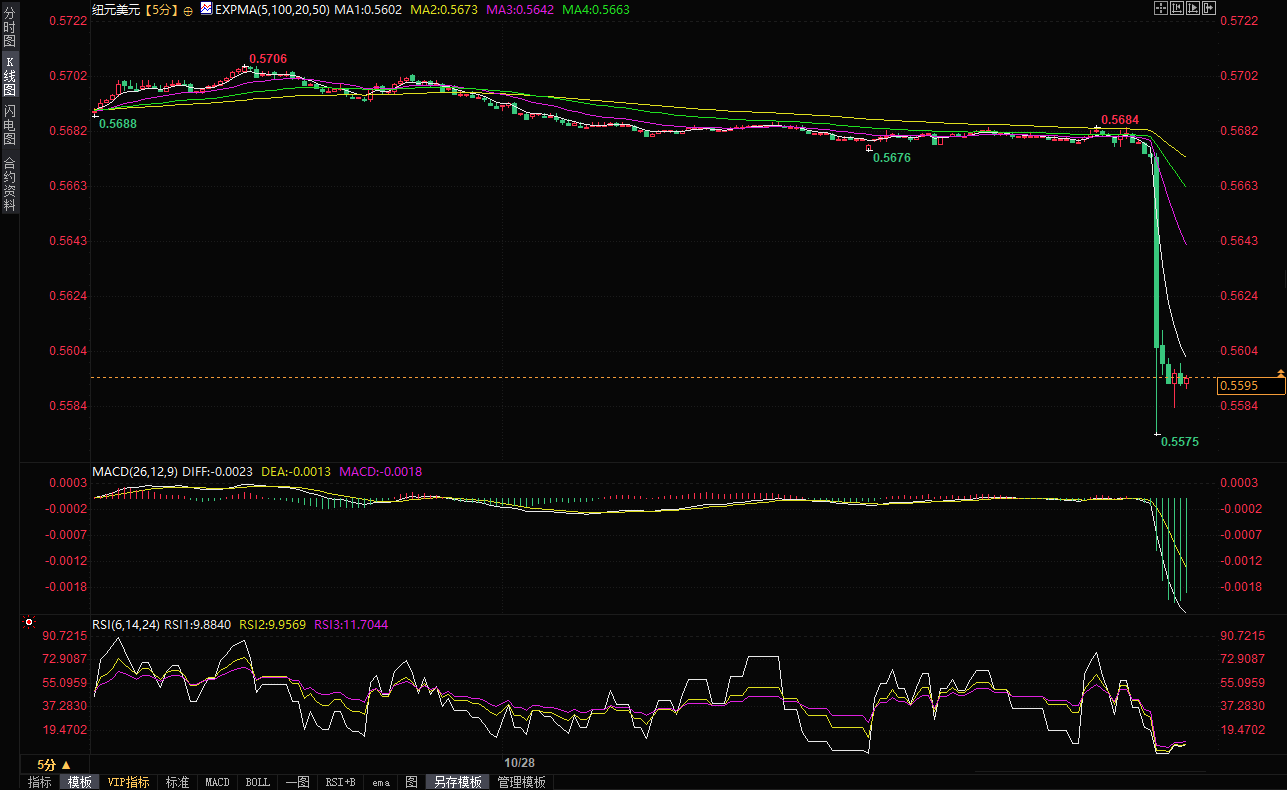 (NZD/USD 5-minute chart, source: EasyForex)
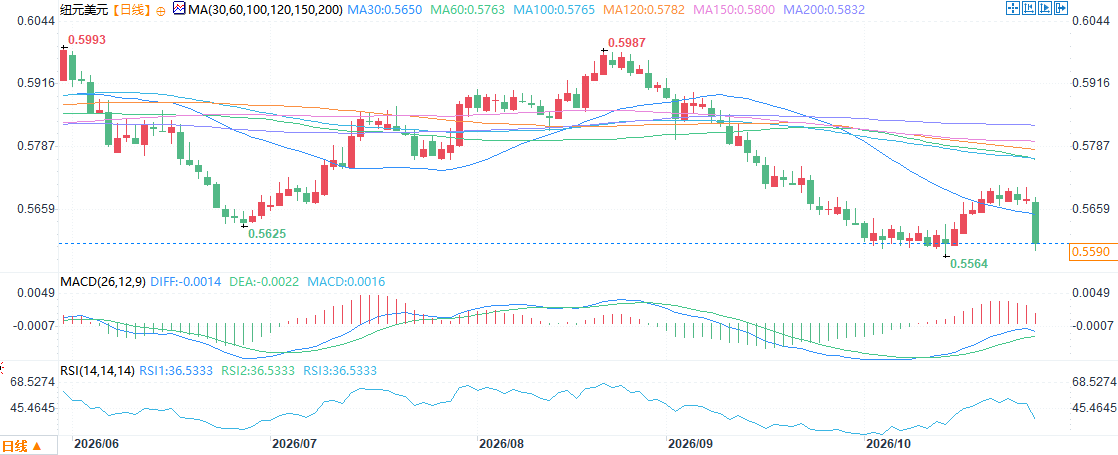 (NZD/USD daily chart, source: EasyForex) At 9:26 Beijing time, the NZD/USD exchange rate was 0.5595/96.
Inflation status: Overall, it has fallen to 3.7%, while core indicators have risen to the upper limit of the target.
The annual Consumer Price Index (CPI) inflation rate was 3.7% in the third quarter, down from 4.1% in June and below expectations. Wage growth has been moderate so far, and medium-term inflation expectations remain stable. However, core inflation measures have risen to near the upper end of the Committee’s 1% to 3% target range, and price increases have become more widespread since the June quarter. Weighted, 56% of items in the CPI basket rose more than 3% over the past year ending September 2026. By component, annual tradable goods inflation fell to 4.3% from 4.9%, but was slightly above expectations; excluding vehicle fuel, annual inflation rose to 3%. Non-tradable goods inflation was 3.3%, weaker than expected, partly reflecting higher government fees. The transmission of global price increases to U.S. domestic price categories has been lower than previously assumed so far, and the impact on short-term pricing behavior appears to be under control, with medium-term inflation expectations remaining well anchored.Recent pressures: Oil prices and a weaker New Zealand dollar push fourth-quarter inflation to 4.4%.
Global events are increasing recent inflationary pressures in New Zealand. Fuel prices have risen further due to continued disruptions in global energy markets, causing the New Zealand dollar to fall by about 3% since early September. Annual inflation is projected to rise to 4.4% in the fourth quarter, primarily reflecting current fuel futures prices. Recent inflation forecasts are uncertain given the volatility in crude oil and refined product prices. Disruptions in global oil supply, losses in refining capacity, and shipping disruptions caused by conflict are putting further upward pressure on international refined product prices. If refined product prices stabilize or fall, the direct effects of rising fuel prices will be excluded from annual inflation calculations by the end of 2027. Persistently high refined product prices and currency depreciation could have a greater indirect effect and increase the likelihood of a second round of effects through wages and pricing behavior; however, transmission is state-dependent, and persistently weak demand may limit these effects.Current economic situation: Export sector benefits, domestic demand is weak, and recovery is uneven.
New Zealand's economy continues its recovery, but the situation remains uneven. Export-related sectors benefited from high commodity prices, strong demand for goods exports, and increased tourist arrivals; however, domestic demand remained weak outside export hubs. Residential investment showed some early signs of recovery, including in Auckland. First-half GDP growth in 2026 exceeded expectations, and business survey indicators pointed to continued expansion in economic activity. Some estimates suggest that international trade supports about a quarter of New Zealand's employment. However, households and businesses focused on domestic demand still face challenges. Household consumption was weak, with the total savings rate estimated at 3.7%, above the ten-year average of 1%. Job growth remained sluggish, and higher prices will further reduce real income and purchasing power. House prices continued to fall, dragging down household sentiment and spending. Businesses reported high costs, but the ability to pass them on varied by industry; in the September quarterly business opinion survey, fewer businesses experienced and expected price increases compared to June, but the level remained high. Business investment intentions were resilient, but focused on improving productivity and cutting costs rather than expansion; employment intentions remained weak.Financial conditions: Wholesale interest rates rose, but some conditions eased due to lower exchange rates and lower lending rates.
The rise in U.S. wholesale rates reflects market expectations of a higher Open Rate of Return (OCR) from the Reserve Bank of New Zealand and rising global long-term interest rates. However, some U.S. domestic financial conditions eased due to a weaker exchange rate and lower term loan rates for some households and businesses. Weak credit demand and increased deposits reduced the transmission of the wholesale rate increase to deposit and loan rates.Global Risks: Uncertainties Intertwined in Energy, Debt, and AI Investment
The Committee assesses that the global economic outlook faces significant risks. Geopolitical events, high energy prices, and high and rising levels of public and private debt pose downside risks to global growth. There is uncertainty as to whether the surge in AI investment can be justified by economic fundamentals. Since the September monetary policy statement, financial stability risks have increased due to high debt levels and the lack of transparency and complexity in some AI investment financing arrangements. Fuel subsidies have mitigated the inflationary impact of high oil prices in some economies, but have also weakened fiscal conditions. Rising long-term interest rates could expose financial vulnerabilities, triggering asset price adjustments and financial stress. The Committee notes that a global downturn could occur suddenly.Policy trade-offs: The direction of interest rate hikes is clear, but the timing depends on the balance between data and risks.
The Committee reflected on the potential trade-offs between raising rates now or waiting until the December monetary policy statement. Information arriving in the next six weeks could materially alter the appropriate policy stance in either direction. Risks include that inflation may have solidified before conventional indicators of expectations respond, despite the two previous rate hikes; a sudden global economic downturn could lead to weaker inflation over the medium term; and escalating geopolitical tensions could simultaneously push up fuel prices and weaken global economic activity. The Committee judged that monetary policy must remain robust in the face of these risks. Further tightening may be necessary if domestic pricing pressures fail to ease sufficiently or expand beyond what costs and normal transmission can explain; conversely, if pricing pressures are subdued, maintaining rates at future meetings may be necessary; and a sharp global economic downturn that materially weakens demand and the inflation outlook could alter the ideal stance, including leading to monetary easing.Institutional Views
Mitsubishi UFJ Financial Group had previously assessed that the risks to the New Zealand dollar were skewed to the downside. The Reserve Bank of New Zealand (RBNZ) chose to hold rates steady today, failing to deliver on its expected rate hike, thus bringing forward the downward pressure on the New Zealand dollar. Mitsubishi UFJ's view places it at the dovish end of the expected spectrum. Domestically in New Zealand, ANZ Bank had previously predicted a pause in December, while ASB and Westpac Bank projected the Open Rate of Return (OCR) to reach 3.5% by February next year. Since today's meeting was a monetary policy assessment and did not update forecasts or the interest rate path, the tone of the RBNZ's statement will likely determine which path the market favors. Analysts point out that New Zealand's unemployment rate hit a 10-year high in the second quarter—any deterioration will limit the scope for further rate hikes, otherwise the economy will fall back into recession. Monetary policy alone cannot achieve positive results—targeted fiscal support is also needed.Summarize
The Reserve Bank of New Zealand (RBNZ) unexpectedly kept the official cash rate at 2.75% on Wednesday by a 4-3 vote, with three members advocating for a rate hike to 3%. Third-quarter annual CPI inflation fell to 3.7%, lower than expected, but core inflation rose to the upper end of the 1%-3% target range, with 56% of CPI items rising by more than 3%, widening price pressures. Fourth-quarter inflation is projected to rise to 4.4%, influenced by global energy market turmoil and a roughly 3% decline in the New Zealand dollar since early September. The economic recovery is uneven, with exports benefiting from high commodity prices and increased tourism, while domestic demand and household consumption remain weak, the savings rate is above the ten-year average, and house prices continue to fall. The committee unanimously agreed that further tightening may be necessary, but the timing depends on the economic outlook: four members advocated waiting to assess the effects of the last two rate hikes and the risks of a weak recovery, while three members emphasized the risk of solidified core inflation and advocated for action. Data and geopolitical developments over the next six weeks will determine the direction of the December meeting. (NZD/USD 5-minute chart, source: EasyForex) (NZD/USD daily chart, source: EasyForex) At 9:26 Beijing time, the NZD/USD exchange rate was 0.5595/96.- Risk Warning and Disclaimer
- The market involves risk, and trading may not be suitable for all investors. This article is for reference only and does not constitute personal investment advice, nor does it take into account certain users’ specific investment objectives, financial situation, or other needs. Any investment decisions made based on this information are at your own risk.