Oil prices and interest rate differentials are putting pressure on the yen, with USD/JPY rising for four consecutive days and nearing the upper limit of its trading range, awaiting a breakout.
2026-10-28 15:14:23
On Wednesday during the Asian session, USD/JPY traded around 158.00, continuing its recovery this week. The core driver of this rally came from dual pressures on the yen: firstly, rising oil prices pushed up import costs through trade terms; secondly, the expectation that the Bank of Japan would hold rates steady on Friday weakened the yen's interest rate attractiveness. Exit polls for the Israeli election showed a close race between Netanyahu and Eisenkot, with neither side securing a majority. Although vote counts showed a slight decline in Netanyahu's support, the deadlock in forming a government itself means that the direction of the Middle East situation remains uncertain. This state of "undetermined outcome and lingering risks" provides a sustained risk premium for oil prices and also places additional imported cost pressures on Japan, a net energy importer.  From the perspective of the yen, the core contradiction lies in the gap between "completed tightening" and "further tightening yet to materialize." The Bank of Japan has raised interest rates by a total of 50 basis points this year and is currently in a pause to assess the impact of previous tightening. Although the market still prices in another rate hike before the end of the year, with a strong bias towards a December action, this expectation lacks an immediate catalyst before Friday's meeting. This means that the yen's support comes more from expectations than reality—once the Bank of Japan's statements are cautious, or the market postpones its expectations for a December rate hike, the yen's bullish logic will quickly weaken. Compared horizontally with other G10 currencies, this situation puts the yen in a relatively passive position: it cannot enjoy the dual benefits of high interest rates and safe-haven demand like the dollar, nor can it directly benefit from rising oil prices like the Canadian dollar; instead, it has to bear the deterioration of trade terms due to rising energy costs. This is also the underlying reason why the current USD/JPY rebound slope is relatively mild, yet it has not been effectively suppressed. The pressure on the dollar side is more direct. The October rate freeze has already been fully priced in, so the meeting itself is unlikely to provide any incremental drivers; the real variable lies in the expected revision of the year-end path. Warsh acknowledged that he was "too traumatized by the global financial crisis," while emphasizing structural growth and the investment boom, and refusing to predict the decisions in October and December—this cautious tone, while not explicitly hawkish, is enough to maintain the expectation of a year-end rate hike. The FXS Fed Sentiment Index remains stable at a hawkish high of 127.51, indicating that the market interprets Warsh's speech as a confirmation of the existing hawkish narrative, rather than a change in policy direction. Any hawkish comments from Fed officials could push up the dollar and create headwinds for the currency pair; conversely, softer rhetoric could trigger dollar long positions to be reduced, thus limiting the upside potential of USD/JPY. From a cross-asset perspective, the current fluctuations in USD/JPY are essentially a confluence of four factors: first, valuation support from the sustained high expectations of the USD/JPY interest rate differential; second, cost pressure on the yen from oil prices through energy imports; third, safe-haven inflows due to Middle East geopolitical risks; and fourth, position-wise observation ahead of the Bank of Japan's policy decision. It's worth noting that this interconnected structure makes a range-bound trading strategy more suitable for this currency pair than a one-sided bet: when oil prices and the dollar rise in tandem, the exchange rate often becomes volatile; only when the two move in opposite directions does a trend-driven movement have a basis. A single-day rebound should not be viewed in isolation but rather evaluated within the transmission chain of "interest rate differential—energy costs—central bank timing—safe-haven outflows." On the daily chart, USD/JPY is trading around 158.00, with an overall bullish bias. The price is trading above the 50-period EMA (around 157.96) and the 9-period EMA (around 157.76), both closely below the current price, indicating potential buying interest on dips. The RSI (14) is around 52, which is in the neutral-to-bullish zone and far from overbought levels, representing a typical "bullish trend, poised for a breakout" pattern. The resistance levels to watch are 158.30, 158.80, and 159.20. Support levels to watch are first the 50-period EMA at around 157.96, followed by the 9-period EMA at 157.76. A deeper pullback would test the structural support zone around 157.30. On the 4-hour chart, the exchange rate is moving upwards along the short-term moving average. The MACD histogram is close to the zero line, and the fast and slow lines are approaching a golden cross, indicating bullish momentum but a breakout has not yet been confirmed. Currently, the price is fluctuating narrowly between 157.90 and 158.15. If it retraces to 157.76-157.96 and finds support, there is still a chance for a short-term upward attack on 158.30-158.60. If it breaks below 157.76 with significant volume, it may seek support at 157.30 or even 156.80.
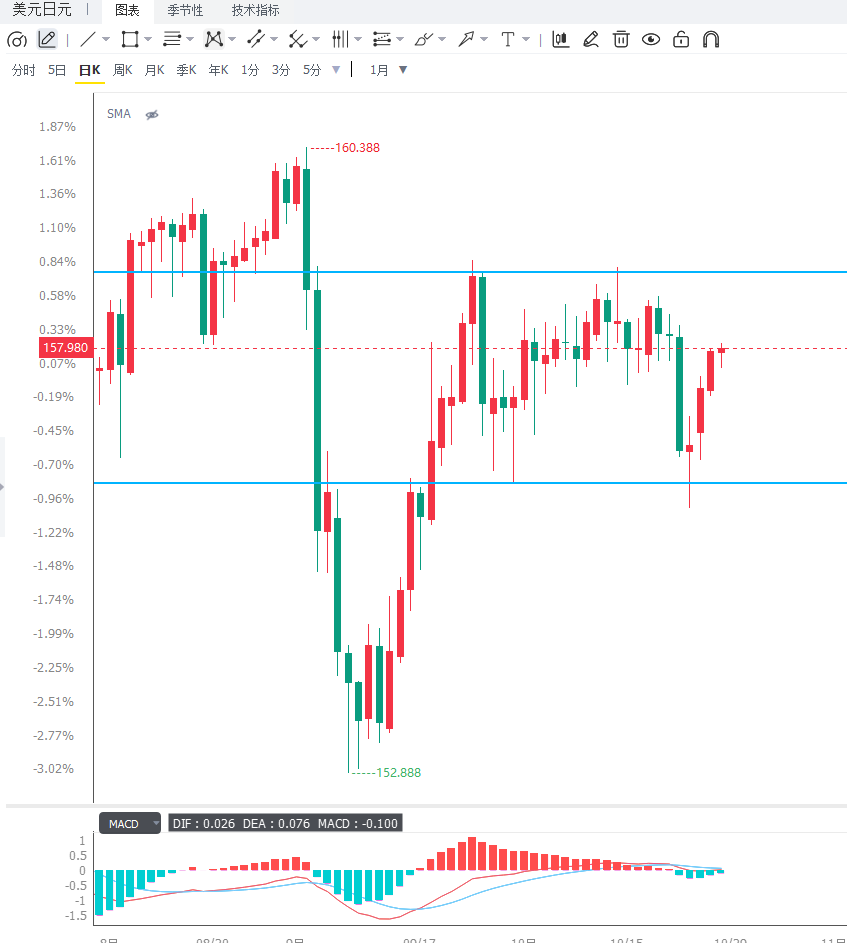 Editor's Summary: The core contradiction in the short-term USD/JPY pair lies in the support provided by the high USD/JPY interest rate differential and oil price pressure on the yen. Meanwhile, the potential interest rate hike expectations from the Bank of Japan, crowded long positions in the dollar, and geopolitical risk aversion exert a two-way influence on the yen, making the pair more likely to consolidate within the 157.76-158.30 range, awaiting a breakthrough from the decisions of the two major central banks. Three key variables need to be monitored: first, the Fed's interest rate decision, policy statement, and Warsh press conference, which will directly determine the strength of the dollar; second, the Bank of Japan's interest rate decision and statement on Friday, which is the primary policy basis for judging whether the yen can shift from a passive to an active position; and third, whether the pair can hold the 50-period EMA at 157.96 and the 9-period EMA at 157.76, which is the primary technical basis for judging whether the bullish momentum continues. In addition, the spillover effects of the US PCE price index and the preliminary Q3 GDP on Thursday, the trends of Brent and WTI crude oil, US Treasury yields and the dollar index, as well as the Israeli vote counting and cabinet formation, also need to be monitored.
From the perspective of the yen, the core contradiction lies in the gap between "completed tightening" and "further tightening yet to materialize." The Bank of Japan has raised interest rates by a total of 50 basis points this year and is currently in a pause to assess the impact of previous tightening. Although the market still prices in another rate hike before the end of the year, with a strong bias towards a December action, this expectation lacks an immediate catalyst before Friday's meeting. This means that the yen's support comes more from expectations than reality—once the Bank of Japan's statements are cautious, or the market postpones its expectations for a December rate hike, the yen's bullish logic will quickly weaken. Compared horizontally with other G10 currencies, this situation puts the yen in a relatively passive position: it cannot enjoy the dual benefits of high interest rates and safe-haven demand like the dollar, nor can it directly benefit from rising oil prices like the Canadian dollar; instead, it has to bear the deterioration of trade terms due to rising energy costs. This is also the underlying reason why the current USD/JPY rebound slope is relatively mild, yet it has not been effectively suppressed. The pressure on the dollar side is more direct. The October rate freeze has already been fully priced in, so the meeting itself is unlikely to provide any incremental drivers; the real variable lies in the expected revision of the year-end path. Warsh acknowledged that he was "too traumatized by the global financial crisis," while emphasizing structural growth and the investment boom, and refusing to predict the decisions in October and December—this cautious tone, while not explicitly hawkish, is enough to maintain the expectation of a year-end rate hike. The FXS Fed Sentiment Index remains stable at a hawkish high of 127.51, indicating that the market interprets Warsh's speech as a confirmation of the existing hawkish narrative, rather than a change in policy direction. Any hawkish comments from Fed officials could push up the dollar and create headwinds for the currency pair; conversely, softer rhetoric could trigger dollar long positions to be reduced, thus limiting the upside potential of USD/JPY. From a cross-asset perspective, the current fluctuations in USD/JPY are essentially a confluence of four factors: first, valuation support from the sustained high expectations of the USD/JPY interest rate differential; second, cost pressure on the yen from oil prices through energy imports; third, safe-haven inflows due to Middle East geopolitical risks; and fourth, position-wise observation ahead of the Bank of Japan's policy decision. It's worth noting that this interconnected structure makes a range-bound trading strategy more suitable for this currency pair than a one-sided bet: when oil prices and the dollar rise in tandem, the exchange rate often becomes volatile; only when the two move in opposite directions does a trend-driven movement have a basis. A single-day rebound should not be viewed in isolation but rather evaluated within the transmission chain of "interest rate differential—energy costs—central bank timing—safe-haven outflows." On the daily chart, USD/JPY is trading around 158.00, with an overall bullish bias. The price is trading above the 50-period EMA (around 157.96) and the 9-period EMA (around 157.76), both closely below the current price, indicating potential buying interest on dips. The RSI (14) is around 52, which is in the neutral-to-bullish zone and far from overbought levels, representing a typical "bullish trend, poised for a breakout" pattern. The resistance levels to watch are 158.30, 158.80, and 159.20. Support levels to watch are first the 50-period EMA at around 157.96, followed by the 9-period EMA at 157.76. A deeper pullback would test the structural support zone around 157.30. On the 4-hour chart, the exchange rate is moving upwards along the short-term moving average. The MACD histogram is close to the zero line, and the fast and slow lines are approaching a golden cross, indicating bullish momentum but a breakout has not yet been confirmed. Currently, the price is fluctuating narrowly between 157.90 and 158.15. If it retraces to 157.76-157.96 and finds support, there is still a chance for a short-term upward attack on 158.30-158.60. If it breaks below 157.76 with significant volume, it may seek support at 157.30 or even 156.80. Editor's Summary: The core contradiction in the short-term USD/JPY pair lies in the support provided by the high USD/JPY interest rate differential and oil price pressure on the yen. Meanwhile, the potential interest rate hike expectations from the Bank of Japan, crowded long positions in the dollar, and geopolitical risk aversion exert a two-way influence on the yen, making the pair more likely to consolidate within the 157.76-158.30 range, awaiting a breakthrough from the decisions of the two major central banks. Three key variables need to be monitored: first, the Fed's interest rate decision, policy statement, and Warsh press conference, which will directly determine the strength of the dollar; second, the Bank of Japan's interest rate decision and statement on Friday, which is the primary policy basis for judging whether the yen can shift from a passive to an active position; and third, whether the pair can hold the 50-period EMA at 157.96 and the 9-period EMA at 157.76, which is the primary technical basis for judging whether the bullish momentum continues. In addition, the spillover effects of the US PCE price index and the preliminary Q3 GDP on Thursday, the trends of Brent and WTI crude oil, US Treasury yields and the dollar index, as well as the Israeli vote counting and cabinet formation, also need to be monitored.
- Risk Warning and Disclaimer
- The market involves risk, and trading may not be suitable for all investors. This article is for reference only and does not constitute personal investment advice, nor does it take into account certain users’ specific investment objectives, financial situation, or other needs. Any investment decisions made based on this information are at your own risk.