The US dollar index rose to a two-week high of 102.40, with bulls poised for a breakout ahead of the Fed decision.
2026-10-28 15:30:24
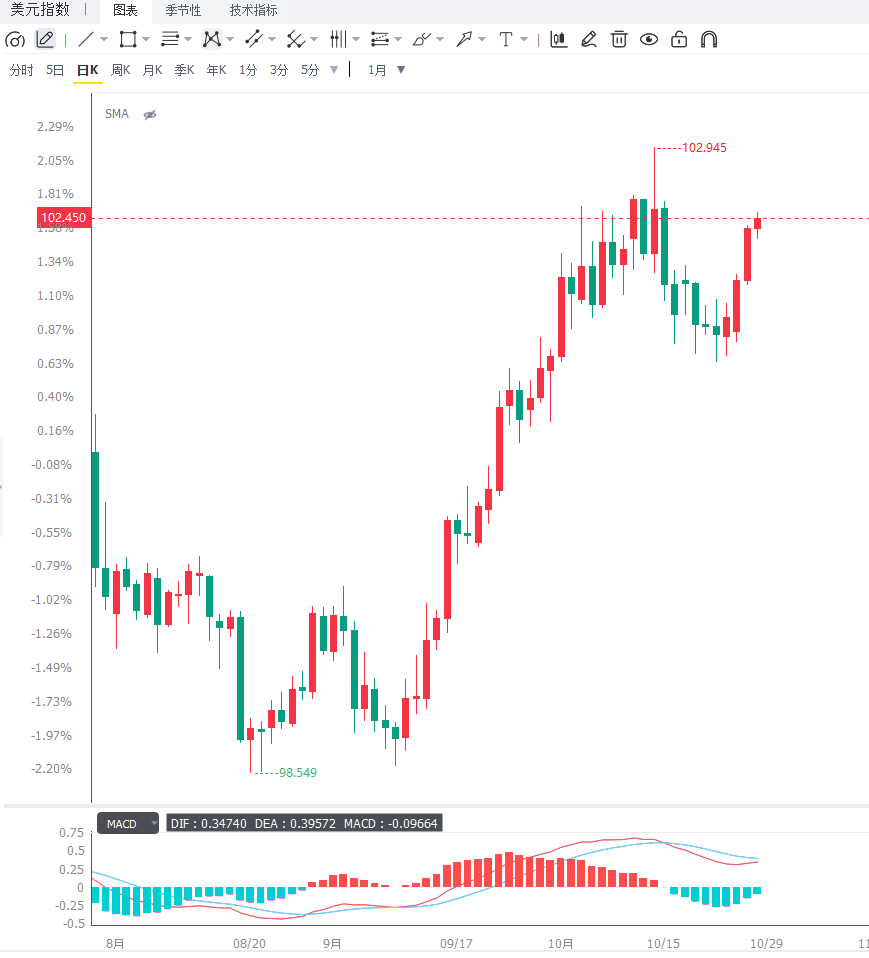
On Wednesday morning in Europe, the US dollar index traded around 102.40, maintaining its strength ahead of the Fed's decision. The key to this level is that the market has already fully priced in a "no rate hike today," so the meeting itself is unlikely to provide any incremental driver; the real variable lies in the expected revision of the December path. As Chris Weston, head of research at Pepperstone Group, stated, "The Fed doesn't need to raise rates today to move the market; it only needs to change the market's perception of the probability of a December rate hike." This highlights the current pricing structure—the strength of the dollar no longer depends on the outcome of a single meeting, but rather on marginal changes in year-end holding cost expectations. This also explains why, despite Warsh's 5.6/10 score and slightly dovish tone, the FXS Fed Sentiment Index remained stable at a hawkish high of 127.51: the speech was more about confirming than changing the existing narrative.  From a supporting perspective, the core drivers of the US dollar come from interest rate differentials and policy certainty. Warsh acknowledged his "deep wounds from the global financial crisis," while emphasizing structural growth and investment driven by "good policies," and viewing AI as an impending demand shock and a tool to strengthen data-driven policies; he refused to predict October and December decisions, anchoring his stance on data dependence. This combination of "optimism about structure and caution about pace" provides asymmetrical support for the dollar: upward movement requires stronger data or tougher rhetoric, while downside risks can be triggered by a single dovish statement. Compared to other G10 currencies, the Canadian and New Zealand dollars have performed slightly better recently, but Societe Generale explicitly stated, "If the FOMC information keeps expectations of a December rate hike active, our bias remains bullish on the dollar"—meaning that as long as the year-end path is not disproven, the bullish bias on the dollar will not easily reverse. However, this strength is facing resistance at the positioning level. Societe Generale cautioned that "the positive backdrop for the dollar triggered from Warsh's Jackson Hole speech to the September FOMC is gradually being dragged down by the weighting of long dollar positions." When crowded long positions become the norm, any less hawkish stance than expected can trigger concentrated selling, which is the underlying reason why the US dollar index has consistently failed to break through the 102.60 upper limit. Furthermore, the variables on the euro side cannot be ignored: the bank also warned that "unless the ECB acts very hawkishly, the fundamentals of the European economy will continue to exert pressure." Since the euro has the largest weighting in the US dollar index, its high energy costs, volatility in French government bonds, and fiscal concerns objectively provide relative support for the dollar; conversely, if the ECB releases an unexpectedly hawkish signal on Thursday, the dollar's passive appreciation potential will be compressed. Therefore, the dollar's direction this week actually depends on the relative wording of the two meetings, rather than the Fed's unilateral statement. From a cross-asset perspective, the current strength of the dollar is essentially a combination of three factors: first, valuation support from the continued high expectations of the US-EU interest rate differential; second, passive appreciation due to weak fundamentals of non-US currencies; and third, upward damping caused by crowded long positions. It's worth noting that the same round of Middle East geopolitical developments have had inconsistent effects on different assets: for crude oil, it's a pure upward driver; for gold, it provides a boost by easing inflation concerns; for yen carry trades, it disrupts them; and for the dollar, it's a double boost from safe-haven outflows and technical strength. This divergence indicates that the net direction is not determined by the event itself, but by the relative strength of the forces in each transmission chain. Investors should not view the single-day rise in the dollar index in isolation, but rather assess it within the transmission chain of "interest rate differentials—positions—non-US fundamentals—safe-haven outflows": only when the expectation of a December rate hike is substantially weakened, or the ECB turns unexpectedly hawkish, will the dollar's temporary top be credible. On the daily chart, the dollar index is trading around 102.40, with an overall bullish bias. The price is running above the Bollinger Middle Band at around 102.05 and firmly above the rising 100-day moving average at around 100.65, both forming a support zone below, indicating that the upward trend structure has not yet been broken. The RSI (14) is at 63, indicating that the momentum is still biased towards the upside and has not yet entered the overbought exhaustion zone. This is a typical "bullish trend, poised for a breakout" pattern. The first resistance level to watch is the upper Bollinger Band at around 102.60, followed by the psychological level of 103.00 and 103.50. The next support levels are the Bollinger Middle Band at approximately 102.05, the Lower Band at approximately 101.50, and the more strategically significant 100-day moving average at approximately 100.65. On the 4-hour chart, the index is moving upwards along the short-term moving averages, the MACD histogram is close to above the zero line, and the fast and slow lines are approaching a golden cross, indicating bullish momentum but a breakout has not yet been confirmed. Currently, the price is fluctuating narrowly between 102.30 and 102.55. If it retraces to 102.20-102.35 and finds support, there is still a chance for a short-term upward move towards 102.60-102.80. If it breaks below 102.05 with significant volume, it may seek support at 101.50 or even 100.65. An upward breakout requires confirmation from the Fed's policy statement; until then, a range-bound trading strategy is advisable, avoiding chasing highs and lows.
 Editor's Summary: The core contradiction for the US dollar index in the short term lies in the high probability of a December rate hike being priced in and the support provided by the weakness of non-US currencies. However, crowded long positions, a slightly dovish tone in Warsh's speech, and the potential hawkishness of the European Central Bank are acting as constraints. These two factors suggest that the index is more likely to consolidate within the 102.20-102.60 range, awaiting a breakout after the Fed's decision. Three key variables need to be monitored: first, the Fed's interest rate decision, policy statement, and Warsh's press conference, which will directly determine the strength of the dollar; second, the ECB meeting and its statements on Thursday. Unless an unexpectedly hawkish signal is released, the European economic fundamentals will continue to support the dollar through weighted channels; and third, whether the dollar index can effectively break through the upper Bollinger Band at 102.60, which is the primary technical basis for judging whether the bullish momentum will continue. In addition, the spillover effects of Thursday's US PCE price index, the trend of US Treasury yields, the relative performance of the Canadian dollar and the New Zealand dollar, and the safe-haven diversion effect of the Middle East geopolitical situation also need to be monitored.
From a supporting perspective, the core drivers of the US dollar come from interest rate differentials and policy certainty. Warsh acknowledged his "deep wounds from the global financial crisis," while emphasizing structural growth and investment driven by "good policies," and viewing AI as an impending demand shock and a tool to strengthen data-driven policies; he refused to predict October and December decisions, anchoring his stance on data dependence. This combination of "optimism about structure and caution about pace" provides asymmetrical support for the dollar: upward movement requires stronger data or tougher rhetoric, while downside risks can be triggered by a single dovish statement. Compared to other G10 currencies, the Canadian and New Zealand dollars have performed slightly better recently, but Societe Generale explicitly stated, "If the FOMC information keeps expectations of a December rate hike active, our bias remains bullish on the dollar"—meaning that as long as the year-end path is not disproven, the bullish bias on the dollar will not easily reverse. However, this strength is facing resistance at the positioning level. Societe Generale cautioned that "the positive backdrop for the dollar triggered from Warsh's Jackson Hole speech to the September FOMC is gradually being dragged down by the weighting of long dollar positions." When crowded long positions become the norm, any less hawkish stance than expected can trigger concentrated selling, which is the underlying reason why the US dollar index has consistently failed to break through the 102.60 upper limit. Furthermore, the variables on the euro side cannot be ignored: the bank also warned that "unless the ECB acts very hawkishly, the fundamentals of the European economy will continue to exert pressure." Since the euro has the largest weighting in the US dollar index, its high energy costs, volatility in French government bonds, and fiscal concerns objectively provide relative support for the dollar; conversely, if the ECB releases an unexpectedly hawkish signal on Thursday, the dollar's passive appreciation potential will be compressed. Therefore, the dollar's direction this week actually depends on the relative wording of the two meetings, rather than the Fed's unilateral statement. From a cross-asset perspective, the current strength of the dollar is essentially a combination of three factors: first, valuation support from the continued high expectations of the US-EU interest rate differential; second, passive appreciation due to weak fundamentals of non-US currencies; and third, upward damping caused by crowded long positions. It's worth noting that the same round of Middle East geopolitical developments have had inconsistent effects on different assets: for crude oil, it's a pure upward driver; for gold, it provides a boost by easing inflation concerns; for yen carry trades, it disrupts them; and for the dollar, it's a double boost from safe-haven outflows and technical strength. This divergence indicates that the net direction is not determined by the event itself, but by the relative strength of the forces in each transmission chain. Investors should not view the single-day rise in the dollar index in isolation, but rather assess it within the transmission chain of "interest rate differentials—positions—non-US fundamentals—safe-haven outflows": only when the expectation of a December rate hike is substantially weakened, or the ECB turns unexpectedly hawkish, will the dollar's temporary top be credible. On the daily chart, the dollar index is trading around 102.40, with an overall bullish bias. The price is running above the Bollinger Middle Band at around 102.05 and firmly above the rising 100-day moving average at around 100.65, both forming a support zone below, indicating that the upward trend structure has not yet been broken. The RSI (14) is at 63, indicating that the momentum is still biased towards the upside and has not yet entered the overbought exhaustion zone. This is a typical "bullish trend, poised for a breakout" pattern. The first resistance level to watch is the upper Bollinger Band at around 102.60, followed by the psychological level of 103.00 and 103.50. The next support levels are the Bollinger Middle Band at approximately 102.05, the Lower Band at approximately 101.50, and the more strategically significant 100-day moving average at approximately 100.65. On the 4-hour chart, the index is moving upwards along the short-term moving averages, the MACD histogram is close to above the zero line, and the fast and slow lines are approaching a golden cross, indicating bullish momentum but a breakout has not yet been confirmed. Currently, the price is fluctuating narrowly between 102.30 and 102.55. If it retraces to 102.20-102.35 and finds support, there is still a chance for a short-term upward move towards 102.60-102.80. If it breaks below 102.05 with significant volume, it may seek support at 101.50 or even 100.65. An upward breakout requires confirmation from the Fed's policy statement; until then, a range-bound trading strategy is advisable, avoiding chasing highs and lows. Editor's Summary: The core contradiction for the US dollar index in the short term lies in the high probability of a December rate hike being priced in and the support provided by the weakness of non-US currencies. However, crowded long positions, a slightly dovish tone in Warsh's speech, and the potential hawkishness of the European Central Bank are acting as constraints. These two factors suggest that the index is more likely to consolidate within the 102.20-102.60 range, awaiting a breakout after the Fed's decision. Three key variables need to be monitored: first, the Fed's interest rate decision, policy statement, and Warsh's press conference, which will directly determine the strength of the dollar; second, the ECB meeting and its statements on Thursday. Unless an unexpectedly hawkish signal is released, the European economic fundamentals will continue to support the dollar through weighted channels; and third, whether the dollar index can effectively break through the upper Bollinger Band at 102.60, which is the primary technical basis for judging whether the bullish momentum will continue. In addition, the spillover effects of Thursday's US PCE price index, the trend of US Treasury yields, the relative performance of the Canadian dollar and the New Zealand dollar, and the safe-haven diversion effect of the Middle East geopolitical situation also need to be monitored.
- Risk Warning and Disclaimer
- The market involves risk, and trading may not be suitable for all investors. This article is for reference only and does not constitute personal investment advice, nor does it take into account certain users’ specific investment objectives, financial situation, or other needs. Any investment decisions made based on this information are at your own risk.